• Welcome to Photrio!
    Registration is fast and free. Join today to unlock search, see fewer ads, and access all forum features.
    Click here to sign up

The Toner Thread

At the Lagoon

A
At the Lagoon

  • 6
  • 4
  • 78
Afternoon Calm II

D
Afternoon Calm II

  • 4
  • 4
  • 57

Forum statistics

Threads
203,512
Messages
2,855,836
Members
101,880
Latest member
coachlinc
Recent bookmarks
0
I don't ever recall experiencing the problems you describe. I do seem to recall a warning that fumes from brown toning can fog unexposed paper. Maybe this has something to do with it?

Ken
 
Does anyone out there have trouble with Brown Toning since Ilford changed their FB paper? I have been toning for 20 years and have never had so many issues with blotchy areas, white borders picking up tone and also stains from the jets on my archival washer. It seems that if I siphon/tray wash, my white borders pick up tone, and if I use the archival washer I get the jet marks. There's plenty of salt in the water softener and my sediment filters are clean. This issue has repeated itself over and over. One printer has suggested that perhaps it's chlorine in the water, and recommends a charcoal filter. I have tried this yet, but I am about to. This problem has occurred with both Kodak and Legacy toner. Ilford has no suggestion, and swears no one else has had this problem. Any thoughts from anyone with direct experience in this would be most appreciated.

Thank you,
M. Crouser

Welcome to APUG
 
I don't ever recall experiencing the problems you describe. I do seem to recall a warning that fumes from brown toning can fog unexposed paper. Maybe this has something to do with it?

Ken

+1

And I'm not sure if it's related, but I've experienced mottling/uneven development issues with Ilford's Classic and Cooltone papers. I would bet that any development unevenness would be amplified through your toning process. Pre-soaking the paper and the use of a stronger developer seems to mitigate the problem.
 
My favourite is Ilford IT-8


IT-8 Ilford Pyrocatechin Toner

For Olive Black tones.
Stock A
Potassium Bichromate 50 g
Water to 1 litre

Stock B
Hydrochloric Acid (conc) 100ml
Water to 1 litre

Expose and process your print as normal and wash well.
Make up bleach from: 2 parts A and 10 parts B with 40 parts water, bleach the print then wash until all the yellow from the bichromate has been removed from the highlights then redevelop in the following Developer.

Developer
Pyrocatechin 1.75 g
Sodium Carbonate (anhyd) 5 g
Water to 1 litre

Temperature is not critical, it should take 1½ to 2 mins at 20°C, this developer will oxide very quickly and should be discarded when it turns a bluish green.
Wash the print and dry.

While originally fomulated for Ilford Plastika paper I first used this about 30 years ago with Iford Multigrade paper and it does produce lovely warm olive tones.

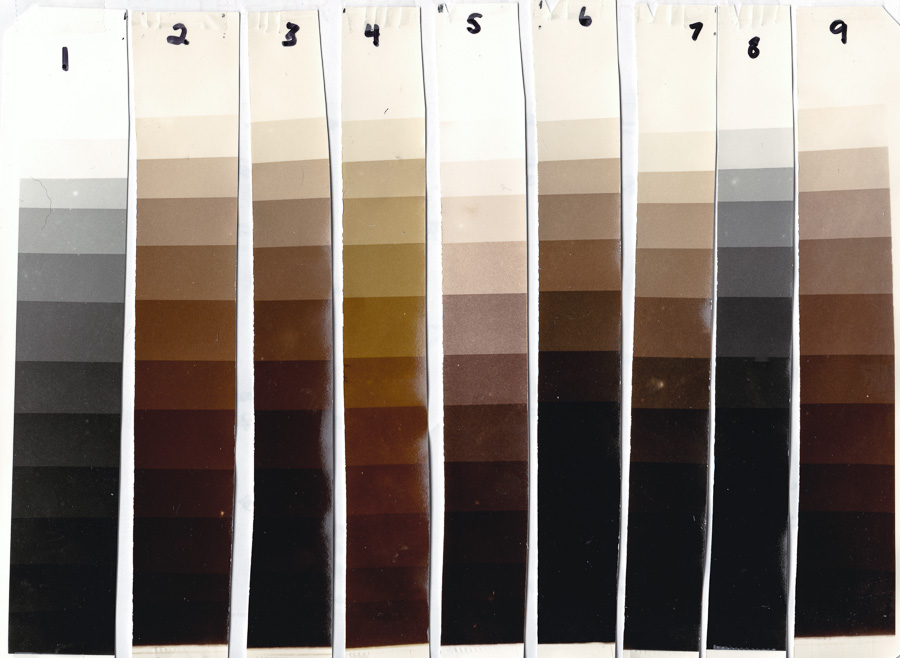
Print - Forte Polywarmtone FB, Developed in ID-78, right half toned in IT-8

IT8toner.jpg
wedge_sm.jpg


This was posted in the Chems section but seems to have been lost.

Ian
Just bumping this post...hope to try this toning method soon.
 
Hi, I am beginning the journey into b&w processing and getting some satisfactory results. Yesterday I did iron toning for beautiful blue prints - pretty straightforward.

I would like to try nickel toning, but have a question about the dimethylgloxime saturated in alcohol. I see 1% alcoholic solutions are available, but I'm assuming that isn't saturated. What I'm wondering is what type of alcohol is used for this purpose? My guess is 100% ethanol, but there are many possibilities. Would slightly contaminated (with water) ethanol perform as well, or does it need to be 200 proof?

The recipie I have is from the Darkroom Handbook by Michael Langford.

Thanks,
Mike
 
Dimethyl glyoxime is not very soluble in water. The more alcohol the better, but denatured alcohol is not very good for this. Pure ethyl alcohol is probably the best. I can't be more specific, as I have not worked with this, just its precursor diacetyl.

PE
 
Thanks, PE! I'll go with 200 proof hooch. It will be a bit before I get to try this, but I'll let you know how it turns out.

By the way, the recipie I have is (for pinkish/magenta nickel toning):

Bleach part A:
25 g Nickel nitrate
75 g Potassium citrate
Dissolve in water to make 500 mL

Bleach part B:
20 g Potsassium ferricyanide
Dissolve in water to make 500 mL

Mix equal parts A&B (acidified with a few drops of citric acid)

Toner:
50 mL Dimethylglyoxime (saturated in alcohol)
50 mL Sodium hydroxide (0.4% solution)
Add water to make 500 mL

Start with a contrasty print as this process reduces contrast.
For full toning - bleach until no silver remains in print

Fix with hypo solution (sodium thiosulfate) for 5-6 minutes, rinse thoroughly.
Place in toner, agitate until it doesn't darken further. Rinse for 10 minutes.

(The Darkroom Handbook - Michael Langford)

Mike
 
Last edited:
I am looking for a brown toner that will give me the deep chocolate brown tones of the old Agra Portriga Rapid paper. I tried using Photographer's Formulary polysulfide toner on Ilford Multigrade FB Warmtone, and I got a reddish brown. Any idea how to get a dark chocolate brown?
 
The Berg Brown toner gives me a range of tones, from deep brown through red (depending on time) with Ilford Multigrade RC neutral tone.
 
Upon inspection of the SDS for Dimethylglyoxime, I think I should use methanol.

Solubility: Soluble in methanol, diethyl ether, acetone. Insoluble in cold water.​

Mike
 
Last edited:
Hello

Maybe this is not the best place but I have a question about toning.
I used pushed film and it was difficult to print them on Matte fiber paper because the few darks/ blacks disappeared while drying. But since I love the feel of that paper I wanted to try a toner to give deeper blacks.
I bought the Amaloco T 55 toner, selenium based.
It gave the paper a brownisch/ sluggish look ( like dirty staines on it).
I tried different toner times, different papers. The dirty stains stay the same.
Anyone knows what this can be?

Thank you very much!
Other ideas to get my picture on the paper with richer blacks are welcome!
 
The stains probably come from either insufficient fixing or too much remaining acid fixer in the paper. Make sure that fixer is not too much used up and you fix long enough. If that's seems ok and you still get stains, then you need to wash a bit longer between the fix and toner.
 
Does anyone know why B&S Gold-Ammonium Thiocynate POP Formua (Bostick & Sullivan Pre-Mixed solution Gold 231 A&B)calls for mixing a stock solution of AC and leaving it sit for 8-12 hours before use whereas there is no sit requirement for the Ilford IT-4 formula. Other that the amount of AC and gold used, the ingredients for both formulas are identical. The Ilford IT-4 formula ius also Ansco 231, GAF-231, etc., and nowhere I have found a requirement to to split it into 2 stock solutions, A&B, and let A with the ammonium thiocyanate sit for 8 to 12 hours before adding the gold.

Thomas
 
I've heard that nickel toning is most useful in split toning processes, but I don't know anything else about that. Does anyone know what ther toners are useful and what the results are?
 
Hi, everyone:

I plan to experiment with polysulfide direct toning (for silver alternative process images) in the near future and intend to make my own concoction based on Kodak T-8 toner like formulation. For that I have acquired a jar of liver of sulfur. Wynn White suggests preparing a 30% solution of liver of sulfur and then using that to make a working solution, which sounds like a good idea. My inquiry is about the longevity of the working solution as well of the 30% liver of sulfur solution.

a) Can I make a large quantity, say a litre, of the 30% solution and store it for extended period of time (how long?) making use of it as and when needed? I would rather not deal with the lumpy/powdery liver of sulfur every time I have to prepare a working solution.

b) Or may be just make a concentrated version of the full recipe (like 5:1) including the sodium carbonate and then just add water to make required quantity of working solution.

c) Once I have made the working solution, how long can that be used before efficacy is significantly reduced.

What has been the experience of the folks about that?

Any information on the subject will be greatly appreciated.

Thanks.

:Niranjan.
 
I've heard that nickel toning is most useful in split toning processes, but I don't know anything else about that. Does anyone know what ther toners are useful and what the results are?
Yes, split toning can be very effective with nickel - as many other toning systems. My experiments with nickel cover a wide range and in many cases are a bit 'punk'. see image belowEmbedded Nickel Sepia distressed.jpg
Embedded Nickel Sepia distressed.jpg
 
Fotospeed have discontinued Palette Toner - is this true please?

If so, what are the options - what exists out there to tone photographic papers or photographic emulsion please?

Thanks,

Ric
 
where can I buy bulk chemicals in Canada. Some chemicals won't ship from the us.
 
I did a Video on how I Sepia Tone Darkroom Prints -- you can see it here :
 
Photrio.com contains affiliate links to products. We may receive a commission for purchases made through these links.
To read our full affiliate disclosure statement please click Here.

PHOTRIO PARTNERS EQUALLY FUNDING OUR COMMUNITY:



Ilford ADOX Freestyle Photographic Stearman Press Weldon Color Lab Blue Moon Camera & Machine
Top Bottom