My theory in photography goes "if you can only measure a difference but not see it, then there is no difference".
I suppose, but the problem is we sometimes see things which are not there.
D76 does that nicely with Borax.
True, but it contains the acidic Metol salt. And to be honest I'm still not entirely clear on precisely how D-76 achieves its operating pH. Haist says there is just enough borax to neutralize the acidity of the Metol salt, and when I read "neutralize" I take it to literally mean the acidity of the Metol salt and the alkalinity of the Borax are gone. If that is the case you're left with the Metol free base, 100g sulfite and 5g HQ. I guess 5g HQ is enough to lower the pH of the sulfite solution all the way to 8.5? Another way to look at it would be to say the Metol salt and HQ bring down the pH of the sulfite solution, the the Borax then maintains the resulting pH (with some buffering). Confusing.
You spent all this effort on creating a developer that gives you full speed, and then you'd throw all that away by adding Sodium Chloride? Unless this new dev is an absolute grain monster, I wonder why you would want to mess around with solvents. As far as I remember, Delagi 8 gave me nice and finely grained results ...
Just keeping the options open. I'm not talking about a huge amount of NaCl or additional sulfite, and NaCl is a fairly weak silver halide solvent and/or restrainer.
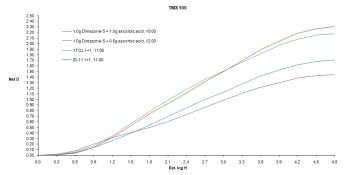
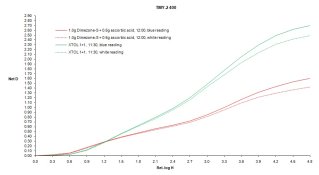
While a definition of speed is problematic with such a low contrast developer, if we simplistically use a fixed density point of say 0.1 above B+F, this latest version of the test developer is actually giving a speed increase vs just maintaining speed. So depending on what you want, there is actually some speed to spare, in a sense. This robust absolute threshold speed has to be weighed against image structure characteristics and tuning may be required to get the best "balance". The end game was to have something which gives a curve very similar to XTOL developed to low contrast (say N-3 in ZS terms), but shifted to the left so that a "normal" EI is maintained. We sort of got there with the 1:1 ratio of Dimezone/ascorbic acid. But before pursuing that further I first wanted to see how far I could push the idea of maximum speed/minimum gamma. As a proof of concept, we've exceeded expectations, but in reality I think from a tone reproduction perspective I would need to pull back a little on this. More contrast is needed (in my opinion).
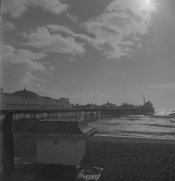
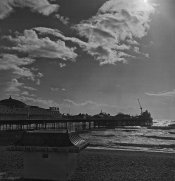
So far in the initial prints from this extreme version, grain seems similar to that of XTOL 1+1 developed to normal contrast, but I'm not sure, and a lot more printing of various comparative densities, exposure levels, and then image evaluations need to be done. From my perspective this is still just an early-phase test of various concepts. Sorry if that's a little depressing