• Welcome to Photrio!
    Registration is fast and free. Join today to unlock search, see fewer ads, and access all forum features.
    Click here to sign up

Zone Placement

Chose vue

A
Chose vue

  • 0
  • 0
  • 20
Chose vue

A
Chose vue

  • 0
  • 0
  • 25

Recent Classifieds

Forum statistics

Threads
202,108
Messages
2,835,194
Members
101,118
Latest member
mretherford
Recent bookmarks
0
OP
OP
Stephen Benskin
Joined
Jan 7, 2005
Messages
2,743
Location
Los Angeles
Format
4x5 Format
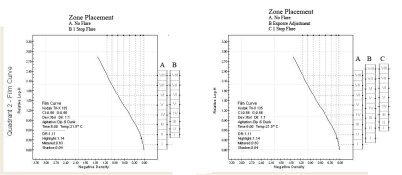
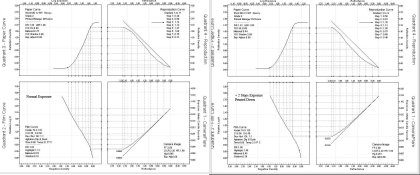
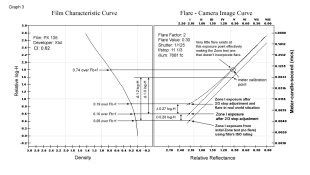
This is example of comparing the placement of Zones.

The curve on the left shows the difference between no flare conditions, which can be considered testing conditions, and the addition of one stop of flare. This is how the Zones would fall if the film was rated at the ISO speed. That is if the film speed from the film/developer combination used in the test was the same as the ISO speed.

The curve on the right shows the same no flare placement (A). Zone Placement B is the 2/3 stop change in the EI rating to bring Zone I up to 0.10 Fb+f. Zone Placement C shows where the Zones would then fall under average one stop flare conditions.
 

Attachments

  • Zone Placement Comparison.jpg
    Zone Placement Comparison.jpg
    213.5 KB · Views: 111

paul ron

Member
Allowing Ads
Joined
Jan 22, 2004
Messages
2,709
Location
NYC
Format
Medium Format
Just out of curiosity Bill, from your real world tests...

What film n developer are you using?
When you did the ASA standardizing tests, what did it come up as?
What times have you come up with for your developing N values so far?

.
 

ic-racer

Member
Joined
Feb 25, 2007
Messages
16,752
Location
USA
Format
Multi Format
Ahh, yes flare again. Seems last time we had a thread on that I got held up with a lack of a good Materials and Methods section in the papers I was reading. I was trying to get a grip on the specifics of original speed papers. Seems they photographed transparencies rather than true scenes. Not sure about the flare characteristics of that system. The paired H&D curves were made, presumably in the standard contact-print method with a step wedge.
 
OP
OP
Stephen Benskin
Joined
Jan 7, 2005
Messages
2,743
Location
Los Angeles
Format
4x5 Format
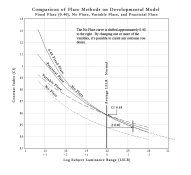
A number of different systems have similar CIs for normal, +1, etc, for the simple reason that they work. The Dev Chart CI Comparisons doc compares four different models, No flare, Practical Flare, Way Beyond Monochrome, and Zone System. Except for the no flare curve, which is included only or reference, the different development models are surprising similar. This means that all of them will produce similar negatives for similar conditions.

What's different is that they assume different values for the variables from which they determine the numbers. The second table Variables for Developmental Models has the variables for the different models.

The attached graph illustrates how this works. By simply changing either the aim value for the negative density range, the value for the subject luminance range (at normal), or a combination of the two, the no flare curve can be shifted over matching up its values with the ones incorporating flare. While the results reflect "reality", the variables don't. Changing either the NDR or LSLR variables basically incorporates flare into the results without acknowledging it as a factor.

(a bad analogy) It's possible to predict where the sun will rise whether you use a heliocentric or geocentric model. Both answers will be the same, but only one of the explanations is correct.
 

Attachments

  • Dev Chart CI comparisons.doc
    31 KB · Views: 129
  • Comparison of CIs of Dev Models, changing the variables.jpg
    Comparison of CIs of Dev Models, changing the variables.jpg
    144.3 KB · Views: 106
Last edited by a moderator:
OP
OP
Stephen Benskin
Joined
Jan 7, 2005
Messages
2,743
Location
Los Angeles
Format
4x5 Format
Seems last time we had a thread on that I got held up with a lack of a good Materials and Methods section in the papers I was reading. I was trying to get a grip on the specifics of original speed papers. Seems they photographed transparencies rather than true scenes. Not sure about the flare characteristics of that system. The paired H&D curves were made, presumably in the standard contact-print method with a step wedge.

Are you referring to the testing method used in the First Excellent Print Test? The flare came when making the master transparencies. After that, they had a fixed, knowable image to work with. The paper that covered luminance range and flare in detail was Jones' "The Brightness Scale of External Scenes and the Computation of Correct Photographic Exposure." It's more of a page turner than the title suggests.
 

Photo Engineer

Subscriber
Allowing Ads
Joined
Apr 19, 2005
Messages
29,018
Location
Rochester, NY
Format
Multi Format
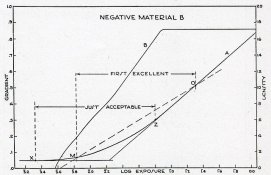
Both Mees and Haist showed this all eloquently for the average Joe with no math by showing the film curve overlaid by the first excellent print on the film curve. It just happens to occur at the ISO rating of the film or 1/3 stop over!

PE
 

Attachments

  • First Excellent print.jpg
    First Excellent print.jpg
    107.5 KB · Views: 117

Bill Burk

Subscriber
Allowing Ads
Joined
Feb 9, 2010
Messages
9,482
Format
4x5 Format
Just out of curiosity Bill, from your real world tests...

What film n developer are you using?
When you did the ASA standardizing tests, what did it come up as?
What times have you come up with for your developing N values so far?

.

Film/Developer: Tray developed TMY-2 in D-76 1:1 68-degrees.
ASA time was 13 minutes.
I am undecided on N times because I want to double-check my LER at different print developing and toning times.

Now this isn't a real standardized test. The D-76 was mixed 5 months ago and partial bottle for a week. I agitate too much. I get more development on the edges of my film because I stack 8 sheets at a time in the tray. Development times are possibly off by 30 seconds because I start the timer then add sheets one by one (which can take 30 seconds).
 

Bill Burk

Subscriber
Allowing Ads
Joined
Feb 9, 2010
Messages
9,482
Format
4x5 Format
Both Mees and Haist showed this all eloquently for the average Joe with no math by showing the film curve overlaid by the first excellent print on the film curve. It just happens to occur at the ISO rating of the film or 1/3 stop over!

PE

Now this makes me want to aim my deepest shadow to land somewhere between the T of jusT Acceptable and F of First excellent.
 

2F/2F

Member
Allowing Ads
Joined
Apr 29, 2008
Messages
8,031
Location
Los Angeles,
Format
Multi Format
Now this makes me want to aim my deepest shadow to land somewhere between the T of jusT Acceptable and F of First excellent.

Your deepest shadow, or the darkest area of shadow in which you want to show texture or detail?

I want the truly deepest shadows to effectively, if not actually, fall completely off of the curve in many cases. If I put them where you want them in a full-ranged scene, I'd call it a terribly overexposed negative (in most cases).
 

Bill Burk

Subscriber
Allowing Ads
Joined
Feb 9, 2010
Messages
9,482
Format
4x5 Format
Your deepest shadow, or the darkest area of shadow in which you want to show texture or detail?

I want the truly deepest shadows to effectively, if not actually, fall completely off of the curve in many cases. If I put them where you want them in a full-ranged scene, I'd call it a terribly overexposed negative (in most cases).

How about where I want to surprise my viewer that there is unexpected detail?

What would a terribly overexposed negative cost in a trade-off?

-Grain, sharpness, resolution? Not worried in 4x5 at 11x14.
-Highlights blocking - not worried TMY-2.
-Motion blur due to camera shake - there I have to be careful. I do a lot of handheld at 1/300. Rate the film too low and I risk this problem.
 
OP
OP
Stephen Benskin
Joined
Jan 7, 2005
Messages
2,743
Location
Los Angeles
Format
4x5 Format
Here's a comparison between normal exposure and +2 stops over exposure printed down. Tonally, both are similar. The overexposure has better separation of the shadows at the expense of the separation of the higher tones.
 

Attachments

  • Normal and plus exposure.jpg
    Normal and plus exposure.jpg
    416.7 KB · Views: 120

Bill Burk

Subscriber
Allowing Ads
Joined
Feb 9, 2010
Messages
9,482
Format
4x5 Format
...at the expense of the separation of the higher tones.

Looks like that separation in the higher tones exists in the negative, could be accommodated by developing less, to fit the paper better or altering paper grade.
 

2F/2F

Member
Allowing Ads
Joined
Apr 29, 2008
Messages
8,031
Location
Los Angeles,
Format
Multi Format
How about where I want to surprise my viewer that there is unexpected detail?

That is a better description IMO, and I do the same when I want detail in a dark area. To me, the deepest shadow is maximum black by definition. If you placed the deepest shadow at that point on the curve, the overexposure would be unnecessary, and detrimental IMO.

In other words, the way I see it, there is usually little point in placing what you want to be an empty shadow that high on the curve. You often end up paying for it on the other end of the scale, and/or with grain. Plus it takes a while longer to expose when printing. I understand the reasons for giving modern emulsions very healthy exposure, but there is also taking it too far.
 
Last edited by a moderator:
OP
OP
Stephen Benskin
Joined
Jan 7, 2005
Messages
2,743
Location
Los Angeles
Format
4x5 Format
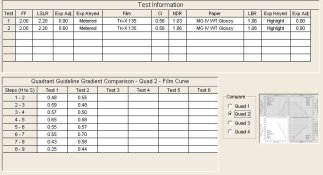
Looks like that separation in the higher tones exists in the negative, could be accommodated by developing less, to fit the paper better or altering paper grade.

The negative density range really didn't change, the higher exposure took the shadows off the toe which increased their separation. I think the highlight gradient took a small hit was because there looks to be an ever slight downward shift in the upper portion of the film curve.

The guideline chart appears to support that assumption. Although because of the really small sampling area used to determine the local gradient, small reading and plotting anomalies in the curve can have a rather large influence on the value. Curve smoothing might be an option.
 

Attachments

  • Quad 2 guideline gradient comparison.jpg
    Quad 2 guideline gradient comparison.jpg
    51.1 KB · Views: 116
Last edited by a moderator:

Bill Burk

Subscriber
Allowing Ads
Joined
Feb 9, 2010
Messages
9,482
Format
4x5 Format
This thought occurred to me...

As I strive to figure out the lower EI that most Zone System users settle on vs box speed...

Loyd Jones' tests were the first excellent print, right? He sent the films off to the lab to make the best print they could of each negative. The first excellent print might have been on Grade 4 paper for all I know, the guys in the lab were doing their best.

Zone System tests aim to fit onto Grade 2 paper. So this could be another factor why the EI is lower for Zone System users.
 
OP
OP
Stephen Benskin
Joined
Jan 7, 2005
Messages
2,743
Location
Los Angeles
Format
4x5 Format
This thought occurred to me...

As I strive to figure out the lower EI that most Zone System users settle on vs box speed...

Loyd Jones' tests were the first excellent print, right? He sent the films off to the lab to make the best print they could of each negative. The first excellent print might have been on Grade 4 paper for all I know, the guys in the lab were doing their best.

Zone System tests aim to fit onto Grade 2 paper. So this could be another factor why the EI is lower for Zone System users.

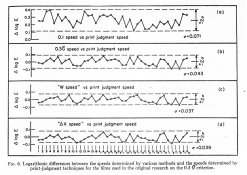
It's been awhile since I've done a thorough reading of the paper so... What they did was make a bunch of negatives from master transparencies varying the exposure and processing. A bunch of prints were made from each of the negatives. The prints were judged for quality and then they went back to determine the sensitometric conditions that produced the best quality images. Finally, they had to come up with a way to determine a film speed that would be in agreement with the results they got in the psychophysical testing. Technically, the best method for speed determination is with psychophysical testing like the first excellent print. It's just not practical to do. What is regarded as the best method to determine film speed would be the mathematical approach that will give results as close as possible to the psychophysical test with the greatest number of different types of film. Attached. Notice the fixed density 0.10 method has the worst results?

There's a concept that I've been thinking about having to do with considering the guidelines used for the judges. They instructed the people judging the prints to base their standards of quality on prints that they thought best produced an impression of what they believed the original scene would look like if they were there. In other words, prints that most closely looked like reality.

What if the intention of the photographer isn't about making the finished print "look" like the original scene? Wouldn't that mean the judging conditions of the testing that determined film speed no longer applies? So the film speed value is, in a way, no longer accurate? Of course, there needs to be some kind of standard in order to have a base to work from and be able to compare apples to apples, but something to consider.

The subjective element of photography is the saving grace of so many "systems." If the intent was to reproduce something exactly, there wouldn't be a debate.

And no, the reason the Zone System speeds are different from the ISO speeds is because the testing methods have different parameters and assumptions. ISO the shadow is 4 1/3 stops below the metered exposure point, but the speed point is 3 1/3 stops because they factor in flare. Zone System has the shadow 4 stops below. EI has to be adjusted by 2/3 stop to bring it up to the 0.10 Fb+f speed point. Also attached is a example from an article I wrote for PHOTO Techniques. For the record, speed point isn't necessarily the point were a specific exposure is supposed to fall (eg shadow exposure), but just a knowable place to calculate film speed.

There are reasons why people haven't caught this, and quality isn't one of them. A little extra exposure doesn't degrade quality and can be considered a good idea, even if you're not aware of it. But I think it's important to keep in mind there's a difference between film speed and preferred exposure.

 

Attachments

  • spread function for Delta X.jpg
    spread function for Delta X.jpg
    214.1 KB · Views: 140
  • Zone System testing and Exposure placement.jpg
    Zone System testing and Exposure placement.jpg
    126.7 KB · Views: 126
Last edited by a moderator:

2F/2F

Member
Allowing Ads
Joined
Apr 29, 2008
Messages
8,031
Location
Los Angeles,
Format
Multi Format
Zone System tests aim to fit onto Grade 2 paper. So this could be another factor why the EI is lower for Zone System users.

My feeling has always been that this occurs because a reflected light meter does not generally produce 18 percent gray unless you open up 1/2 to 2/3 stop from the reading of a gray card. It produces 12 percent gray (or slightly different, depending on the K values used by the light meter maker). Interesting how working EIs obtained via Zone System testing are quite often 1/2 to 2/3 EI slower than box speed. So, in it's own little bubble, the Zone System works great. But it is hard to compare it directly to other systems of exposure and development because it uses different criteria for calibration.

Once I stopped using the Zone System primarily for my "static" pictures, and started calibrating to gray scales and using an incident meter, I started noticing that box speed and manufacturer's recommended development were almost always very close to being spot on.
 
OP
OP
Stephen Benskin
Joined
Jan 7, 2005
Messages
2,743
Location
Los Angeles
Format
4x5 Format
My feeling has always been that this occurs because a reflected light meter does not generally produce 18 percent gray unless you open up 1/2 to 2/3 stop from the reading of a gray card. It produces 12 percent gray (or slightly different, depending on the K values used by the light meter maker). Interesting how working EIs obtained via Zone System testing are quite often 1/2 to 2/3 EI slower than box speed.

This might be true if speed was determined at the metered exposure point. Making the assumption that meters "see" at different values would explain the different interpretations of the results. And rating the EI at 1/2 stop less than the ISO would bring Zone V up to equal 18% reflectance but only if you are using the modern values for K and C. But speed point isn't determined at the metered exposure. (K works differently than how most people think. See (there was a url link here which no longer exists) for the thread with a very detailed explanation.)

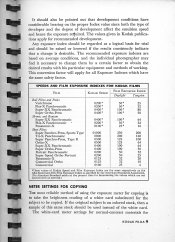
It also doesn't explain why the general refrain is "1/2 box speed" (one stop vs the 1/2 stop 18%/12% difference), or that there isn't any evidence the mantra was heard before 1960. ASA film speeds where approximately one stop slower pior to 1960. The attachment is from a Kodak data book from the 1950s. The Zone System's fundamental testing method was the same then as today. From all indications the ZS and ASA speeds tended to conform. They wouldn't if it was about a light meter calibration discrepancy.

The relationship between the metered exposure point to b&w speed point can be defined as the Hg/Hm where Hg is the exposure at the meter exposure point and Hm is the exposure where the film density equals 0.10 Fb+f. For a given film speed Hg = 8/ISO and Hm = 0.8/ISO. The ratio, k1, can also be found using the two constants 8/0.8 = 10, or 1.0 logs, or 3 1/3 stops.
 

Attachments

  • Kodak Data book - old film speeds.jpg
    Kodak Data book - old film speeds.jpg
    761.4 KB · Views: 110
Last edited by a moderator:

2F/2F

Member
Allowing Ads
Joined
Apr 29, 2008
Messages
8,031
Location
Los Angeles,
Format
Multi Format
This might be true if speed was determined at the metered exposure point. Assuming meters "see" at different values would explain the different interpretations of the results. (Sorry, I dislike using percentages because meters read luminances not percentages.) And yes, rating the EI at 1/2 stop less than the ISO would bring Zone V up to equal 18% reflectance but only if you are using the modern values for K and C. But speed point isn't determined at the metered calibration point.

It also doesn't explain why the general refrain is "1/2 box speed" (one stop vs the 1/2 stop 18%/12% difference), or that there isn't any evidence the mantra was heard before 1960. ASA film speeds where approximately one stop slower pior to 1960. The attachment is from a Kodak data book from the 1950s. The Zone System's fundamental testing method was the same then as today. From all indications the ZS and ASA speeds tended to conform. They wouldn't if it was about a light meter calibration discrepancy.

The relationship between the metered exposure point to b&w speed point can be defined as the Hg/Hm where Hg is the exposure at the meter exposure point and Hm is the exposure where the film density equals 0.10 Fb+f. For a given film speed Hg = 8/ISO and Hm = 0.8/ISO. The ratio, k1, can also be found using the two constants 8/0.8 = 10, or 1.0 logs, or 3 1/3 stops.

Stephen,

It sounds like you maybe misunderstood what I wrote. I am not saying the reason for lower Eis is differences in light meter calibration or K values. I am saying it is the different (flawed?) methodology of how the Zone System uses a gray card.

Technical jargon aside, in the Zone System, the gray card is used as the tool for finding an EI. A reading is taken, and this reading is then stopped down from to what Ansel Adams thought "should" be the threshold of density. However, the way I see it, he was wrong; where he chose to stop down to really should not have been the threshold of density; it should have been 1/2 stop below the threshold of density. In short, Adams' whole darned thing was off by a half stop from the get go; he was confused as to how to use a gray card to determine a correct exposure (forgot the bit about opening up from the reading). It works in and of itself, but it sure would be nice if Zone System EIs were closer to box speed. The difference is building the adjustment into the EI, as Adams did, or adding it each time you take a shot, as I prefer to do, so I can use incident and spot meters together to find my exposure and development for a picture.

Also, the common refrain of "rate your film at half box speed" is, IMHO, sloppy, and wrong, as are most rules of thumb when adhered to without thought. I never do that unless testing has indicated that I should...and it only has on two or three occasions, with older film. As mentioned above, I find box speed and manufacturer's recommended developing times to be scarily close to dead on for me when using an incident meter and a reflected gray scale for testing...and when used with reflected meters, if I add the 1/2 to 2/3 stop that I am supposed to (that it says to do right on the back of my gray card).

In short: It makes sense to me that Zone System EIs are lower than box speed because of the methodology of the initial EI test. Ansel Adams was off by 1/2 a stop from the get go. The whole system is offset from box speed 1/2 stop automatically by this fact alone.
 
Last edited by a moderator:

markbarendt

Member
Allowing Ads
Joined
May 18, 2008
Messages
9,422
Location
Beaverton, OR
Format
Multi Format
Once I stopped using the Zone System primarily for my "static" pictures, and started calibrating to gray scales and using an incident meter, I started noticing that box speed and manufacturer's recommended development were almost always very close to being spot on.

This has been my experience too 2F/2F.

Over the last year I started making the transition from zoning and 1/2 box speed to the almost exclusive use of incident metering at box and it really has made a significant improvement in the quality of my exposures.

Part of what I find interesting in Stephen's example in post 123 is that flare has little effect up near the meter calibration point. To me that screams "middle tones are better reference points".

Another thing that I've noticed is that for any particular shot there appears to be a point where the print looks natural, surely there s a range in which it can be printed nicely, but the farther I stray from normal exposure (incident in my case) the tougher it is to make the shot look right on paper.

It s no stretch for me to believe the psychological testing results.

As a side note, this has pushed me more toward finding or creating better lighting or filtering or using graduated NDs, for my shots rather than trying to burn or dodge after the fact.
 
OP
OP
Stephen Benskin
Joined
Jan 7, 2005
Messages
2,743
Location
Los Angeles
Format
4x5 Format
That doesn't explain why speeds conformed before 1960, but not after. Adams was only a little off in his assumption that the shadows fell 4 stops down, as opposed to 4 1/3. Based on the way ZS tests, this should actually make ZS EIs 1/3 stop faster than the ISO speed if this was the only factor. The real question is why is the ratio between Hg and Hm 3 1/3 stops and not 4 1/3. The answer is, this is the way flare is factored into the calculation. The attached paper is on meter calibration.

The reason why they conformed before 1960 is because the ASA standard had an extra stop safety factor which just happened to compensate for the difference in testing methodology.
 

Attachments

  • Calibration Levels of Films and Exposure Devices, Connelly.pdf
    927.6 KB · Views: 211
Last edited by a moderator:

Bill Burk

Subscriber
Allowing Ads
Joined
Feb 9, 2010
Messages
9,482
Format
4x5 Format
However, the way I see it, he was wrong; where he chose to stop down to really should not have been the threshold of density; it should have been 1/2 stop below the threshold of density.

Not to detract from the rest of your post...

The gray card will read whatever it reads, even a 33% gray target (to pick a random number) when metered and stopped down 4 stops will put the same exposure on the film as a standard gray card.

Because the gray card is the subject when you make the exposure, it doesn't matter what percent it is.

Normal gray card usage, where the percentage matters, you take the gray card away and shoot a pictorial subject.
 

2F/2F

Member
Allowing Ads
Joined
Apr 29, 2008
Messages
8,031
Location
Los Angeles,
Format
Multi Format
Not to detract from the rest of your post...

The gray card will read whatever it reads, even a 33% gray target (to pick a random number) when metered and stopped down 4 stops will put the same exposure on the film as a standard gray card.

Because the gray card is the subject when you make the exposure, it doesn't matter what percent it is.

Normal gray card usage, where the percentage matters, you take the gray card away and shoot a pictorial subject.

You can indeed use any even-toned surface for Zone System testing. The point about 18 percent was simply to point out that most light meters are designed to produce a darker tone of gray than a "middle gray" card, so the middle-toned card is not reproduced accurately if it is exposed at zone V (i.e. if the meter reading is used directly); if you expose directly off of a gray card and print normally, you get a tone on the print that is darker than a the gray card. Expose off of anything, and you get that slightly-darker-than-a-gray-card gray. Since print value V should look like an 18 percent gray card, and should correspond with a zone V placement and normal printing, I would personally reason that 4 stops is too much to stop down to expect to land on the threshold of density, and 3-1/2 should be where you start looking for zone I. Knowing that a reflected light meter will reproduce a tone that is actually about 1/2 stop darker than middle gray, I'd expect stopping down four stops from the reading to give me a print value "1/2," not I. It isn't about the tone of the gray card, except to say that light meters do not accurately reproduce one unless the reading is adjusted a bit, so we should not expect a zone V placement to give us a gray card gray on the print. Not saying that the Zone System is wrong. It simply builds that 1/2 stop into the working EI...thus lowering speeds below box speed. That is great if all you use is the Zone System. But try combining it with other methods, and it is a bit awkward. I use incident meters, and use spots to measure luminance range, with the occasional placement of a certain subject, or simply the measurement of one to know where it will land tonally at my decided-upon incident exposure.
 
Last edited by a moderator:

Bill Burk

Subscriber
Allowing Ads
Joined
Feb 9, 2010
Messages
9,482
Format
4x5 Format
Once I stopped using the Zone System primarily for my "static" pictures, and started calibrating to gray scales and using an incident meter, I started noticing that box speed and manufacturer's recommended development were almost always very close to being spot on.

Of course manufacturer's speeds are correct, I rely on that. But my negatives have been too thin, to me it becomes a question of placement.

Here is my placement plan for now (subject to change)...

-sensitometry to plot curve family and (thanks to this thread), time/CI.
-target paper LER (still need to do paperwork).
-enter half the proven speed at 0.1 as meter EI (subject to change).
-use Zone System roman numerals metering the scene, placing values and checking falls. For example placing shadows on Zone II and caucasian faces on Zone VI.
 
Photrio.com contains affiliate links to products. We may receive a commission for purchases made through these links.
To read our full affiliate disclosure statement please click Here.

PHOTRIO PARTNERS EQUALLY FUNDING OUR COMMUNITY:


Ilford ADOX Freestyle Photographic Stearman Press Weldon Color Lab Blue Moon Camera & Machine
Top Bottom