OP
OP

Dale, you've made a good logical argument but there are a few details that need to be included and they will lead to a different conclusion. If you go back to the beginning of this thread, one of the concepts was the correct interpretation of the data requires a proper understanding of the principles involved. With aim NDR, it was interpreting flare from the data in a non-flare test.
You're correct that the information that comes with the grey card recommends opening up 1/2 stop when metering the card outdoors. You are also correct that, given all the conditions of the standard model of exposure, 18% reflectance is 1/2 stop brighter than the metered exposure point of 12%.
What you left out was there is a distinction with using a grey card as a test target and using it to base the exposure upon. The exposure meter wants to make an exposure at the film plane of 8/ISO no matter what it is pointed at. It doesn't matter. Whether it's a 18% grey card, white card, or whatever, the metered exposure will fall at the same point on the curve. Meter an 18% grey card or a white card and stop down a stop and the exposure will fall 0.30 log-H units to the left of the metered exposure point. Therefore, the reflectance of the target card has no affect on the placement of exposure.
What is important is all the tones surrounding the reflectance of the object metered and where they will fall on the film curve in relation to the metered exposure.
The concept of exposure is to place the exposure values of the scene on the film curve where there is sufficient separation (gradient) to produce a quality print. This is why determining the minimum point of exposure (fractional gradient) where this can happen is a vital component in the determination of film speeds.
For an average scene, the shadows fall 4 1/3 stops below the meter exposure point. As we know, no matter the luminance of an object in a scene, the exposure meter will want to make it the same exposure value. The difference between shooting a card for a test and metering it to photograph a scene? The test card is by itself. The card used for photographing a scene has the scene attached with its range.
If you meter a white object and use the metered exposure, the white card will fall at 8/ISO. As most of the rest of the scene is darker, it will fall to the left of that point on the curve. We know that the fractional gradient point falls approximately 4 1/3 stops below the metered exposure point, so anything below that will have degraded quality.
The shadows in an average scene fall between 4 3/4 and 5 stops below 18% reflectance. In order to have the shadows fall at a point for good reproduction, the metered exposure must be adjusted by 1/2 stop. That's why you open up when metering an 18% grey card to photograph an outside scene.
The instructions that come with Kodak's Neutral Grey Card also say not to adjust the exposure when using the card to determine the exposure for a copy or 2 dimensional set-up. Why? It has nothing to do with mid-tone reproduction. It's because the blacks from art work don't fall as far down on the curve as the exterior scene's shadows.
Other than making sure there's sufficient separation of the shadows, there is no placing of tones on the negative. The negative is the intermediary step in the process. You just need to have a negative that separates all the luminance values from the scene and has a density range that closely matches the paper. The rest is misinterpretation on how it works.
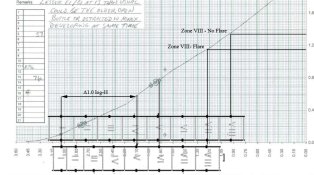
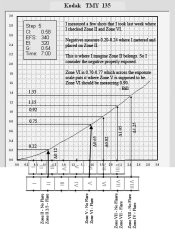
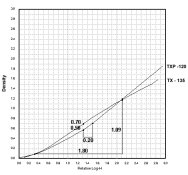
I've attached two fun examples. The film curve shows a long toed film (TXP 120) and a medium toed film (TX 135). They are processed to the same CI. The metered exposure point falls 1.0 log-H units to the right of 0.10 Fb+f. The two films have different densities at this point. It would take an additional 2/3 stop with the long toed film for the densities to match.
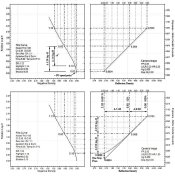
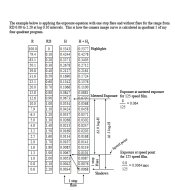
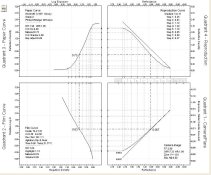
The four quadrant curve has the reflectance of Zone V equaling 12%. Because of the various factors of the film and paper curve shape, and the luminance range interact, it is possible to meter a 12% Zone V reflectance and have it print as a 18% reflectance. And this is with strict computer curve fitting. Sight differences in print exposure will easily shift the mid-tone around enough to concluded anything you want about Zonal relationships.
You're correct that the information that comes with the grey card recommends opening up 1/2 stop when metering the card outdoors. You are also correct that, given all the conditions of the standard model of exposure, 18% reflectance is 1/2 stop brighter than the metered exposure point of 12%.
What you left out was there is a distinction with using a grey card as a test target and using it to base the exposure upon. The exposure meter wants to make an exposure at the film plane of 8/ISO no matter what it is pointed at. It doesn't matter. Whether it's a 18% grey card, white card, or whatever, the metered exposure will fall at the same point on the curve. Meter an 18% grey card or a white card and stop down a stop and the exposure will fall 0.30 log-H units to the left of the metered exposure point. Therefore, the reflectance of the target card has no affect on the placement of exposure.
What is important is all the tones surrounding the reflectance of the object metered and where they will fall on the film curve in relation to the metered exposure.
The concept of exposure is to place the exposure values of the scene on the film curve where there is sufficient separation (gradient) to produce a quality print. This is why determining the minimum point of exposure (fractional gradient) where this can happen is a vital component in the determination of film speeds.
For an average scene, the shadows fall 4 1/3 stops below the meter exposure point. As we know, no matter the luminance of an object in a scene, the exposure meter will want to make it the same exposure value. The difference between shooting a card for a test and metering it to photograph a scene? The test card is by itself. The card used for photographing a scene has the scene attached with its range.
If you meter a white object and use the metered exposure, the white card will fall at 8/ISO. As most of the rest of the scene is darker, it will fall to the left of that point on the curve. We know that the fractional gradient point falls approximately 4 1/3 stops below the metered exposure point, so anything below that will have degraded quality.
The shadows in an average scene fall between 4 3/4 and 5 stops below 18% reflectance. In order to have the shadows fall at a point for good reproduction, the metered exposure must be adjusted by 1/2 stop. That's why you open up when metering an 18% grey card to photograph an outside scene.
The instructions that come with Kodak's Neutral Grey Card also say not to adjust the exposure when using the card to determine the exposure for a copy or 2 dimensional set-up. Why? It has nothing to do with mid-tone reproduction. It's because the blacks from art work don't fall as far down on the curve as the exterior scene's shadows.
Other than making sure there's sufficient separation of the shadows, there is no placing of tones on the negative. The negative is the intermediary step in the process. You just need to have a negative that separates all the luminance values from the scene and has a density range that closely matches the paper. The rest is misinterpretation on how it works.
I've attached two fun examples. The film curve shows a long toed film (TXP 120) and a medium toed film (TX 135). They are processed to the same CI. The metered exposure point falls 1.0 log-H units to the right of 0.10 Fb+f. The two films have different densities at this point. It would take an additional 2/3 stop with the long toed film for the densities to match.
The four quadrant curve has the reflectance of Zone V equaling 12%. Because of the various factors of the film and paper curve shape, and the luminance range interact, it is possible to meter a 12% Zone V reflectance and have it print as a 18% reflectance. And this is with strict computer curve fitting. Sight differences in print exposure will easily shift the mid-tone around enough to concluded anything you want about Zonal relationships.
Attachments
Last edited by a moderator: