


• Welcome to Photrio!
    Registration is fast and free. Join today to unlock search, see fewer ads, and access all forum features.
    Click here to sign up

When did the industry move from ASA to ISO?

Tree of a kind

H
Tree of a kind

  • 1
  • 0
  • 0
Two Horses

A
Two Horses

  • 10
  • 2
  • 41

Recent Classifieds

Forum statistics

Threads
202,803
Messages
2,845,718
Members
101,541
Latest member
ΦÆdon
Recent bookmarks
0

Paul Verizzo

Member
Joined
Jan 20, 2008
Messages
1,648
Location
Round Rock, TX
Format
35mm
The reason I ask is that going through some ancient boxes containing photo related things, I came across a roll of 400 ASA C-41 Kodacolor.

Of course, it could have been made well before the change over date.

I'm positive that it spent most of its life in un-airconditioned Florida houses and storage sheds.

For the cost of processing, I'll probably shoot it anyway.

See what "develops."
 
I think C-41 was introduced in the early 70's as well, so my guess would be that the box speed is more or less accurate (for when the film was fresh). In my experience, faster films lose speed after expiration much more noticeably than slower films. I imagine there will be some heat fog too, since you indicate the film wasn't stored in a climate controlled environment. Given that it's negative film, it probably wouldn't hurt to shoot a stop or two over.
 
Actually, it was 1974 when the ASA speed was incorporated into the ISO speed, but the changeover which resulted in ASA disappearing from film boxes happened between 1982 and 1987.
 
Actually, it was 1974 when the ASA speed was incorporated into the ISO speed, but the changeover which resulted in ASA disappearing from film boxes happened between 1982 and 1987.

Thank you, Matt! An actual answer. I'm back here on APUG after a hiatus and it's always great to read your posts.
 
By the way, that info is accurately included in the Wikipedia article linked to above. The way it is expressed isn't exactly crystal clear.
I took the date range from it - my experience with selling film ended ~ 1982 when ISO labelling first appeared.
Good to see you posting again Paul.
 
Actually, it was 1974 when the ASA speed was incorporated into the ISO speed.

At that time the ISO designation was just the combination of the ASA and the DIN designations into one new designation and omitting "ASA" and "DIN", but using "ISO" instead.
 
Is there a chance it depends on the location the film was bought?

I recall in the UK, when I started in the late 70s films were sold and described with ASA speed ratings, and sometimes the ISO rating which gave both ASA and DIN (eg 400/27). I recall visiting West Germany in 1987 and the local supply of Agfa C41 film was labelled in DIN with the ISO combination in the small print. Sometime in the 1980s the combination arith/log ISO was used on pretty much every film box in the UK.

By the end of the 80s, I think everything moved to ISO ratings without the DIN incorporated, ie just the arithmetic scale. By the time I started spending considerable lengths in the USA in the late 90s....nobody seemed aware that the arith/log ISO had ever existed and still referred to ASA.
 
The reason I ask is that going through some ancient boxes containing photo related things, I came across a roll of 400 ASA C-41 Kodacolor.

Of course, it could have been made well before the change over date.

I'm positive that it spent most of its life in un-airconditioned Florida houses and storage sheds.

For the cost of processing, I'll probably shoot it anyway.

See what "develops."
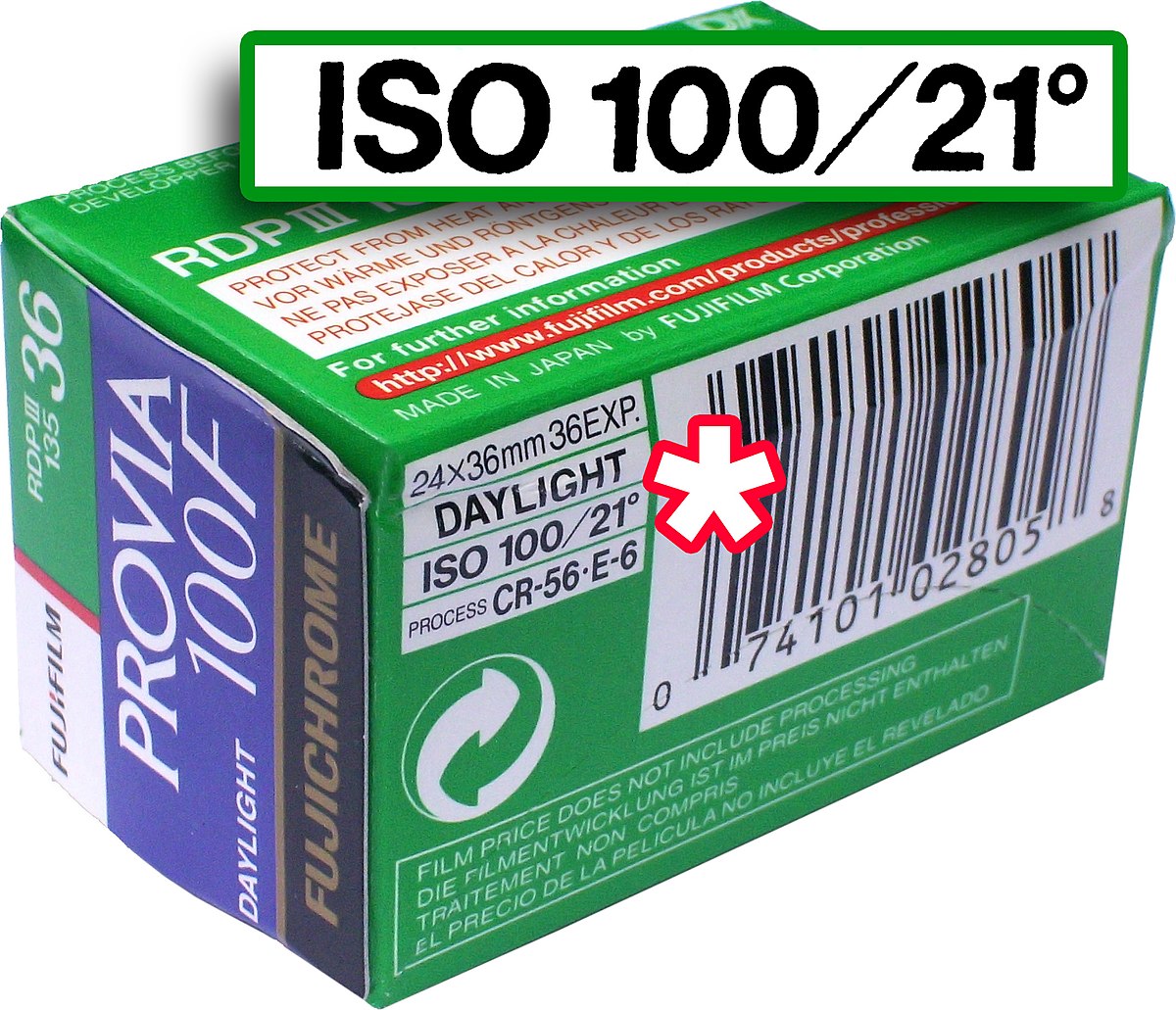
So the latest your film is around 1987. I think by that time all films are labeled with ISO. The earliest is 1972 when Kodak introduced process C-41. Before that it was process C-22.
 
So the latest your film is around 1987. I think by that time all films are labeled with ISO. The earliest is 1972 when Kodak introduced process C-41. Before that it was process C-22.

Because of the C-41 processing, and this was found with some of my brother's camera stuff and when he was "into" it, I'm leaning on early-mid 1970's.
 
Actually, it was 1974 when the ASA speed was incorporated into the ISO speed, but the changeover which resulted in ASA disappearing from film boxes happened between 1982 and 1987.

For those using the ASA setting on cameras, the change over did not cause any consternation and we continued using the ASA dial as though it was an ISO dial.
 
At that time the ISO designation was just the combination of the ASA and the DIN designations into one new designation and omitting "ASA" and "DIN", but using "ISO" instead.

I think ASA speeds are the same as ISO, DIN numbers are very different.
 
Both DIN and ASA, as NATIONAL standards were a world of their own. :smile:
 
At the time when the ISO standard was released, there was enough film volume that packaging was tailored to individual markets. In areas where ASA was the long term standard, there was no reason to change the label to ISO.
 
I think ASA speeds are the same as ISO, DIN numbers are very different.

There are 2 kinds of ISO disignatons:
-) consisting of both, the arithmetric and the logarithmic designation
the current one
-) consisting just of the arithmetric one
 
When I bought my first roll of colour print film in Summer, 1980, it said ASA. When I bought a roll of colour slide film in 1988 to photography my art portfolio, it said ISO. So, the change happened sometime between those years. Sorry...that's the best I can do. I wasn't into photography until '91.
 
Beats me. Not sure when I noticed the letters changed. The numbers are the same. The film is the same. A non-event.
 
Anyone know of a film in which the new ISO label was a different number from the old ASA number? I don’t know of any, but I’m only familiar with BW emulsions.
 
Essentially, ISO adopted the ASA system.
actually, they came out with a system that is simaler to both ASA (and BS and JIS) and DIN. an iso speed might be 400/27, and you pick off the numbers that work with your workflow.
 
Photrio.com contains affiliate links to products. We may receive a commission for purchases made through these links.
To read our full affiliate disclosure statement please click Here.

PHOTRIO PARTNERS EQUALLY FUNDING OUR COMMUNITY:


Ilford ADOX Freestyle Photographic Stearman Press Weldon Color Lab Blue Moon Camera & Machine
Top Bottom