• Welcome to Photrio!
    Registration is fast and free. Join today to unlock search, see fewer ads, and access all forum features.
    Click here to sign up

Taking the plunge - Sanity checks, questions ...

Forum statistics

Threads
203,466
Messages
2,855,210
Members
101,855
Latest member
Minoltalan
Recent bookmarks
2
Get accordion bottles for your C41. A roll a week is fine this way; no need to hoard film. In an accordion bottle with the air evacuated, C41 chems have lasted me well past 6 months.
One caution - there are a lot of people (myself included) who have had bad experiences with the accordion bottles.
They are impossible to clean properly, and many of them are not in any way oxygen impermeable.
 
One caution - there are a lot of people (myself included) who have had bad experiences with the accordion bottles.
They are impossible to clean properly, and many of them are not in any way oxygen impermeable.

I too had problems with accordion bottles, and I stopped using them. I guess there's different qualities offered, and mine weren't good enough for photo use.
 
I'd suggest that wherever you load your film that you put the cassette, bottle opener or whatever, the tank and the reels into something like a plastic dish pan or such. It's amazing how big a small bathroom floor becomes when you're searching for something in the dark! Don't ask me how I discovered this!:cry:

Also if you plan to load the film tonight, say, and then wait until tomorrow to process it, do put masking tape or some such over the lid and label it with whatever film is inside. Again, don't ask why I suggest this! :sick:
 
I've had dektol eat through plastic beverage bottles... you should see what dektol does to linoleum!

Just a word on digital thermometers. One of the very best is the thermapen (made for cooking but FAST and accuarte). But it's like $70-$100.

Now they make the "thermopop", same tech as the pen but simpler, less features - about forty bucks. Buy direct from thermapen. If you want sort of the "BMW of thermometers" (vs. the Rolls Royce) I'd check it out.
 
I currently use the Digibase kit and many films later, it produces really good results, and is also really easy to get on with. I use it at 37.8°C, but it can allegedly be used at 20°C with longer dev times.

I also bought 4x 500ml (pretty much 18oz) amber bottles and 2x Salter digital thermometers (UK link, but you should be able to find something similar), I also have a couple of regular analogue thermometers.

I half fill the kitchen sink with water around 42°C (108°F), stand all 4 bottles and a measuring cylinder of distilled water for the pre-wash in it. I then load (and occasionally swear) the film(s) onto my steel tanks (apparently can help retain the temperature) in a changing bag, then replace the water before starting.

I use the 2 mercury thermometers in the bath and pre-wash, then the 2 digital in the DEV and BLEACH, washing and swapping them into the FIX and STAB bottles as I develop the films.

The Digibase kit instructions are a bit misleading, but by using APUG, instructions from Nik & Trick (UK seller) and some Fuji info that this kit is apparently based on, I've found the following times produce great results:

Developer 3min 15 sec at 37.8ºC ±0.5°C
Bleach 6min 30 sec at 37.8°C ±3°C
Wash 1min 5 sec at 35°C ±5°C - Or 4x30 sec washes
Fixer 6min 30 sec at 37.8°C ± 5°C
Wash 3 min 15 sec at 35°C ± 5°C - Or 4x30 sec + 2x1 min washes
Stabilizer 1min 5 sec 25-40°C

Then, hang the negs in the shower and don't squeegee, run your first 2 fingers down the film.

Notes:
I mixed the 1lt chem kit for 500ml amounts, you process something like 8 or 10 films, then dump all of the chems apart from the stabilizer which will work twice as long, for the full recommended number of films for the kit

Through the process, the temperature tolerances widen, so make sure the pre-wash and DEV is at the correct temp, everything else is a bit less critical.

I bought everything to develop C41 for the equivalent cost of developing 3 or 4 films in a local lab. I currently sc*n and print d*gitally and get better looking results!
 
I have tested accordion bottles at the store before I bought them only to have some of them fail in a few months.
 
I would advise against paper towels. The reason fingers work is that you can feel any grit before it scratches your film.
 
With all of the negative (pun not intended) comments about squeegees, this individual here (link below) suggests paper towels. Comments?

Surf here, look about 2/3 down the page:

https://meiows.wordpress.com/2014/07/17/how-to-develop-color-film-at-home-c41-tutorial/
With a final rinse in distilled or deionised water, with or without a wetting agent like photoflo or ilfotol, there's no need for wiping of any sort.

NB Intended to refer only to b&w; see post by MattKing: (there was a url link here which no longer exists)
 
Last edited:
With a final rinse in distilled or deionised water, with or without a wetting agent like photoflo or ilfotol, there's no need for wiping of any sort.
Don't use a final rinse in water with colour film. Colour film requires a final rinse in anti-bacterial stabilizer/Final Rinse.
 
No squeegees, no fingers, no towels... nothing! Mix your stabiliser with distilled water and it should be fine.
 
Don't use a final rinse in water with colour film. Colour film requires a final rinse in anti-bacterial stabilizer/Final Rinse.
Absolutely not no and well spotted matt. I did not pay proper attention to the op in my zeal for her not to wipe.
Mea culpa
 
With all of the negative (pun not intended) comments about squeegees, this individual here (link below) suggests paper towels. Comments?

Surf here, look about 2/3 down the page:

https://meiows.wordpress.com/2014/07/17/how-to-develop-color-film-at-home-c41-tutorial/
I would suggest nothing. Don't run anything down your film. My experience is that it's probable that you will scratch your film.

Get it dry, get the water blobs off of it and you don't have to worry about it.

After it's dry you can remove the water spots via Pec Pads and Pec cleaner but the best way is to just not have them there in the first place.
 
No squeegees, no fingers, no towels... nothing! Mix your stabiliser with distilled water and it should be fine.

I used to do this and always ended up with spots. I did and still use a squeegee sometimes. I dip it into photo flo water. I use my wet fingers for the most part, or a glasses cleaning cloth.
 
With all of the negative (pun not intended) comments about squeegees, this individual here (link below) suggests paper towels. Comments?

Surf here, look about 2/3 down the page:

https://meiows.wordpress.com/2014/07/17/how-to-develop-color-film-at-home-c41-tutorial/

Nooooooo :sad:

I would advise against paper towels. The reason fingers work is that you can feel any grit before it scratches your film.

+1

With a final rinse in distilled or deionised water, with or without a wetting agent like photoflo or ilfotol, there's no need for wiping of any sort.

NB Intended to refer only to b&w; see post by MattKing: (there was a url link here which no longer exists)

+1

Don't use a final rinse in water with colour film. Colour film requires a final rinse in anti-bacterial stabilizer/Final Rinse.

+1

No squeegees, no fingers, no towels... nothing! Mix your stabiliser with distilled water and it should be fine.

+1
 
After my B/W film is thoroughly dry I like to give each side a swipe with Edwal Film Cleaner. It seems to have anti-static properties, always a good thing. I don't know about C 41 stock, although I've used the Edwal before scanning color negs.

Don't even think of using paper towels! They are mildly abrasive, just the thing for film...NOT! Pec "pads" or such, or just your CLEAN fingers.
 
This is my go-to as well. Inexpensive, good caps and seals on seltzer bottles as compared to water, and you can have a scotch & soda while waiting on the film to dry.

There's a half bottle left, what are you going to do? I have a kit that just came in! Guzzle time!
 
The only obvious bit of specialized kit you seem to be missing are negative sleeves, or some other way to safely store your dried, unscratched, unsqueeged, negatives.
 
I use a Corning plate-warmer I got at Goodwill and a rectangular steam-table pan (total cost $7). I start with warm water and check it after an hour. It is usually 105F to 107F. I use the C-41 kit from Film Photography Project and store it in amber glass Boston Round bottles (available on Amazon). I mix it with distilled water, I don't use any rinse agent after stabilizer, I hang my film in the shower to dry, and I don't get spots. I love my ThermaPen for spot-checking (it comes with a calibration certificate), but you will want a traditional dial-thermometer in the pan. An ordinary binder clip from Kinko's keeps the thermometer in place. Good luck. It sounds like you're on the right track.
 
Success! :smile:

Well, yesterday I got my feet wet, well, hands wet, kinda, anyway.

I had three rolls to do, which is what they say is the capacity of 8oz of mixed solutions.

As I said, I wanted to do the first one manually, in the steel tank, just to have the experience of doing it the hard way. :smile: For that I used the Jobo only as a heated water bath to keep the tank temperature-stable. The second and third I used the Jobo.

For these first three rolls, I followed the mixing, temperature, and timing to the letter!

A few notes on the process ...

* I used the Cinestill brand solutions. In doing some web surfing and price comparisons and such, it looks like the Arista brand kit uses exactly the same bottles with similar but slightly different labels, so I'm assuming those kits are the same.

* I mixed the solutions with distilled H2O. I'm assuming this is best, as in not having contamination from, or worse, reactions with, any stuff that's in the city water.

* I'm assuming a stainless laboratory type stirring stick is OK to use. It said to stir continuously when mixing the solutions.

* The first one I did on the Jobo was 24 exposures. It "walked" into the Jobo reel easily. The second was 36 and it took me a good 15 minutes in the dark to get it right. It would "hang" every few motions. I finally figured out that coaxing the wound film to the exact center using thumb and fingernail would help get it moving again.

* The Jobo makes it almost too easy! Just pour the solutions in, time them, and hold the bottle up to the drain hose to collect them. No real "wet work" at all! :smile: I'm very impressed.

* As was noted, a film squeegee was not needed. After the bath in the stabilizer solution and a hanging for a couple of hours, the films were dry and clean. No obvious spots at all.

* For the recommended (mandated) seven rinses between the blix and stabilizer, I used plain old city tap water at approximately the correct temperature. I assume this is correct, since the purpose is to get rid of the blix and the stabilizer was indeed mixed with distilled H2O.

* The blix looks like really nasty stuff! :smile: :smile: :smile:

* I'm also assuming that it's OK to simply run the tanks (steel and plastic) and the Jobo bottles and such through the dishwasher. (Yes, I did them in a separate load, not with any human-food dishes or utensils.) :smile:

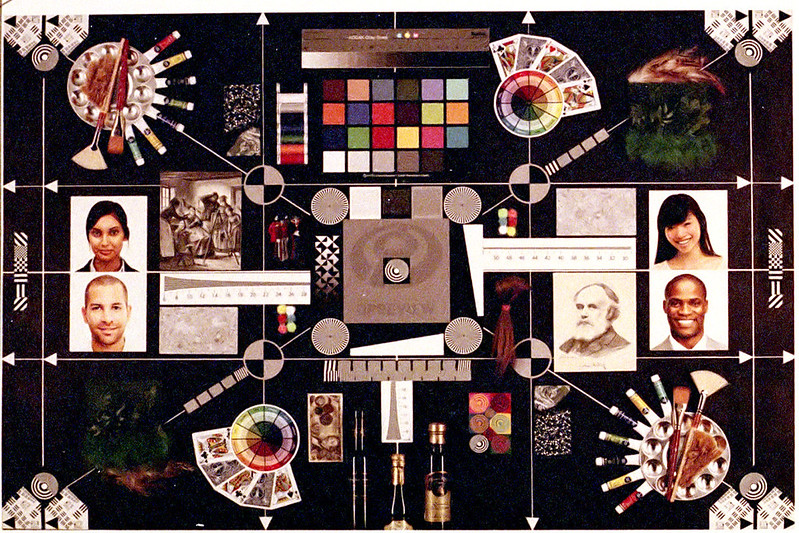
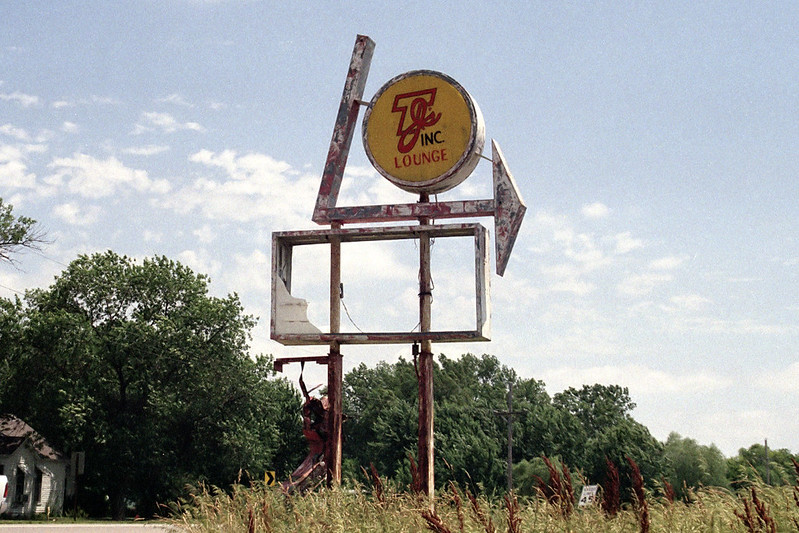
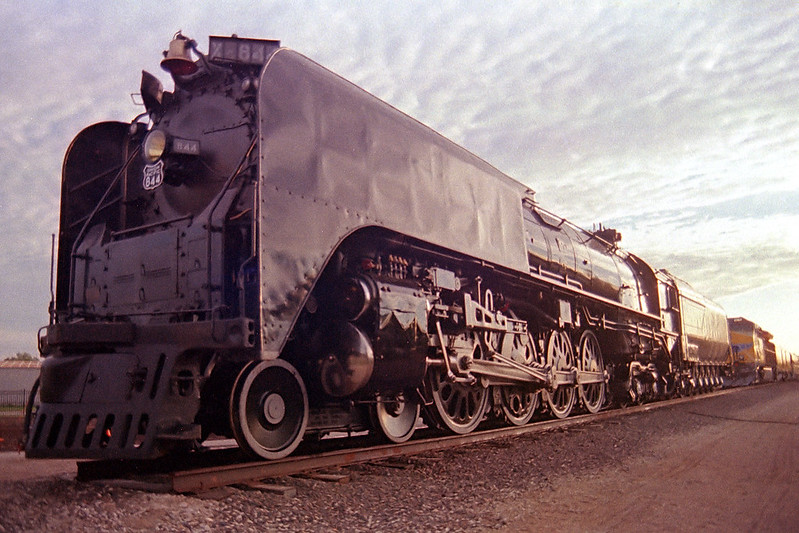
Below are a few scans from the first, second, and third rolls respectively.

The first roll was just slop shots. Test charts, shots out the window, a few of the cats who would not hold still for me. The one I'm posting is of the one test chart, room lights only, handheld, not scientific but a good sanity check that the colors are somewhat in the ballpark.

The second one is kind of a random one from a roll I had exposed. One of those abandoned roadside signs.

The third is odd color, odd light, using an odd film. This was a roll of Rollei/Agfa CN 200, which I decided to try just for the {whatever} of it. It shows one of the UP heritage steam engines parked by the local stadium in celebration of the College World Series, which is going on now.

Again, thanks to all here for the advice and encouragement. I think that (particularly with the Jobo) this will be a great alternative to the Disappearing Photo-lab Blues! :smile:

34561054183_1bf54a8743_c.jpg


35204277032_25d6488d5d_c.jpg


35204276842_3ea091726b_c.jpg
 
Congratulations! Looks like you did fine!

Thanks. :smile:

I'm probably going to be shooting more film, now that I don't have to wait forever to get it processed.

I was thinking about it, and for that second roll on the Jobo (meaning I did not have to mix and let the thing warm up) it probably took less time than two trips to the lab would have.

It's probably gonna be cost-effective, time-effective, and hassle-effective! :smile:
 
Photrio.com contains affiliate links to products. We may receive a commission for purchases made through these links.
To read our full affiliate disclosure statement please click Here.

PHOTRIO PARTNERS EQUALLY FUNDING OUR COMMUNITY:


Ilford ADOX Freestyle Photographic Stearman Press Weldon Color Lab Blue Moon Camera & Machine
Top Bottom