Success!

Well, yesterday I got my feet wet, well, hands wet, kinda, anyway.
I had three rolls to do, which is what they say is the capacity of 8oz of mixed solutions.
As I said, I wanted to do the first one manually, in the steel tank, just to have the experience of doing it the hard way.
For that I used the Jobo only as a heated water bath to keep the tank temperature-stable. The second and third I used the Jobo.
For these first three rolls, I followed the mixing, temperature, and timing to the letter!
A few notes on the process ...
* I used the Cinestill brand solutions. In doing some web surfing and price comparisons and such, it looks like the Arista brand kit uses exactly the same bottles with similar but slightly different labels, so I'm assuming those kits are the same.
* I mixed the solutions with distilled H2O. I'm assuming this is best, as in not having contamination from, or worse, reactions with, any stuff that's in the city water.
* I'm assuming a stainless laboratory type stirring stick is OK to use. It said to stir continuously when mixing the solutions.
* The first one I did on the Jobo was 24 exposures. It "walked" into the Jobo reel easily. The second was 36 and it took me a good 15 minutes in the dark to get it right. It would "hang" every few motions. I finally figured out that coaxing the wound film to the exact center using thumb and fingernail would help get it moving again.
* The Jobo makes it almost too easy! Just pour the solutions in, time them, and hold the bottle up to the drain hose to collect them. No real "wet work" at all!
I'm very impressed.
* As was noted, a film squeegee was not needed. After the bath in the stabilizer solution and a hanging for a couple of hours, the films were dry and clean. No obvious spots at all.
* For the recommended (mandated) seven rinses between the blix and stabilizer, I used plain old city tap water at approximately the correct temperature. I assume this is correct, since the purpose is to get rid of the blix and the stabilizer was indeed mixed with distilled H2O.
* The blix looks like really nasty stuff!
* I'm also assuming that it's OK to simply run the tanks (steel and plastic) and the Jobo bottles and such through the dishwasher. (Yes, I did them in a separate load, not with any human-food dishes or utensils.)
Below are a few scans from the first, second, and third rolls respectively.
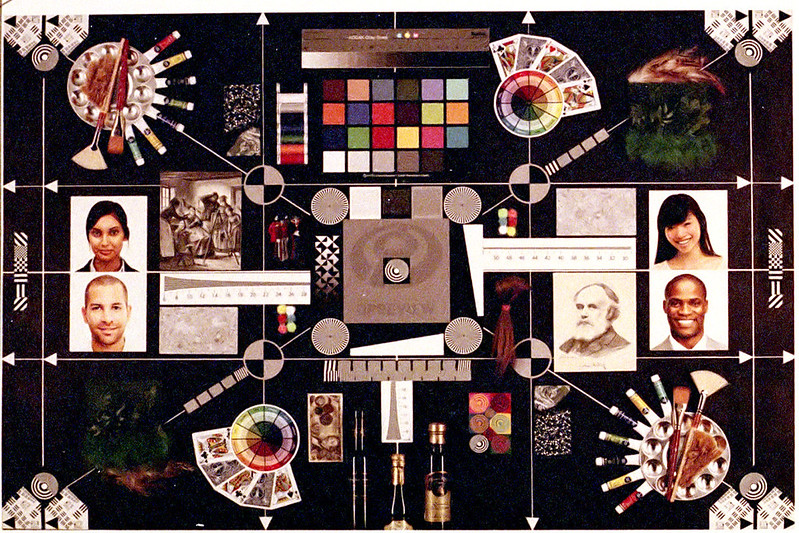
The first roll was just slop shots. Test charts, shots out the window, a few of the cats who would not hold still for me. The one I'm posting is of the one test chart, room lights only, handheld, not scientific but a good sanity check that the colors are somewhat in the ballpark.
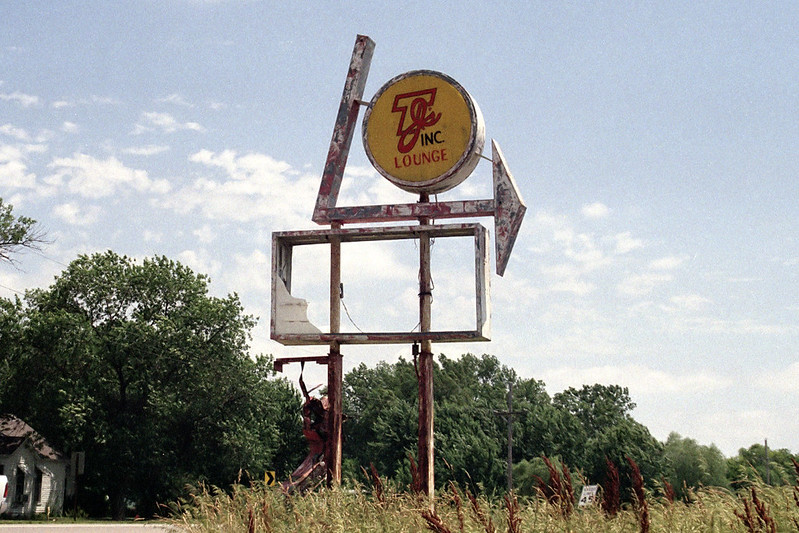
The second one is kind of a random one from a roll I had exposed. One of those abandoned roadside signs.
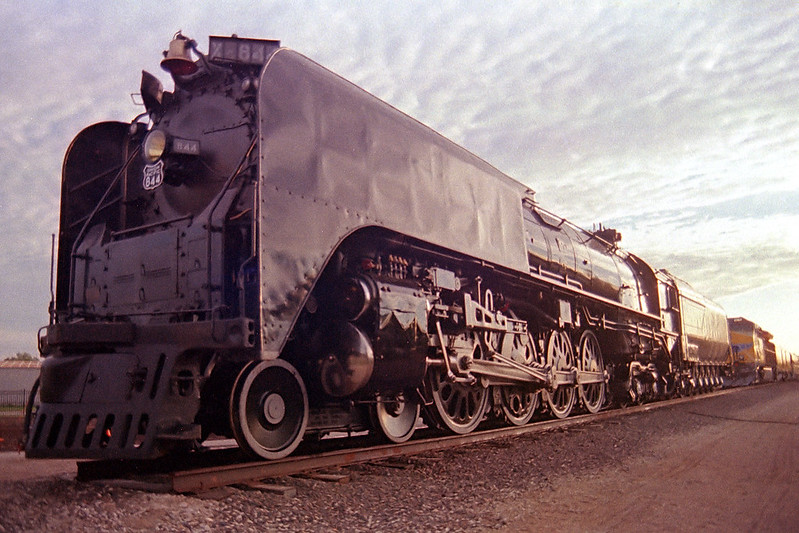
The third is odd color, odd light, using an odd film. This was a roll of Rollei/Agfa CN 200, which I decided to try just for the {whatever} of it. It shows one of the UP heritage steam engines parked by the local stadium in celebration of the College World Series, which is going on now.
Again, thanks to all here for the advice and encouragement. I think that (particularly with the Jobo) this will be a great alternative to the Disappearing Photo-lab Blues!