

• Welcome to Photrio!
    Registration is fast and free. Join today to unlock search, see fewer ads, and access all forum features.
    Click here to sign up

Numbers on 120 backing paper not aligning with red window

Manners street Lads

A
Manners street Lads

  • 0
  • 0
  • 21
Arkansas Ent

A
Arkansas Ent

  • 3
  • 2
  • 52

Recent Classifieds

Forum statistics

Threads
203,048
Messages
2,849,126
Members
101,623
Latest member
Ohio in Photography
Recent bookmarks
1
I know that Simon Galley once stated that there was only one remaining manufacturer of backing paper, but it seems that the black paper used by Foma looks and feels quite different from the Kodak backing. Does Foma just have a lot of old paper floating around?
If Foma has a load of thias backing paper then so does Rollei/Maco as they use the same paper, same feel, same printing style and same hole, never been a problem to me, with any of my folders, and I have a lot from Ensign,Zeiss,Balda,Voightlande, 645,66,and 69, also some feanka's, in at least 10 years of using foma films, indeed, I developed a roll from my latest batch and left the window shutter open while winding the film to the end, yes, the hole is their, but well away from the last negative, must be a problem with the user not the film, surely if there was a big problem them more here would be complaining?
 
I was just over on the other big photography web site and a fellow on the "film and processing" forum is having the same problem with Kodak Portra 160. He's tried film from exp. date 1/2017 and from 6/2017 and both have the same bleed problem. I'm not to informed on Portra 160 so maybe this was a problem sometime back and now Kodak Alaris is taking care of it. Still, I wish they would go back to the ink they were and have been using for years, since this new ink sucks. Of course Kodak might have bought thousands of gallons of the new stuff and doesn't want to waste or dump it and resupply with the old style ink. Bean counters at work again?
 
i emailed and got a response within an hour or so. the email included an image of the backing paper
which will have markings for 6x6, 6x9 and 6x4.5 ... i think. still not really very helpful for folks who use
other formats. i wrote back but haven't received anything in return.
 
i emailed and got a response within an hour or so. the email included an image of the backing paper
which will have markings for 6x6, 6x9 and 6x4.5 ... i think. still not really very helpful for folks who use
other formats. i wrote back but haven't received anything in return.
Let us see the picture please.
 
FWIW, on at least a couple of occasions when I have corresponded with Mr. Mooney I have indicated in my enquiry that I planned to share his response on APUG unless he had any objection, and he has never had any problem with that.
 
Kodak sent me an email. They say they are no, well, to quote: "
Dear Mr. Carter,

We are in the process of printing backing paper with an added frame number track for Voigtlander Bessa 6x9 cameras. See below. The very bottom track is the one we have added back.

Here is the photo of what they sent to me:

Kodak.png


Here is a photo of paper, (PX125), with my window outlined, which I immediately sent back to them:
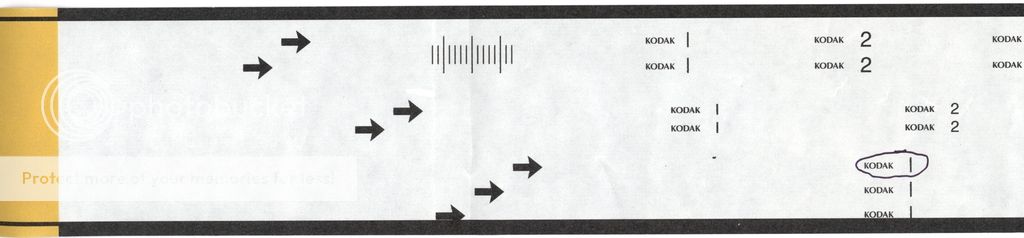
2016-10-05-0001.jpg

Are they adding the correct row or not? I specifically asked for the inner track in my initial inquiry.
What I wrote:
Hello,
New 400TMY no longer has 9 rows of numbers. I tried to use my Voigtlander Bessa 6x9 / 6x4.5 that has two red Windows in a line not on the edge and not in the center. No numbers could be seen. A piece of one was seen way out of frame. TX is the same.
Lightness of the ink is not the issue here. The numbers are gone entirely.
Please put them back.
Thank you.
1013 views at the time of writing this post.
V0igtlander Bessa,s must pull a lot of weight over at Kodak.
 
OK (since a luncheon excursion was canceled :angel:)

View attachment 164743
Note the competition has the multiple rows of numbers.
Also, not obvious in this scan, but the Fuji paper is whiter and has a glossier surface, as in maybe they have a different source (their printing is darker too).

As an old coworker used to say "Ah wish ah understood all ah know about this here thang."

Thanks for posting the film backing scans. They are most helpful.
After running a roll of Ilford through a new Ondu and not being able to see the numbers I went out and bouught a roll of everything available to try and figure out whose frame numbers and paper color provided enough contrast for me to pick out the numbers or at least a darkening where they were but haven't gotten around to exposing any of those rolls. It looks like I am going to have to bight the bullet and spend the extra $ on Fuji.
 
Thanks for posting the film backing scans. They are most helpful.
After running a roll of Ilford through a new Ondu and not being able to see the numbers I went out and bought a roll of everything available to try and figure out whose frame numbers and paper color provided enough contrast for me to pick out the numbers or at least a darkening where they were but haven't gotten around to exposing any of those rolls. It looks like I am going to have to bight the bullet and spend the extra $ on Fuji.

Glad it was helpful. One advantage of Fuji Acros for pinholery is that its reciprocity characteristics are better than average, requiring less adjustment for longer exposures (no compensation up to 120 seconds). Don't know if that's worth an extra cost, but at least it's something. It appears we can't let our guard down on this stuff!
 
I've been waiting for the TMY2 bleed problem to disappear completely before I order more, but now, if the numbers have truly disappeared, I will be ordering no more TMY2. Many of my cameras have the "ruby window" and that means Delta 100 and Delta 400 are now going to totally replace Kodak for me. Not a problem since I like both of the Delta's, but still think TMY2 was the "Gold Standard" when it comes to ISO 400.
I agree with TMY2 being a gold standard but it is a subjective choice;my all-time favorite for bodyscapes and portraits though.
 
I have a circa 1933 Certo Dolly SuperSport for which the numbers lined up just fine for 6x6, but the numbers were no where to be seen at 645 for any film. I decided that 6x6 was better.
 
I have acquired an old Rolleicord from the 1930's that has the red window on the bottom. If you hold the camera with its back to your chest and the lens pointing forward, then tilt the camera forward so you can see the bottom, the red window is on the left. That means it lines up with the numbers for 6X9, not 6X6 (which would required having a window on the right). Did 120 films in the 1930's have 6X6 numbers on the left?
 
I was not around in the 1930's, but I know that in the 1950's through at least the 1970's the frame numbers were on both sides for 645 and in the center for 6x6.
 
I don't mean to be kicking a fallen horse here and trying to get it to run, but I'm curious as to whether or not Kodak Alaris has told anyone here what the real reason is for this paper bleed problem. I know we've been told that the reason is poor storage prior to sale. Now that could speed up or induce the bleed, but that's certainly not the root cause. Maybe I missed it, but I have never heard anyone here say that Kodak told them the real problem stems from the ink itself or the paper itself. It all seems to get pushed onto distributors, retailers and improper storage. As for the number alignment thing? Certainly not a solution in my book and a rather rude copout to many of us that use older folders. I will never abandon my Zeiss Super Ikonta's or my favorite Kodak Monitor among many others, but I might have to abandon certain Kodak films. At least for now anyway!
 
John:
1) 120 film has always been susceptible to wrapper offset problems. The phenomena is always related to conditions of heat or humidity or handling, but there are various ways to minimize how susceptible the film is;
2) Until very recently, Kodak's solutions for minimizing the problem were the best or among the best in the industry, in that they had been able to maintain high visibility for the numbers, while still minimizing the occurrences. Other manufacturers like Ilford have in the past been forced to reduce the visibility of the numbers. Ilford doesn't manufacture its own backing paper;
3) Kodak lost the capacity to manufacture and print their own backing paper. They now have to buy it from a specialty paper manufacturer who uses different equipment, materials and processes to make it;
4) The original replacement backing paper was sufficiently different to be problematic when combined with the films itself;
5) The only remedy that appears to be at least partially successful so far is for the backing paper to have less visible numbers and letters, and fewer of them at that. And that hasn't worked with every film (T-Max 100 being the notable exception).
 
I have acquired an old Rolleicord from the 1930's that has the red window on the bottom. If you hold the camera with its back to your chest and the lens pointing forward, then tilt the camera forward so you can see the bottom, the red window is on the left. That means it lines up with the numbers for 6X9, not 6X6 (which would required having a window on the right). Did 120 films in the 1930's have 6X6 numbers on the left?

Rollfilms back then where not standardized to the degree we were used the last decades.
 
hi trask
if your rolleicord is like the one i had ( i had a 1 a /3 )
the ruby window is primarily for only finding frame #1
and the camera has a mechanism to wind to the next frame
so you don't have to keep looking at the ruby window.
there is a little button you pressed when you lined up #1
and at the same time you pushed a the button in the center of the
wind-knob and it resets the internal frame counter mechanism ...
some old folding cameras have a similar
here's a little utub vid that shows how to use it
 
Jnanian -- thanks very young much for the link. I'd known about pushing in and pulling down, but seeing it done has clarified the sequence and patience needed. The Rolleicord manual for this model was much less helpful. I'll load up another roll and see how it all works.
 
:smile: glad i could help !
its much easier to wind till it stops
than deal with that ruby window :smile:
 
I have acquired an old Rolleicord from the 1930's that has the red window on the bottom. If you hold the camera with its back to your chest and the lens pointing forward, then tilt the camera forward so you can see the bottom, the red window is on the left. That means it lines up with the numbers for 6X9, not 6X6 (which would required having a window on the right). Did 120 films in the 1930's have 6X6 numbers on the left?

The red window on that vintage of Rolleicord used the number 1 on the 6x9 line to align the first frame and after that relied on the roller on the receiving spool to space the frames. Confused me until i found a copy of the instructions.
 
Forget about using 400-TMY T-Max 120 film in an old folder. There are no numbers on the paper backing. The little red window cannot be used to wind the film. Grrrrrr!
Are there any other surprises?

Could you scan a sample of this paper and post it. I would be most interested in its appearance. I cannot verify any other instance of this other than this thread.

Thanks.

PE
 
Could you scan a sample of this paper and post it. I would be most interested in its appearance. I cannot verify any other instance of this other than this thread.

Thanks.

PE
PE:
He (the OP) found the new, much fainter and slightly less complete numbers when he looked more closely - see post #19.
 
Photrio.com contains affiliate links to products. We may receive a commission for purchases made through these links.
To read our full affiliate disclosure statement please click Here.

PHOTRIO PARTNERS EQUALLY FUNDING OUR COMMUNITY:



Ilford ADOX Freestyle Photographic Stearman Press Weldon Color Lab Blue Moon Camera & Machine
Top Bottom