• Welcome to Photrio!
    Registration is fast and free. Join today to unlock search, see fewer ads, and access all forum features.
    Click here to sign up

Motion Picture Film Used As Stills. Post Results Here.

Focus

D
Focus

  • 0
  • 0
  • 0
Naxos Street Art

D
Naxos Street Art

  • 1
  • 0
  • 7

Recent Classifieds

Forum statistics

Threads
204,360
Messages
2,867,553
Members
102,233
Latest member
CristianSP
Recent bookmarks
0
That's not a wide angle shot. In any case, the colors are not normal and a sky never looks like that. The photographer acknowledged his process was messed up and/or film was expired.

I am providing an example of the phenomenon.
 
Posting these cine film images is not a productive use of time because they have been scanned, and monkeyed around with in the scanning software and/or the post processing software, before being uploaded to the forum. This is a situation where you need to bite the bullet and order a roll of cine film, process it or get it processed, and make your own judgement about the results.
 
That's not a wide angle shot. In any case, the colors are not normal and a sky never looks like that. The photographer acknowledged his process was messed up and/or film was expired.

You're right. It was a 50mm 1.8 on an OM-1. I was using a motor drive that worked and didn't. I had to take it off a few times and whack it around. Also the light seals in the camera are older than me, by a good few decades. I'm not shooting for accuracy anyhow, if I want that I have a 5D4 and a backache of lenses. Or I can buy fresh film, send it off to a lab, have them scan it and then hope they got the colors right and pay for the fun.

Or shoot 60 year old cameras with whoknows film in idunno chemicals and have loads of fun.
 
Posting these cine film images is not a productive use of time because they have been scanned, and monkeyed around with in the scanning software and/or the post processing software, before being uploaded to the forum. This is a situation where you need to bite the bullet and order a roll of cine film, process it or get it processed, and make your own judgement about the results.

All. Film. Since the 90's. Are. Scanned. And. Monkied. Around. With.

Geeze, you'd think we've moved past this! Commercial scanners have built in profiles that decide how the film should look. A tech then goes and plays with the sliders if they feel like it.
 
All. Film. Since the 90's. Are. Scanned. And. Monkied. Around. With.

Geeze, you'd think we've moved past this! Commercial scanners have built in profiles that decide how the film should look. A tech then goes and plays with the sliders if they feel like it.

That explains why the results posted here are so inconsistent. Without consistent scanning, how can you make a judgment about whether to go down the cine film route based on some uploaded scans of cine film.

I think it would be more productive to buy a roll, get it processed, and see what it looks like.
 
That explains why the results posted here are so inconsistent. Without consistent scanning, how can you make a judgment about whether to go down the cine film route based on some uploaded scans of cine film.

I think it would be more productive to buy a roll, get it processed, and see what it looks like.

Scanners are not calibrated for cine film. They were all built long before it became a thing. Their guess as to what it should look like is as good as mine.
 
Scanners are not calibrated for cine film. They were all built long before it became a thing. Their guess as to what it should look like is as good as mine.

So how does that help in making a judgement about whether to buy cine film based on images uploaded to Photrio?

As I said, I think it would be more productive to buy a roll, get it processed, and see what it looks like.
 
Last edited:
So how does that help in making a judgement about whether to buy cine film based on images uploaded to Photrio?

As I said, I think it would be more productive to buy a roll, get it processed, and see what it looks like.

I'm not sure where you're going with this.

How about people are posting here and you get to see the spectrum of what can be done with this film. It's all over the place and allows you all sorts of room for post production to meet your vision.
 
Here's a Flickr group on Cinestill. The colors and contrast look blah. They also seem off. What advantage is this film if this is what you're going to get? One of the posters above got much better results than most of these. He;s doing something right while the rest don;t seem to know how to handle this film.
 
Here's a Flickr group on Cinestill. The colors and contrast look blah. They also seem off. What advantage is this film if this is what you're going to get? One of the posters above got much better results than most of these. He;s doing something right while the rest don;t seem to know how to handle this film.

Maybe the users - hold on to your hat - like it?
 
FWIW, if you want to compare the results from different films, it is best to minimize the number of variables.
If you are relying on lab development and lab scans, I'd recommend sending two rolls with very similar images - one a still film that has given you good results from that lab, and the other a Motion Picture Film used for still photography.
Then compare the results from both.
That will help you determine whether the lab can adapt to the Motion Picture film's differences.
And whatever you do, don't send them anything with remjet, unless they are specifically set up to deal with films with remjet.
 
There are 4 different emulsions under Cinestill umbrella.

Still, if you look at Kodak NEW Ektachrome 100 group you get a feeling people are shooting not 4 but 10 different emulsions.

So much about how much consistency you magically get with a "proper" film :wink:
 
There are 4 different emulsions under Cinestill umbrella.

Still, if you look at Kodak NEW Ektachrome 100 group you get a feeling people are shooting not 4 but 10 different emulsions.

So much about how much consistency you magically get with a "proper" film :wink:

Ektachrome colors seem more saturated and contrasty than Cinestill. Yet, the poster above showed that you can get more saturated and normal looking colors from Cinestill as well. So is it that Cinestill users just like less saturated and unnatural colors? That it's not the film iteself causing this results?
Attached are multiple images over multiple looks with different lighting all shot on 500T and I believe they are consistent enough for most uses. If absolute consistency was required it would not be any harder to manipulate these than a set of standard portra negatives. But that is not because of the film, it is because they were processed and scanned in a consistent manor without any automatic adjustments (from metering, to processing, to scanning, to inversion)
 
Could you provide some details on how you alter the prescribed C41 process when processing Vision3 film? Second question, what is your process for removing the remjet? I am about to embark on a similar endeavour.

Sure! I shot 6 rolls of 250D and 500T in direct sun and in shade with a person holding a color checker. I then processed each roll from 99°F to 104°F for 3:15. After they dried I took a strip from each roll and contact printed them in my darkroom and chose the temperature that looked best (100°F) in my case. They were lower contrast than I would have liked so I up my time to 3:30. FWIW I usually process C-41 at 104°F in my darkroom to get proper color and contrast. You’ll have to test for your darkroom.

As far as remjet removal I have played with a few different methods, but here’s what I do now - after the fixer process I fill the tank with 10ml/L of Zep brand driveway cleaner and shake it vigorously for 30 seconds. I then wash the film for 10 minutes under running water. As I pull the film off the reel I use a pec pad to clean off any remaining remjet. Then the film gets dunked in final rinse and wiped with one more clean pec pad. This process was detailed by another member in another thread, anyone have a link?

And yea, I know my times and temps are out of spec but I also know my images print correctly in the darkroom and that’s what I’m concerned with. The only thing I feel uneasy about is the driveway cleaner possibly harming the dyes in the film. Anytime I shoot a roll that is something I truly care about preserving for the future I skip the driveway cleaner and use the QWD remjet removal bath. It doesn’t work as well as the driveway cleaner but I also trust it isn’t harming my film.
 
Sure! I shot 6 rolls of 250D and 500T in direct sun and in shade with a person holding a color checker. I then processed each roll from 99°F to 104°F for 3:15. After they dried I took a strip from each roll and contact printed them in my darkroom and chose the temperature that looked best (100°F) in my case. They were lower contrast than I would have liked so I up my time to 3:30. FWIW I usually process C-41 at 104°F in my darkroom to get proper color and contrast. You’ll have to test for your darkroom.

As far as remjet removal I have played with a few different methods, but here’s what I do now - after the fixer process I fill the tank with 10ml/L of Zep brand driveway cleaner and shake it vigorously for 30 seconds. I then wash the film for 10 minutes under running water. As I pull the film off the reel I use a pec pad to clean off any remaining remjet. Then the film gets dunked in final rinse and wiped with one more clean pec pad. This process was detailed by another member in another thread, anyone have a link?

And yea, I know my times and temps are out of spec but I also know my images print correctly in the darkroom and that’s what I’m concerned with. The only thing I feel uneasy about is the driveway cleaner possibly harming the dyes in the film. Anytime I shoot a roll that is something I truly care about preserving for the future I skip the driveway cleaner and use the QWD remjet removal bath. It doesn’t work as well as the driveway cleaner but I also trust it isn’t harming my film.

Driveway cleaner didn't work for me. I'm back to baking soda.
 
Foul Balls

foul ballss.jpg

Vivitar 35ES 'Auto' mode @ ISO 320; 1/250s
Vision3 250D; ECN-2

Great thread, but it could use more content and less dementia.
 
Sure! I shot 6 rolls of 250D and 500T in direct sun and in shade with a person holding a color checker. I then processed each roll from 99°F to 104°F for 3:15. After they dried I took a strip from each roll and contact printed them in my darkroom and chose the temperature that looked best (100°F) in my case. They were lower contrast than I would have liked so I up my time to 3:30. FWIW I usually process C-41 at 104°F in my darkroom to get proper color and contrast. You’ll have to test for your darkroom.

As far as remjet removal I have played with a few different methods, but here’s what I do now - after the fixer process I fill the tank with 10ml/L of Zep brand driveway cleaner and shake it vigorously for 30 seconds. I then wash the film for 10 minutes under running water. As I pull the film off the reel I use a pec pad to clean off any remaining remjet. Then the film gets dunked in final rinse and wiped with one more clean pec pad. This process was detailed by another member in another thread, anyone have a link?

And yea, I know my times and temps are out of spec but I also know my images print correctly in the darkroom and that’s what I’m concerned with. The only thing I feel uneasy about is the driveway cleaner possibly harming the dyes in the film. Anytime I shoot a roll that is something I truly care about preserving for the future I skip the driveway cleaner and use the QWD remjet removal bath. It doesn’t work as well as the driveway cleaner but I also trust it isn’t harming my film.

Driveway cleaner didn't work for me. I'm back to baking soda.

Thanks for this. I did a bit of research before processing a couple rolls just now and decided on 105F for 3:00. Not scanned them yet. They look a touch on the dense side but we'll see.

I just tried my ECN-2 prebath mixed according to Kodak's specs (water, borax, sodium sulfate, sodium hydroxide) and it would appear it took off all the remjet effortlessly. The negs are still drying but I didn't see any remjet on them at all, though a wipe down with a Pec Pad after coming out of the tank revealed a bit of black water. I can't imagine it being any easier than this.

 
Thanks for this. I did a bit of research before processing a couple rolls just now and decided on 105F for 3:00. Not scanned them yet. They look a touch on the dense side but we'll see.

I just tried my ECN-2 prebath mixed according to Kodak's specs (water, borax, sodium sulfate, sodium hydroxide) and it would appear it took off all the remjet effortlessly. The negs are still drying but I didn't see any remjet on them at all, though a wipe down with a Pec Pad after coming out of the tank revealed a bit of black water. I can't imagine it being any easier than this.

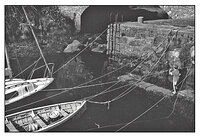
Baking soda gave me better results than borax. I do need to wipe after the stab though. I generally will unspool from reel and use thumb under running water to wash off the remaining remjet. I found that borax makes the photos a bit more grainy for some reason.
 
I just tried my ECN-2 prebath mixed according to Kodak's specs (water, borax, sodium sulfate, sodium hydroxide) and it would appear it took off all the remjet effortlessly. The negs are still drying but I didn't see any remjet on them at all, though a wipe down with a Pec Pad after coming out of the tank revealed a bit of black water. I can't imagine it being any easier than this.

This is exactly how it works for me, using QWDs prebath. Only soak it for 10 seconds, quickly dump it, then refill with 100F water 5 times, shaking as hard as you can for 10 seconds each time. The first 2 dumpings are always dark purple to black. Leaves zero residue on my 2 Paterson plastic reels (the only ones I use for ECN-2).
 
Great thread, but it could use more content and less dementia.

Well, if the skeptics in the thread would have participated in the postcard exchange, they might have already helped themselves. My contribution this round was 6 different images, all Vision3 250D, optically printed to Crystal Archive color paper, distributed over the 15 cards I sent out.
 
The great advantage of the Kodak formula is that it is reusable. For me, after some use, a sediment begins to form, but I filter and continue to use. Works well :smile:
 

Gotcha. That'll work better than with what I'm doing I'd bet.

Foul Balls

View attachment 343639

Vivitar 35ES 'Auto' mode @ ISO 320; 1/250s
Vision3 250D; ECN-2

Great thread, but it could use more content and less dementia.

This has been a pretty good thread until the last few pages. Talk and write all you'd like about photography but the photos are what matter.
 
Photrio.com contains affiliate links to products. We may receive a commission for purchases made through these links.
To read our full affiliate disclosure statement please click Here.

PHOTRIO PARTNERS EQUALLY FUNDING OUR COMMUNITY:


Ilford ADOX Freestyle Photographic Stearman Press Weldon Color Lab Blue Moon Camera & Machine
Top Bottom