

..I've used an RB 67 for stereo photography - moving the camera between two very distant points to produce a pair of images. Baselength was about 30 feet, and the '3d' effect was apparent even at great distances.
I can do cross-eye with almost any size image; for parallel, I can only free-view if the images are closer, center to center, than about 65 mm (my interpupillary distance is 67mm and change).
..I've used an RB 67 for stereo photography - moving the camera between two very distant points to produce a pair of images. Baselength was about 30 feet, and the '3d' effect was apparent even at great distances.
I've owned two vintage 1920's Heidoscops, and made images with one of them. Pretty fiddly but they have their moments. Film holders/sheaths tend to be problematic.
I tried this a long time ago with two Ikoflex' tlr's mounted on an aluminum bar to a tripod. It was a rigid setup and worked well for a few irreplaceable portraits of my mom and brothers. Due to the wider distance between the two taking lenses, a guy on the old RUG pointed out that these were "hyper stereo" images better suited to distant subjects.
Well, but how hard is to find those "eyeglases" that you put in front of your eyes to see stereo images. I've seen on the internet stuff like that, but is there any for 6 x 9 format or larger?
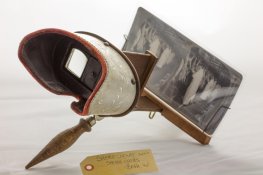
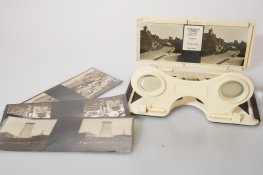
I think you are asking whether there are any viewers for looking at 6x9 cm transparencies? I don't think so. AFAIK, the slide viewers stop at 6x6 size. Of course you can make stereo images with cameras that shoot 6x9, but you would have to make prints of the images for viewing with one of the viewers such as those in the photo you posted, or view the images on a screen with such a viewer (I use the OWL viewer from London Stereoscopic Company, which has a removable back plate and can be used to look at online images on a phone or tablet, as well as small prints.)
Hi Alan. You need to choose a static subject without a stereo camera. Take a photo. Move the camera about 72mm left or right in the plane of the film and take another photo. This works if the closest object is about 2-3 m away. For longer distances, space the two camera positions proportionally wider (hyperstereo--wider than eye spacing). Scan the two images and make jpegs. For your TV, you will need to use some software utility that converts two jpgs. into a .mpo file. 3D stereo photomaker is a popular one for PC. You can probably get better advice on the digital aspect in one of the digital forums.
Yes, Alan stated that he has the active 3D glasses. Those 3D TVs use a system whereby they rapidly alternate the display between left and right views. The active 3D glasses contain LCD shutters that go transparent alternately between left and right in sync with the display.
Hi Alan. You need to choose a static subject without a stereo camera. Take a photo. Move the camera about 72mm left or right in the plane of the film and take another photo. This works if the closest object is about 2-3 m away. For longer distances, space the two camera positions proportionally wider (hyperstereo--wider than eye spacing). Scan the two images and make jpegs. For your TV, you will need to use some software utility that converts two jpgs. into a .mpo file. 3D stereo photomaker is a popular one for PC. You can probably get better advice on the digital aspect in one of the digital forums.
You need the TV to be able to display 3D. I believe most manufacturers have stopped making them. We got our a few years ago. It was the last year Sony made 3D I believe. But you could Google it as they may be available in the aftermarket. The TV plays regular as well. YOuTube has some interesting 3D videos from riding on roller coasters to a rafting trip down the rapids in the Grand Canyon which was pretty terrific.
Yes, Alan stated that he has the active 3D glasses. Those 3D TVs use a system whereby they rapidly alternate the display between left and right views. The active 3D glasses contain LCD shutters that go transparent alternately between left and right in sync with the display.
You need the TV to be able to display 3D. I believe most manufacturers have stopped making them. We got our a few years ago. It was the last year Sony made 3D I believe. But you could Google it as they may be available in the aftermarket. The TV plays regular as well. YOuTube has some interesting 3D videos from riding on roller coasters to a rafting trip down the rapids in the Grand Canyon which was pretty terrific.
I watch a fellow make hyper 3D images in Yosemite. Two hassies about 30 feet apart. He tossed a rock into the air, and when it hit both he and his assistant would fire the cameras. I like the simplity. He enlarged the negatives, put the prints on the wall. and made a hand-held viewer to look at them from several feet away.
Photrio.com contains affiliate links to products. We may receive a commission for purchases made through these links. To read our full affiliate disclosure statement please click Here.