Thomas Bertilsson
Member
Why not keep the tank in a tempering bath on the tray heater?
Not a bad idea. But it's easier to control the water bath temp by adding a smidgeon of hot water every two minutes. I've tried it.
Thanks!
Why not keep the tank in a tempering bath on the tray heater?
Perhaps. But it may be the TMY is a red herring. Different films and all. The most common cause of uneven development is agitation. I think that's where you should look. It could be that the presoak+ your initial agitation is causing trouble. Good luck! These problems can be vexing.

I hear you. But I just can't believe that this particular brick of film can be so radically different from every other film I've tried. It just doesn't add up.
Over a thousand rolls and virtually no issues, and then one brick where all rolls have a problem?
Fp4+, Pan-F+, Delta 100, Delta 400, Delta 3200, Plus-X, Tri-X, TMY-2, TMX, TMZ, Acros, Neopan 400, Foma 100, 200, and 400, even HP5+ in 35mm, and some Ektapan sheets.
In all sorts of developers.
And now this, with an entire brick, in Edwal 12, Xtol, and D76. In different film backs.
This isn't freaking rocket science. I make sure the temp is right by presoaking the film (worked with EVERY OTHER FILM I tried), agitate the way I have always done to avoid uneven densities, use a good repeatable process.
So, I brought the camera with me to work, and I will stop on the way home to run a roll of HP5+ through it, and also a roll of TMY-2.
Then I'll develop without presoaking and see what happens. I will change only one variable.

Cool thread and quite a mystery!
One question that sprung to mind is whether the two patchy negs posted came from the same roll, or two different rolls?
If they came from different rolls, I would guess that this particular set of rolls were faulty.
The pattern of patchyness is more or less the same in the two frames.
I assume that it would be less likely that two separate runs, albeit glitchy, would produce identical patterns of uneveness?
They are from two different rolls of film.

Then I would blame the film, because of the consistent pattern. Probably pre-purchase storage then, unless the rolls were taken from the same swatch of film in the factory? But that should have been picked up in quality control?
On a slight sidenote, I just discovered that Ilford Delta 400 doesn't agree with my standard process at all (agitated presoak, XTOL 1:1 mild agitation, water stop wash, TMAX fixer, wash and soak, Photo Flo). It works for virtually every other film I have tried but the Deltas all look bad. The flaws are not consistent however. Different rolls look different kinds of bad (patchy, foggy, grainy...). I have also tried slight variants (more agiation, acid stop, Ilford Fix) but to little avail.
Rather than changing chemicals and re-working my process, I'm ditching Delta and sticking with the films that work for me.
Have you tried omitting the pre-soak??
Does overdeveloping make the neg thicker or thinner? If so, then wouldn't the overdeveloped part be thicker (and thus darker) than the underdeveloped parts? Thinking about temperature changes too.
Yes, but remember the water in is WATER, not developer, so it would dilute the outer areas while the center would stay at strength for a bit until it fully mixed because there's more flow around the edges than in between the tight spaces of spiraled films. That would also explain why the 35mm was ok, less surface area enclosing and restricting the flow.
This is all theoretical speculation.
Visual inspection after film wash is good.
It's from a different batch of film, and I used exactly the same procedure as last time to start out, with 2 min presoak, just to see if just getting film from a different batch made a difference, and it appears that it did.
First thing tomorrow morning I will do a test scan to confirm.
My early conclusion is that I had a batch of ten rolls where somehow ALL of the rolls showed the same problem. And at the same time those ten rolls represent the sum total of all the rolls I've had issues with in the last few years and roughly a thousand rolls of film.
Very strange indeed, and one hell of a coincidence if it was anything other than the film.
I was thinking of one other thing, maybe HP5+ is more sensitive to temperature differences? Maybe pouring in the hotter temp water hits parts of the emulsion first before it's fully blended, and that causes the film that's been hit with the warmer water to react to developer differently than the cooler areas of the film.
Especially since it appears the center of the film (where more concentrated dev would be) is darker while the edges (where more dilute and hotter water would initially hot the film before mixing) causing the difference?
I know that probably came our jumbled, it makes sense in my head.
Just a thought.
I Was told the story of how Fay Godwin had the same problem when she used FP4 film. She always pre-soaked her films, but kept getting uneven processing marks on her films. It got to a stage where she had a back log of undeveloped films that she was reluctant to process because of this problem.My method of developing HP5+ is:
2 minute pre-soak
13 minutes in D76 1+1, agitation first minute, then three inversions every minute.
30s indicator stop bath
6 minute Ilford Hypam fix
Wash 25 minutes in film washer
Sprint End Run wash aid
Hang to dry
The film has not been through airport X-rays, has been stored in a 50*F basement, and is well within date (expiration 2015).
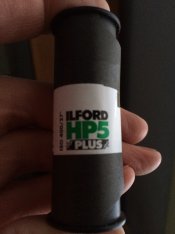
Has anybody else experienced this with 120 HP5+ roll film lately?
I have another fresh brick of HP5+ 120 that I will try out when there's an open blue sky around to see if it persists or if it was a fluke.
Dear Thomas,
I am very sorry you have experienced a problem with an ILFORD Photo product.
I have read through the thread and it seems very odd to say the least.
You frequently need to 'look' into the emulsion layer ( with an electron microscope ) to identify a 'true' film performance issue, typically and very usually they are 'process' related as opposed to a manufacturing issue but if you return the film to us we will do this check, and others, and if a fault exists with the film it will of course be identified, explained to you and replaced.
We have no current QC issues outstanding on any HP5+ film product as of todays monthly log.
An interesting sub note is that you have a brick of ten films 'affected' this would immediately tell us certain things, a full 120 slitting 610m long is made into 120 film, after slitting they are placed in large light proof cassettes and transferred to the 120 finishing machine, we would typically finish many of these actual slitting cassettes at one manufacture, each slitting made into 120 film from each cassette has the first and and last films removed and processed ( this is after the parent roll itself has had its own QC procedures and passed before being released for finishing ) so if you had a fault in any single slitting it could be identified ( and we can post manufacture identify any single 120 slitting ) as the slittings are finished they go into a production tub, so they are effectively 'mixed' they then go into the foiling section when again they are 'mixed' and then a final time they are 'mixed' before being shrink wrapped into the 10 pack, so, it is highly unusual to have 10 films from the same slitting in the same brick, whilst they would most likely ( but not exclusively ) come from the same parent roll. It tells us what ? to have a manufacturing fault in one slitting would be incredibly rare, to have a fault across two would statistically very small, to have a a fault affecting each 120 roll in each slitting would be infintesimily small.
Thank you for buying, using and valuing ILFORD Photo products.
Simon ILFORD Photo / HARMAN technology Limited :
| Photrio.com contains affiliate links to products. We may receive a commission for purchases made through these links. To read our full affiliate disclosure statement please click Here. |
PHOTRIO PARTNERS EQUALLY FUNDING OUR COMMUNITY: ![]() |