

• Welcome to Photrio!
    Registration is fast and free. Join today to unlock search, see fewer ads, and access all forum features.
    Click here to sign up

Help with Kodak RA4 Chemistry

Sunk

H
Sunk

  • 2
  • 0
  • 30

Forum statistics

Threads
201,227
Messages
2,820,785
Members
100,600
Latest member
qoolpix
Recent bookmarks
0

arespencer

Member
Allowing Ads
Joined
Nov 27, 2025
Messages
41
Location
California
Format
Medium Format
I'm having a bit of trouble understanding for certain some parts of RA4 chemistry and I'm hoping some of you could give me some clarity on some questions. Doesn't seem like there are much super clear "instructions" out there.

I ended up ordering Kodak Color Print SP (single part) Developer Replenisher, SP Developer Starter, and SP Bleach Fix Replenisher.

There doesn't seem to be a clear explanation on the difference between single part and the "regular" chemicals where you mix parts A, B and C. From what I could find they are essentially the same but the SP just comes pre mixed. How are these different (aside from the mixing/pre mixed), are there any quality, lifetime or usage differences between them? I went with Single Part since it seemed better for someone working as a home printer (working with drums) and simplicity seemed like the best route for me right now.

I originally had some confusion on developer replenisher and developer starter but have figured out that they are both needed to make a batch of chemicals to develop prints with (along with water). Speaking of water when I mix my chemicals can I use tap water or do I need to use distilled water? I feel like I've seen comments from people online that have said that starter isn't needed when processing in drums. Can anyone clear up these chemicals?


Mixing a batch of chemicals

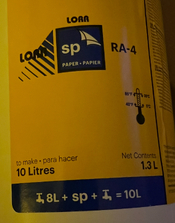
On the bottle of the developer replenisher the little instructions they give you at the bottom goes like this, Icon of a spigot with 8L next to it + sp + spigot icon = 10L. I'm assuming the spigot means water and sp is referencing the bottle of developer replenisher which is 1.3 L in volume. So would this mean I'm taking 8 liters of water, adding the entire 1.3 L bottle of replenisher and then adding an additional 0.7 liters of water to get to the final 10 liters? Why wouldn't they just say mix 8.7 liters of water and this entire 1.3 liter bottle of chemicals? Do you need to mix everything in these steps and adding the final 0.7 L of water at the very end? Or does the second spigot represent something else?

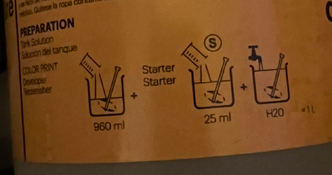
On the Developer Starter bottle it looks like it gives you instructions for mixing 1 L of chemicals. The first part says developer replenisher 960 ml. I'm assuming this is 960ml of the replenisher that has already been mixed with water (and whatever else). Then says + starter starter 25ml and then H20 without a measurement. So am I just adding 15 ml of water during this process?

Since I only need 25 ml of starter to mix 1 L of developing chemicals how long is this bottle of starter good for after I open it? I do a decent amount of printing but still think it would take me a while to go through a 1 L bottle of starter at this rate. Also topping off with 15ml of water seems silly but who am I to argue science.

I have the same longevity question for the mixed replenisher. 1 bottle will mix 10 L. If I'm busy with projects this could take me about a month to go through (in drums). During slower times it could be a few months. How long is this good for once it's mixed?


I'm just about ready to go for my first trial run. Just waiting on a few last items to arrive so I'm excited to get my darkroom rolling after building and buying all the stuff I need. I'm in the process of building out the ultimate drum processing darkroom in my garage. Multiple jobo tanks, Arkay print dryer, starting with a beseler drum roller (will upgrade to a jobo if needed but seems unnecessary). Excited to get everything rolling so thanks for your help in this process.


Side question so I don't need to start another thread - What is the best method or product for washing prints? I've heard the Kodak siphon is a really nice way to go and saw catlabs has remade one but just wanted to get peoples thoughts on the best option for this.
 

Attachments

  • IMG_5554.jpg
    IMG_5554.jpg
    554.2 KB · Views: 9
  • IMG_5556.jpg
    IMG_5556.jpg
    1.5 MB · Views: 10

koraks

Moderator
Moderator
Joined
Nov 29, 2018
Messages
26,117
Location
Europe
Format
Multi Format
are there any quality, lifetime or usage differences between them?
That really depends; there are no hard & fast rules. A single-part concentrate may have a shorter shelf life than a multi-part concentrate. But some single-part concentrates these are so good that they may even outperform the multi-part concentrates in this regard. Single part may be more voluminous (more water needed to make the concentrate), so it may end up taking a little more shelf space, but that's not really relevant for the end user most of the time.
Overall a single part is indeed easier/more straightforward to use.

Speaking of water when I mix my chemicals can I use tap water or do I need to use distilled water?
Tap water is fine. Commercial developer & blix concentrates are specifically formulated to perform well with regular tap water.

I feel like I've seen comments from people online that have said that starter isn't needed when processing in drums.
This is incorrect and anyone who says this really is just plain wrong. To make a working strength developer using a developer replenisher concentrate, you also need a starter. However, there are also developers aimed at home users, like the ADOX RA4 chemistry, that make a working strength developer as-is; these are not intended (and cannot really be used) as a replenisher, so it's really a different product. If you have a developer replenisher, you also need to use the starter.

There is one way of getting out of using the starter, and that's by making a working strength replenisher, diluting it a bit and then seasoning it by running a lot of paper through it. However, it's very uneconomical and imprecise and I don't recommend this approach especially if you're going to use your developer one-shot, as I expect you're aiming for.

Icon of a spigot
That icon represents a regular tap as you'll find above your kitchen sink etc.; i.e. it signifies that regular tap water is fine to use here.

So would this mean I'm taking 8 liters of water, adding the entire 1.3 L bottle of replenisher and then adding an additional 0.7 liters of water to get to the final 10 liters?
That's correct.

Why wouldn't they just say mix 8.7 liters of water and this entire 1.3 liter bottle of chemicals?
That will work too, but it's common/best practice in chemistry to mix a liquid initially to a lower volume than targeted and then topping up to the desired final volume. This is because it's easier /more reliable this way to get to *exactly* the required end volume. However, since the degree of exactness required here isn't so strict (deviating let's say up to 5% won't make much of a difference), your approach of 8.7 water + 1.3 replenisher concentrate will work fine, too.

I'm assuming this is 960ml of the replenisher that has already been mixed with water
Correct.

Then says + starter starter 25ml and then H20 without a measurement.
There is a final volume stated: 1l (=1000ml). So again, you take 960ml mixed replenisher, add 25ml of starter, then top up with water to make 1000ml.

So am I just adding 15 ml of water during this process?
Yes, and of course, the 15ml is such a small percentage of the 1000ml final volume that it's not very consequential.

how long is this bottle of starter good for after I open it?
Starter generally has an indefinite shelf life even when opened. It's really a fairly weak solution of sodium bromide and/or sodium chloride, which is stable.

How long is this good for once it's mixed?
It will likely survive a month (easily) provided you store the developer in entirely full bottles/containers with no air on top and the containers are of a non-permeable material. I generally use PET soda bottles.

What is the best method or product for washing prints?
Water. It doesn't matter how you do it, and since color paper is RC paper it doesn't require a very extensive wash anyway. I always just wash my prints in trays with a couple of changes of water. I dump the freshly developed prints into a holding tray and then periodically wash the prints in e.g. 3 changes of water, a few minutes per bath, with more or less constant agitation. It doesn't take a whole lot of water either. A tray siphon will work fine, too.
 

mshchem

Subscriber
Allowing Ads
Joined
Nov 26, 2007
Messages
15,685
Location
Iowa City, Iowa USA
Format
Medium Format
I'm having a bit of trouble understanding for certain some parts of RA4 chemistry and I'm hoping some of you could give me some clarity on some questions. Doesn't seem like there are much super clear "instructions" out there.

I ended up ordering Kodak Color Print SP (single part) Developer Replenisher, SP Developer Starter, and SP Bleach Fix Replenisher.

There doesn't seem to be a clear explanation on the difference between single part and the "regular" chemicals where you mix parts A, B and C. From what I could find they are essentially the same but the SP just comes pre mixed. How are these different (aside from the mixing/pre mixed), are there any quality, lifetime or usage differences between them? I went with Single Part since it seemed better for someone working as a home printer (working with drums) and simplicity seemed like the best route for me right now.

I originally had some confusion on developer replenisher and developer starter but have figured out that they are both needed to make a batch of chemicals to develop prints with (along with water). Speaking of water when I mix my chemicals can I use tap water or do I need to use distilled water? I feel like I've seen comments from people online that have said that starter isn't needed when processing in drums. Can anyone clear up these chemicals?


Mixing a batch of chemicals

On the bottle of the developer replenisher the little instructions they give you at the bottom goes like this, Icon of a spigot with 8L next to it + sp + spigot icon = 10L. I'm assuming the spigot means water and sp is referencing the bottle of developer replenisher which is 1.3 L in volume. So would this mean I'm taking 8 liters of water, adding the entire 1.3 L bottle of replenisher and then adding an additional 0.7 liters of water to get to the final 10 liters? Why wouldn't they just say mix 8.7 liters of water and this entire 1.3 liter bottle of chemicals? Do you need to mix everything in these steps and adding the final 0.7 L of water at the very end? Or does the second spigot represent something else?

On the Developer Starter bottle it looks like it gives you instructions for mixing 1 L of chemicals. The first part says developer replenisher 960 ml. I'm assuming this is 960ml of the replenisher that has already been mixed with water (and whatever else). Then says + starter starter 25ml and then H20 without a measurement. So am I just adding 15 ml of water during this process?

Since I only need 25 ml of starter to mix 1 L of developing chemicals how long is this bottle of starter good for after I open it? I do a decent amount of printing but still think it would take me a while to go through a 1 L bottle of starter at this rate. Also topping off with 15ml of water seems silly but who am I to argue science.

I have the same longevity question for the mixed replenisher. 1 bottle will mix 10 L. If I'm busy with projects this could take me about a month to go through (in drums). During slower times it could be a few months. How long is this good for once it's mixed?


I'm just about ready to go for my first trial run. Just waiting on a few last items to arrive so I'm excited to get my darkroom rolling after building and buying all the stuff I need. I'm in the process of building out the ultimate drum processing darkroom in my garage. Multiple jobo tanks, Arkay print dryer, starting with a beseler drum roller (will upgrade to a jobo if needed but seems unnecessary). Excited to get everything rolling so thanks for your help in this process.


Side question so I don't need to start another thread - What is the best method or product for washing prints? I've heard the Kodak siphon is a really nice way to go and saw catlabs has remade one but just wanted to get peoples thoughts on the best option for this.

Well you're asking a lot of questions here.

So yes the picture of a spigot (or sill cock?) Indicates good quality tap water. 1.3 liter bottle of SP is first diluted to a total volume of 10 liters. This is developer replenisher. To make working developer (referred to as "tank solution") you take specified amount of replenisher add specified amount of starter and dilute to 1 liter.
Once open the starter will last for years, just keep it at room temperature (70 F)

What needs to be kept in always full bottles is the replenisher and the tank solutions.

Back in the ancient times people used 1 gallon tanks with floating lids and print baskets.

Kodak print washing syphon is quite good for 1950's practice of washing several smaller prints (black and white) fiber base paper for extended periods think 30 to 90 minutes.

Just use a tray place your blixed print in the tray and wash with warm water for 1 to 2 minutes. Not longer.
 

mshchem

Subscriber
Allowing Ads
Joined
Nov 26, 2007
Messages
15,685
Location
Iowa City, Iowa USA
Format
Medium Format
That really depends; there are no hard & fast rules. A single-part concentrate may have a shorter shelf life than a multi-part concentrate. But some single-part concentrates these are so good that they may even outperform the multi-part concentrates in this regard. Single part may be more voluminous (more water needed to make the concentrate), so it may end up taking a little more shelf space, but that's not really relevant for the end user most of the time.
Overall a single part is indeed easier/more straightforward to use.


Tap water is fine. Commercial developer & blix concentrates are specifically formulated to perform well with regular tap water.


This is incorrect and anyone who says this really is just plain wrong. To make a working strength developer using a developer replenisher concentrate, you also need a starter. However, there are also developers aimed at home users, like the ADOX RA4 chemistry, that make a working strength developer as-is; these are not intended (and cannot really be used) as a replenisher, so it's really a different product. If you have a developer replenisher, you also need to use the starter.

There is one way of getting out of using the starter, and that's by making a working strength replenisher, diluting it a bit and then seasoning it by running a lot of paper through it. However, it's very uneconomical and imprecise and I don't recommend this approach especially if you're going to use your developer one-shot, as I expect you're aiming for.


That icon represents a regular tap as you'll find above your kitchen sink etc.; i.e. it signifies that regular tap water is fine to use here.


That's correct.


That will work too, but it's common/best practice in chemistry to mix a liquid initially to a lower volume than targeted and then topping up to the desired final volume. This is because it's easier /more reliable this way to get to *exactly* the required end volume. However, since the degree of exactness required here isn't so strict (deviating let's say up to 5% won't make much of a difference), your approach of 8.7 water + 1.3 replenisher concentrate will work fine, too.


Correct.


There is a final volume stated: 1l (=1000ml). So again, you take 960ml mixed replenisher, add 25ml of starter, then top up with water to make 1000ml.


Yes, and of course, the 15ml is such a small percentage of the 1000ml final volume that it's not very consequential.


Starter generally has an indefinite shelf life even when opened. It's really a fairly weak solution of sodium bromide and/or sodium chloride, which is stable.


It will likely survive a month (easily) provided you store the developer in entirely full bottles/containers with no air on top and the containers are of a non-permeable material. I generally use PET soda bottles.


Water. It doesn't matter how you do it, and since color paper is RC paper it doesn't require a very extensive wash anyway. I always just wash my prints in trays with a couple of changes of water. I dump the freshly developed prints into a holding tray and then periodically wash the prints in e.g. 3 changes of water, a few minutes per bath, with more or less constant agitation. It doesn't take a whole lot of water either. A tray siphon will work fine, too.

All good information here from Koraks. Starter is desperately important when using drums. Probably more than other methods that are replenished.
 

koraks

Moderator
Moderator
Joined
Nov 29, 2018
Messages
26,117
Location
Europe
Format
Multi Format
Starter is desperately important when using drums. Probably more than other methods that are replenished.

There's no difference in the requirement of a starter between development/processing methods. The determinant is the chemistry itself; if this comes as a developer replenisher, then a starter is *always* needed to make the initial tank volume.
 

mshchem

Subscriber
Allowing Ads
Joined
Nov 26, 2007
Messages
15,685
Location
Iowa City, Iowa USA
Format
Medium Format
Longer washing is totally fine and will not harm the prints in any way. It's better to wash a little longer esp. because the blix washes out with some difficulty.

Baloney. Use warm water. I'm following the instructions from The Great Yellow Father, Eastman Kodak the ones that invented the stuff. I wash with 95 F water
 

mshchem

Subscriber
Allowing Ads
Joined
Nov 26, 2007
Messages
15,685
Location
Iowa City, Iowa USA
Format
Medium Format
There's no difference in the requirement of a starter between development/processing methods. The determinant is the chemistry itself; if this comes as a developer replenisher, then a starter is *always* needed to make the initial tank volume.

I understand that completely. But eventually you will slow down a replenished system from halides. Using straight replenisher without starter in a tube, it will fog the print. Brown cast.
 

koraks

Moderator
Moderator
Joined
Nov 29, 2018
Messages
26,117
Location
Europe
Format
Multi Format
I understand that completely. But eventually you will slow down a replenished system from halides. Using straight replenisher without starter in a tube, it will fog the print. Brown cast.
I'm not sure what you're saying here.
A replenishment system is simple: you start with an initial tank system that's made with the starter. For replenishment, you use the replenisher that has no starter added to it. Provided replenishment is done at the correct rate w.r.t. the surface area of paper processed, halide buildup will not be a problem.

I'd rather not rely on manufacturing for engineering development.
With all due respect, you have no clue who I've been talking to or what their backgrounds are. These people are chemical engineers deeply involved in quality control of both the product and the application; i.e. they are intimately aware of actual processing lines and processing parameters and are engaged in optimization and troubleshooting on a daily basis. The people I received my information from are probably part of a tiny handful of people on this planet who are best positioned in terms of both theoretical and practical knowledge on this subject.
 

mshchem

Subscriber
Allowing Ads
Joined
Nov 26, 2007
Messages
15,685
Location
Iowa City, Iowa USA
Format
Medium Format
Blix washes out fine in warm water. Minilabs use 3 concurrent 30 second bathes in final rinse which is plenty to remove the blix.

When I use the, still best processor ever made Kodak, Rapid Color processor, 45 seconds developer, 45 seconds blix, the 3 30 second washes right on the machine. Laminar flow, absolutely perfect temperature control and repeatable agitation. All held at 95 F +/- 1/2 F.
 

koraks

Moderator
Moderator
Joined
Nov 29, 2018
Messages
26,117
Location
Europe
Format
Multi Format
Minilabs use 3 concurrent 30 second bathes in final rinse which is plenty to remove the blix.
No, not 'plenty'; the wash step in a typical minilab is marginal and for some papers like Maxima entirely insufficient. The latter is part of the reason why Maxima only comes in longer rolls than those that will go into a minilab since both blix and wash are insufficient in the machine to properly process the paper, leaving prints with severely reduced lifetime. You can deduce from this that also for papers like DPII etc. a minilab wash is a marginal affair.
Temperature control for the wash step is irrelevant.
You can wash fine at lower temperature as long as the wash time is extended. At a higher temperature, wash can also be extended as there is no risk of washing out something that should remain in the paper.
Arguably a laminar flow is NOT what you want for a wash as it means you end up with a thin layer of highly contaminated water hugging the print; fortunately in practice the flow will NOT be perfectly laminar so don't worry about it!
A wash procedure of "3x 30sec" is technically speaking insufficiently specified; a wash procedure might be characterized as e.g. 250ml/m2 for 90 sec. at 35C. This btw is a (minimum) target I received directly from a Fuji engineer (BSc chemistry, 35+ years working experience in color paper & film manufacturing + processing) for the actual product as sold today and used by us all.

When introduced.
Again, with all due respect - this is 2025.
 

mshchem

Subscriber
Allowing Ads
Joined
Nov 26, 2007
Messages
15,685
Location
Iowa City, Iowa USA
Format
Medium Format
No, not 'plenty'; the wash step in a typical minilab is marginal and for some papers like Maxima entirely insufficient. The latter is part of the reason why Maxima only comes in longer rolls than those that will go into a minilab since both blix and wash are insufficient in the machine to properly process the paper, leaving prints with severely reduced lifetime. You can deduce from this that also for papers like DPII etc. a minilab wash is a marginal affair.
Temperature control for the wash step is irrelevant.
You can wash fine at lower temperature as long as the wash time is extended. At a higher temperature, wash can also be extended as there is no risk of washing out something that should remain in the paper.
Arguably a laminar flow is NOT what you want for a wash as it means you end up with a thin layer of highly contaminated water hugging the print; fortunately in practice the flow will NOT be perfectly laminar so don't worry about it!
A wash procedure of "3x 30sec" is technically speaking insufficiently specified; a wash procedure might be characterized as e.g. 250ml/m2 for 90 sec. at 35C. This btw is a (minimum) target I received directly from a Fuji engineer (BSc chemistry, 35+ years working experience in color paper & film manufacturing + processing) for the actual product as sold today and used by us all.


Again, with all due respect - this is 2025.

Who other than Drew has access to Maxima? This paper is designed to be used for commercial displays and huge prints. Come on now. I have a BS bachelor's in chemistry and started when I was 14 now I'm 69 holy cow!

The huge width fits nicely in the monstrous printers that print, slice and stack.

Regarding laminar flow. It's never going to be in a tube! But paper floating on a constantly renewing, perfectly controlled layer of temperature controlled solution. This is how film is made.

Extended wash times equal liquid intrusion at the cut edges. Big deal for folks making individual prints. It's not a big problem. I have color prints I've made over the last decades still ok.

And 3 30 second washes is with copious amounts of water. I use mixing valves set at 95F and running water wash in a tray when using a Jobo, on the machine with my Kodak model 11 and 16k
 

mshchem

Subscriber
Allowing Ads
Joined
Nov 26, 2007
Messages
15,685
Location
Iowa City, Iowa USA
Format
Medium Format
BTW who is selling the starters for RA4? cinestill has Flexicolor for negative. It doesn't matter. Everyone does their own thing.
 
OP
OP

arespencer

Member
Allowing Ads
Joined
Nov 27, 2025
Messages
41
Location
California
Format
Medium Format
That really depends; there are no hard & fast rules. A single-part concentrate may have a shorter shelf life than a multi-part concentrate. But some single-part concentrates these are so good that they may even outperform the multi-part concentrates in this regard. Single part may be more voluminous (more water needed to make the concentrate), so it may end up taking a little more shelf space, but that's not really relevant for the end user most of the time.
Overall a single part is indeed easier/more straightforward to use.


Tap water is fine. Commercial developer & blix concentrates are specifically formulated to perform well with regular tap water.


This is incorrect and anyone who says this really is just plain wrong. To make a working strength developer using a developer replenisher concentrate, you also need a starter. However, there are also developers aimed at home users, like the ADOX RA4 chemistry, that make a working strength developer as-is; these are not intended (and cannot really be used) as a replenisher, so it's really a different product. If you have a developer replenisher, you also need to use the starter.

There is one way of getting out of using the starter, and that's by making a working strength replenisher, diluting it a bit and then seasoning it by running a lot of paper through it. However, it's very uneconomical and imprecise and I don't recommend this approach especially if you're going to use your developer one-shot, as I expect you're aiming for.


That icon represents a regular tap as you'll find above your kitchen sink etc.; i.e. it signifies that regular tap water is fine to use here.


That's correct.


That will work too, but it's common/best practice in chemistry to mix a liquid initially to a lower volume than targeted and then topping up to the desired final volume. This is because it's easier /more reliable this way to get to *exactly* the required end volume. However, since the degree of exactness required here isn't so strict (deviating let's say up to 5% won't make much of a difference), your approach of 8.7 water + 1.3 replenisher concentrate will work fine, too.


Correct.


There is a final volume stated: 1l (=1000ml). So again, you take 960ml mixed replenisher, add 25ml of starter, then top up with water to make 1000ml.


Yes, and of course, the 15ml is such a small percentage of the 1000ml final volume that it's not very consequential.


Starter generally has an indefinite shelf life even when opened. It's really a fairly weak solution of sodium bromide and/or sodium chloride, which is stable.


It will likely survive a month (easily) provided you store the developer in entirely full bottles/containers with no air on top and the containers are of a non-permeable material. I generally use PET soda bottles.


Water. It doesn't matter how you do it, and since color paper is RC paper it doesn't require a very extensive wash anyway. I always just wash my prints in trays with a couple of changes of water. I dump the freshly developed prints into a holding tray and then periodically wash the prints in e.g. 3 changes of water, a few minutes per bath, with more or less constant agitation. It doesn't take a whole lot of water either. A tray siphon will work fine, too.

Koraks to the rescue!! Thanks dude. For the washing does that final wash need to be done at the same temp I’m developing at (30°) or can this be done at tap water temp which might be fairly cold during the winter (California cold)?
 
OP
OP

arespencer

Member
Allowing Ads
Joined
Nov 27, 2025
Messages
41
Location
California
Format
Medium Format
Who other than Drew has access to Maxima? This paper is designed to be used for commercial displays and huge prints.

I ordered a pack of 12x16” cut sheets from rapid eye darkroom in London. Seems to be gone from their website now.


BTW who is selling the starters for RA4? cinestill has Flexicolor for negative. It doesn't matter. Everyone does their own thing.

I ordered my starter from Kodak Photo Systems website. I think I got the last box cause it said out of stock after I ordered it.

Kodak Starter


The way I was planning on washing prints was to do a 30 second wash in the drum with 30° water and then go into a tray for another 30-60 seconds with running water at tap water temp. I’m also printing on DPII. Does anyone see any problems with this way of washing?
 
OP
OP

arespencer

Member
Allowing Ads
Joined
Nov 27, 2025
Messages
41
Location
California
Format
Medium Format
Well you're asking a lot of questions here.

So yes the picture of a spigot (or sill cock?) Indicates good quality tap water. 1.3 liter bottle of SP is first diluted to a total volume of 10 liters. This is developer replenisher. To make working developer (referred to as "tank solution") you take specified amount of replenisher add specified amount of starter and dilute to 1 liter.
Once open the starter will last for years, just keep it at room temperature (70 F)

What needs to be kept in always full bottles is the replenisher and the tank solutions.

Back in the ancient times people used 1 gallon tanks with floating lids and print baskets.

Kodak print washing syphon is quite good for 1950's practice of washing several smaller prints (black and white) fiber base paper for extended periods think 30 to 90 minutes.

Just use a tray place your blixed print in the tray and wash with warm water for 1 to 2 minutes. Not longer.

Sure am, I had a fair amount of confusion because there’s really not a ton of clear information out there, or maybe I’m just dumb. But I tried my best to do as much research ahead of time and format my post in as clear, concise and organized way as possible. But I’ve been spending a lot of time and money building this darkroom and wanted some confirmations as to eliminate any mistakes and wasting chemicals.

My darkroom will only have tap running water and won’t be tempered. Is it important that my wash is done at developing temp? Was hoping to do a wash in the drum at 30° and then into a print washing tray at tap water then into a dryer.
 

mshchem

Subscriber
Allowing Ads
Joined
Nov 26, 2007
Messages
15,685
Location
Iowa City, Iowa USA
Format
Medium Format
I ordered a pack of 12x16” cut sheets from rapid eye darkroom in London. Seems to be gone from their website now.


I ordered my starter from Kodak Photo Systems website. I think I got the last box cause it said out of stock after I ordered it.

Kodak Starter


The way I was planning on washing prints was to do a 30 second wash in the drum with 30° water and then go into a tray for another 30-60 seconds with running water at tap water temp. I’m also printing on DPII. Does anyone see any problems with this way of washing?

Yes! Perfect. You have enough starter to sell individual bottles 😀 Cinestill is trying to sell case quantities of everything to push individuals into the kits. I use cut sheets from B&H DP2

 
Photrio.com contains affiliate links to products. We may receive a commission for purchases made through these links.
To read our full affiliate disclosure statement please click Here.

PHOTRIO PARTNERS EQUALLY FUNDING OUR COMMUNITY:


Ilford ADOX Freestyle Photographic Stearman Press Weldon Color Lab Blue Moon Camera & Machine
Top Bottom