



FILM Ferrania
Member
So, old developing times would carry forward?
That's a very good question. I will attempt to get a proper answer from the team.
So, old developing times would carry forward?


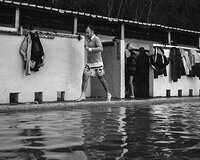
 File0046 by Ricardo Miranda, on Flickr
 File0025 by Ricardo Miranda, on Flickr
 File0006 by Ricardo Miranda, on Flickr

On my blog, I've collected a series of tests.
I start from the sensitometric analysis made by Diego from which you can clearly see that P30 has an effective sensibility from ISO 12 to 32*, a long way from the ISO 80 declared by the manufacturer.
Judging from the curves, the best compromise of gamma/contrast, for my taste, is obtained exposing at ISO 50 and this is what i've done.(...)
The best way (for my taste) for developing in D76 a P30 exposed at ISO 50, is treating it at 1+1 dilution for 13 minutes in continuous rotations (or 16 minutes if using intermittent agitation). Plus 1 minute of stop bath, 4 minutes of rapid fixing and washing the Ilford way.
(...)
It is not a film that you can develop in 3 minutes (...) if you use a strong (energetic) developer, you should dilute it in such a way to translate the development times to 8-9 minutes (minimum for this film, imo), or substitute such developer with a solvent developer. In short, the P30 suits a developer that develops deeply, not one that only develops in the surface. (...)
XTOL and HC110 do not go along well. Rodinal goes well only when used very diluted and in stand development. (...)
The film is weakly sensitive to the red; it resembles a quasi-orthocromatic film. (...) this defect is accentuated if the film is developed with a surface developer. (...)
In my opinion, but, note that this defect could be also a characteristic: Why would you buy a film like the P30 if it was a generic film? I buy other similar films if they cost half as much! Thus, from my point of view it is important that if a film positionates itself within the high-tier market, it should have its own characteristics. And "similar to orthochrome" is the main characteristic of the P30.
(...) tonal width is an excellent characteristic of P30 if exposed at ISO 50. (...) excellent acutance, despite using a solvent developer. Grain: I swear i tried hard to find it with a (grain) focuser, i almost couldn't bring it to focus under the enlarger.
I would like to see which kind of light was used for the supplied test that concludes that real ISO is 32. Due to the almost-orthochromatic sensitivity, if this test was done with tungsten light, of course the speed would suffer. I wouldn't be surprised if, on 'real life' under sunlight, the real speed was higher.
Still, in any case, an E.I. 50 film of 'excellent acutance' and superfine grain, and wide tonality, is something quite welcome for my taste!

So, P30 is not panchromatic?
We can perhaps say that it has reduced sensitivity to red

For the times used for the Jobo rotary processor be similar to a rondinax or should I use the -15% time from a spiral tank?
Thanks, @gioffry for your blog, this is what I was looking for before I develop my second roll.
For my experience, to develop P30 in spiral tank you must increase the time: +20/25%
Well done
Would you help me to translate this blog-post in English?Thanks for posting, and welcome to APUG! I wish my Italian was as good as your English, but very nice blog, and very nice results with the P30. My Italian is good enough I think I understand the high points, just need to re-read it slowly enough with a translator to understand the finer points. Nice job, thank you!


Would you help me to translate this blog-post in English?
In this way, all could understand it.
Thank you

Here's a few from my first roll of P30. Taken with a Nikon F (FTn) and 50/1.4 pre-AI and 35/2 AI lenses. These are scans of the negs, a close approximation of my straight prints at grade #2
Film rated at 80 ISO and developed in D76 full-strength for 9 mins, with 1 inversion per min.
I noticed a different "look" to the negs as soon as I hung them to dry, at least distinctive from what I usually see with Tri-X or HP5. Contact sheets showed relatively high contrast, but didn't necessarily seem to be under or over-exposed.
Personally, I like the look of this film. It seems really punchy, but in wet printing, I have been able to pull detail out of the highlights and hold back the shadows without them getting muddy. I'll try D-76 1:1 for the roll I just finished, then try shooting @ ISO 50 for the next one, as some here have recommended.

Indeed, seconded.Nice work, thanks for posting.
Here's a few from my first roll of P30. Taken with a Nikon F (FTn) and 50/1.4 pre-AI and 35/2 AI lenses. These are scans of the negs, a close approximation of my straight prints at grade #2
Film rated at 80 ISO and developed in D76 full-strength for 9 mins, with 1 inversion per min.
I noticed a different "look" to the negs as soon as I hung them to dry, at least distinctive from what I usually see with Tri-X or HP5. Contact sheets showed relatively high contrast, but didn't necessarily seem to be under or over-exposed.
Personally, I like the look of this film. It seems really punchy, but in wet printing, I have been able to pull detail out of the highlights and hold back the shadows without them getting muddy. I'll try D-76 1:1 for the roll I just finished, then try shooting @ ISO 50 for the next one, as some here have recommended.


Got my rolls yesterday! and of course it's raining and dull today. More waiting.. arrgggh
| Photrio.com contains affiliate links to products. We may receive a commission for purchases made through these links. To read our full affiliate disclosure statement please click Here. |
PHOTRIO PARTNERS EQUALLY FUNDING OUR COMMUNITY:  |