I knew I should have stayed out of this ...
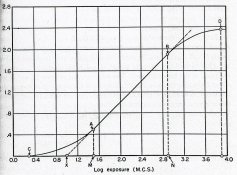
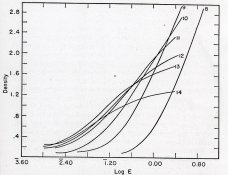
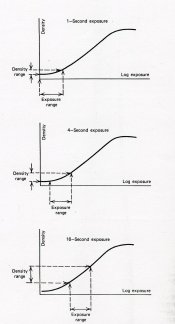
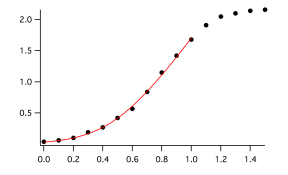
Unlike polynomial curve fitting (where a small section of a polynomial is forced to mimic a small section of data representing a sampling of physical data) the proper fit to the HD curve uses the equation that represents the underlying physics. It doesn't have to be bent to the task, it normally fulfills the task and fits the HD curve from 0 to infinite exposure.
The correct function is
not a bell curve. A bell curve (properly called a "normal distribution" or a "Gaussian distribution"
http://en.wikipedia.org/wiki/Normal_distribution)
does not fit an HD curve. As one is bell shaped and one is S shaped this is sort of obvious. Mangling the parameters of a bell curve so that half of it sort-of fits a portion of an HD curve is not the answer.
It is the
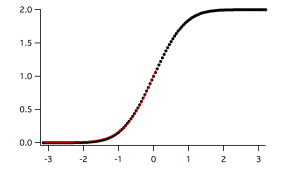
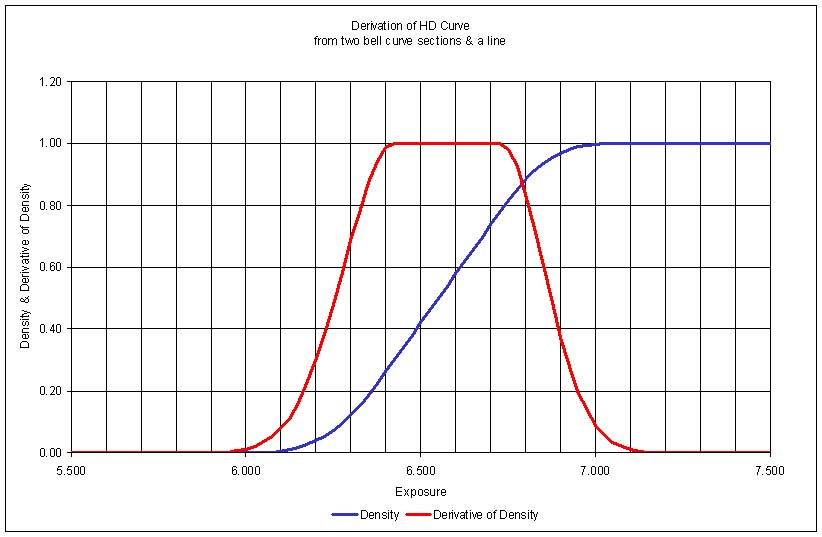
integral (summation, adding together) of the bell curve distribution that needs to be used - it gives the total number of silver grains that have been exposed as a function of the light exposure. The integral of a probability is called a "Cumulative Distribution Function" (cdf), which in the case of a bell/normal/Gaussian distribution is the "Error Function" (erf).
http://en.wikipedia.org/wiki/Error_function - please click on the link for the picture, it should look familiar...
The following is a very crude simplification: The bell curve gives the
probability that one more grains of silver will be exposed. In the toe region the probability increases with increasing amounts of exposure for rather obvious reasons: the more light shining on the film, the higher the chance a grain of silver will be activated. However, as the number of grains of exposed silver in the film increases the probability of light hitting an unexposed grain falls. After all the grains are exposed the probability of another grain getting exposed is zero (though, as we all know, probabilities never fall to zero, rather they become infinitely improbable).
So we have two sets of probabilities: one for the toe and one for the shoulder. There are several factors contributing to the physics at the toe region, but as a Gaussian function with a bit of a twiddle fits the data well enough it is what is commonly used for this part of the curve.
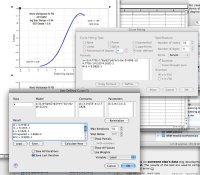
The integral of a Gaussian distribution - the “error function” or “erf” - can only be represented numerically. There is no closed form solution to the erf. Your math package may or may not include the erf even though it is a very common function in physics. An easy and universal method for calculating an HD curve is with a spread sheet and simple numerical integration. An Excel file is provided at
http://nolindan.com/UsenetStuff/GaussianHD.xls