
• Welcome to Photrio!
    Registration is fast and free. Join today to unlock search, see fewer ads, and access all forum features.
    Click here to sign up

Edible Film Developers

Angular building 6

A
Angular building 6

  • 2
  • 0
  • 12
Angular building 5

A
Angular building 5

  • 0
  • 0
  • 7

Recent Classifieds

Forum statistics

Threads
202,549
Messages
2,842,227
Members
101,379
Latest member
deckeda
Recent bookmarks
0
OK...so would it be the water on bottom with the sodium carbonate.....and is sodium carbonate NOT soluble in alcohol?


so perhaps I stumbled onto a way to separate water and alcohol....just dump a salt in there & skim the alcohol off the top?...could be a way to turbocharge the ol' moonshine
 
Last edited by a moderator:
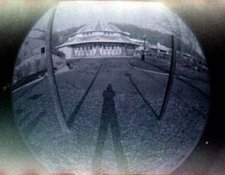
Blackberry/Blueberry developer

500ml of blueberry/blackberry goop + 3 tbsp sodium carbonate...

after 30 min faint images of bright objects


(by "goop" I mean I smashed...blended...squished...abused a bunch of berries...hardly any water added..this wasn't just juice from the store)
 
Last edited by a moderator:
tri-x developed 3 hours in Blackberry/blueberry developer 9 mostly blackberries)

B4-2-2-post1.jpg
 
Shallot onion developer works!!

smells bad, but it worked!!

after 3 hours there are nice images with a pleasant brown tint on the film

the images came out as POSITIVES!!!!?!?!?!?!!

looks like beautiful sepia slides!!!

how did THAT happen??????

330grams of chopped up shallot soaked in 600ml water/isopropyl alcohol for a week...then 4 tbsp sodium carbonate was added and Tri-X was developed for 3 hours....not really anything different than the other experiments, except it's a POSITIVE image

according to the all-knowing Google, Shallots contains allyl propyl disulphide (APDS).....is this compound at all related to sulfide sepia toners? is it acting like a fogging developer that somehow "ignores" the latent image?!?!??

WHAT caused the image to come out as positive??
 
Last edited by a moderator:
THAT is pretty cool ...
does it matter the variety ... supermarket californian, or mooseer ( persian ) ?
 
I read this thread with some bemusement - I limit myself to using our citrus orchard for lemon juice stop bath

Apart from that I love my toxic sludge, especially that layer of brown sticky stuff like Vegemite/Marmite on the bottom of my deep tanks of D76d, beautiful on toast for breakfast - Does anyone remember the book "Toxic Sludge is Good For You"? - Or was it a film, or is it toxic sludge between my ears?
 
Shallot onion developer works!!

smells bad, but it worked!!

after 3 hours there are nice images with a pleasant brown tint on the film

the images came out as POSITIVES!!!!?!?!?!?!!

looks like beautiful sepia slides!!!

how did THAT happen??????

330grams of chopped up shallot soaked in 600ml water/isopropyl alcohol for a week...then 4 tbsp sodium carbonate was added and Tri-X was developed for 3 hours....not really anything different than the other experiments, except it's a POSITIVE image

according to the all-knowing Google, Shallots contains allyl propyl disulphide (APDS).....is this compound at all related to sulfide sepia toners? is it acting like a fogging developer that somehow "ignores" the latent image?!?!??

WHAT caused the image to come out as positive??

maybe it is a positive because the fog darkened the base so much that the image ( underexposed ? ) reversed itself like an ambrotype/tintype ...
or when you severely underexpose film and tilt it when you look at it, it reverses itself.
 
maybe it is a positive because the fog darkened the base so much that the image ( underexposed ? ) reversed itself like an ambrotype/tintype ...
or when you severely underexpose film and tilt it when you look at it, it reverses itself.

it's not a reflection thing, if that's what you mean...I am viewing through the film -- and of course so did the scanner

one interesting things is that the part of the film that stuck out of the film cassette is the ONLY area that looks like it has a slight fog from a silver image -- the printing out PE explained to me a while ago -- in that region ONLY there is no sepia tone....in all other areas density seems to only be from the sepia tone ( I call it sepia tone for lack of a better term...whatever it is ) and not from a regular silver image

it's as if no silver got developed and density is only from this brown/sepia image...except on the teeny bit of film that only has "printing out" and no sepia

quite a puzzle..
 
hey...I'll have to try it on paper too

so now I gotta find out:

(1)...do I really need to add alcohol? I was assuming I needed it to help dissolve Quercetin from the shallot - but perhaps that's irrelevant now
(2)...do I really need to let this mess sit for a week ( like people do when making tinctures )

gonna go get more Shallots and try it again to make sure this wasn't just some bizarre fluke I can't repeat

...and also...how "archival" is this image anyway?
 
I started a separate thread for the shallot direct positive experiments...since figuring out how I got a positive image ( and learning of other methods ) is kind of a different animal than simply testing all these different natural developers

just got a supply of garlic to try that next.....
 
it's not a reflection thing, if that's what you mean...I am viewing through the film -- and of course so did the scanner

one interesting things is that the part of the film that stuck out of the film cassette is the ONLY area that looks like it has a slight fog from a silver image -- the printing out PE explained to me a while ago -- in that region ONLY there is no sepia tone....in all other areas density seems to only be from the sepia tone ( I call it sepia tone for lack of a better term...whatever it is ) and not from a regular silver image

it's as if no silver got developed and density is only from this brown/sepia image...except on the teeny bit of film that only has "printing out" and no sepia

quite a puzzle..


no i didn't really mean the reflection thing, but that type of positive image because of underdevelopment is what i mean ...
i was thinking that the main image was faint/under developed and the film got all dark all around it, so the image looks reversed.
i tried to do something like that with photo paper ...
i totally exposed and developed it so it was black,
then i coated it with liquid emulsion and attempted to get an under exposed /developed image on it
so it would "look" reversed but i think my liquid emulsion was bad/old so it didn't really work well ...

looking forward to part c :smile:
 
ah...I see what you mean

I wonder what I would learn by developing several strips of film in the same developer for different times to see what the images look like as the film develops
 
I started a separate thread for the shallot-bsed reversal experiments here:

(there was a url link here which no longer exists)
 
tested Vitamin B1 tonight ( aka thiamine mononitrate )

the bad news - it didn't work...the film is perfectly clear

the good news - my fixer isn't exhausted yet
 
testing vitamin B2 ( riboflavin ) right now

just did a clip test...not sure if anything got developed because I snipped off such a small bit of film, but the film has a wonderful yellow tint...

should know more in an hour or so
 
testing garlic tonight...after 1 hour just have streaks on the film....still have film in the garlic that will come out after 3 hours...
 
garlic developer after 2.75 hours gives no image with a subtle tone/fog

since I had a similar experience with shallot...I might have to try garlic soaked in water only w/o alcohol & see if that works
 
Last edited by a moderator:
D.E. this is superb, I just came across this thread via your other thread. It would be good if you could create a blog or site with all these experiments with all the formulas however successful or not in one place. Alas I have little to no idea as to what to look for in these developers etc, but have the desire for some mad experimentation though more with paper developers. Anyhow thanks for a riveting read.
 
Alex...I haven't done anything with paper yet...but I'm sure it would be a lot of fun with all the different tints you'd get on a print

actually...paper might be a lot easier to test since you'd see your results so quickly compared to film
 
Photrio.com contains affiliate links to products. We may receive a commission for purchases made through these links.
To read our full affiliate disclosure statement please click Here.

PHOTRIO PARTNERS EQUALLY FUNDING OUR COMMUNITY:


Ilford ADOX Freestyle Photographic Stearman Press Weldon Color Lab Blue Moon Camera & Machine
Top Bottom