• Welcome to Photrio!
    Registration is fast and free. Join today to unlock search, see fewer ads, and access all forum features.
    Click here to sign up

All things Chiba and Dichromate alternatives.

Ecstatic Roundabout

A
Ecstatic Roundabout

  • 0
  • 0
  • 24
MIT. 25:35

MIT. 25:35

  • 1
  • 0
  • 69

Recent Classifieds

Forum statistics

Threads
202,955
Messages
2,848,107
Members
101,553
Latest member
JasonGoh
Recent bookmarks
0
From the brief experience I had with hide glue and CHIBA process, it didn't need any O2 barrier. The hardening happened just fine. Habib Saidane in his myriad combinations of materials/process never uses one. So it must not be critical requirement. In theory, O2 is a quencher in a free radical reaction hence the caution in the original thesis paper.

:Niranjan.
 
Is there much evidence of CO2 bubbles from the citrate decarboxylation? I'm reminded of DAS forming nitrogen during carbon transfer.

When I spray or dunk the exposed tissue to H2O2 0.3% I do see tiny bubbles form on top of the emulsion. It doesn't seem to cause big visible spots on an image though. However, I also never used an agar agar cover.
 
From the brief experience I had with hide glue and CHIBA process, it didn't need any O2 barrier. The hardening happened just fine. Habib Saidane in his myriad combinations of materials/process never uses one. So it must not be critical requirement. In theory, O2 is a quencher in a free radical reaction hence the caution in the original thesis paper.

:Niranjan.

It might be related to the fact that Chiba as I recall explored alternatives for a transfer process; the direct pigment processes don't involve a transfer. I might not remember that bit correctly though.
 
Since this is an all things Chiba, I am happy to report that indeed Iota Carrageenan can be used in the process. Not only does it harden with Ferric Ammonium Citrate and Ferric Ammonium Oxalate like the other stuff but it seems like a great material for paper sizing. PVA bonds to it tenaciously and it bonds to paper tenaciously. I tried it on plastic...not very good, it wrinkles like it was 40 below outside and you just took a shower.

On other things I've been trying to extend the tonal range of PVA Chiba. Here is my latest successful step forward:
Pigment (yellow) 0.107g
5%PVA: 3g
FAO solid powder mass: 0.15g

That's it, that's the whole recipe! so far.
Expose between 4 and 10 minutes.
The resulting image doesn't continue to dissolve away easily. In fact you can try to remove most of it with a toothbrush and you won't succeed. The image will be ruined instantaneously with a toothbrush, but you'll have to try hard to remove that very last bit.
 
I just did my first layer using the carrageenan sizing on water color paper and the mix I mentioned on my previous post. I have a couple of extra things to mention. One is that the combination results in very much carbon-like image swelling/relief while wet. The other is about the FAO sensitizer. I've been adjusting it here and there, but the thing that seems to help the most so far is to not add citric acid and to increase the percentage of PVA. Citric Acid may help with Ferric Ammonium Citrate to make it closer to dichromate's speed, but with oxalate it decreases the tonal range. Either that, or I was putting way too much sensitizer in there in the first place. I will have to keep testing various combinations to really tell.
 
Your issue with citric acid might be related to what I once saw with sugar+starch. I have no idea on the underlying mechanism however.
With waxy maize starch, if sugar was also present in the emulsion, I observed the opposite of hardening. The exposed areas became easier to wash off. I did not manage to get proper images with this effect though.
 
I learned something today: McCormick Food Colors and Egg Dye, although it looks interesting for adding to your emulsion it seems to block UV or otherwise hinder the exposure. I got a very weak exposure using it. Once removed with all the quantities the same I got a good exposure. well on a 21 step stouffer I got step 4 solid color, 5,6,7,8 gradually reducing. The image was resistant to wash, which is good. The citric acid is back on the menu, the CMC is back.

Ideally 5-15%​
g​
g clear​
g​
g​
g​
ideally~20%​
ideally~20%​
s​
step# in wedge​
step# in wedge​
notes​
%pigment​
pigment​
PVA emulsion​
FAO​
Citric​
total mass​
$FAO-PVA​
$FAO solids​
exposure​
first shade​
Last shade​
11.69​
0.389​
2.948​
0.318​
0.062​
3.717​
17.75​
5.05​
4.00​
4.00​
8.00​
Emulsion 2parts 5% PVA, 2 parts 2% CMC and extra citric, no food dye only magenta 366 water color. Best combo so far.​
 
I'm going to try this ammonium persulfate recipe too: https://www.alternativeprocesses.org/post/the-chiba-system-a-safer-way-to-print-with-gum:

1773007184992.png
 
hmm, so this is the combination I used for that persulfate experiment:

1773364796128.png


It made a messy looking coating that was very unevenly coating. I exposed it but there was no image made at all after sprayed with dilute peroxide, it just did not dissolve but I brushed it off. I left the paint brush in it and forgot about it for a few days. Now I come back to a beaker that has a coating on the interior surfaces and a puddle of yellow chemical over it. I proceeded to wash my paint brush thinking it would just dissolve and nope.

It feels like rubber with a leathery texture. the yellow stuff was probably just FAO, APS, Citric just remaining there. anyway, this is relatively interesting because maybe there is something to be had from it. APS is supposed to have a slow dark reaction. maybe I just needed less of it. Maybe I don't need peroxide for this. I should give it a second try. if anything this could be a good sizing material maybe.
 
I still have the riboflavin itch. how does it work compared to ferric? well so far terribly to say the least. The best I've been able to come up with has bee a differential fluorescence... so the un exposed parts look different than the exposed parts under UV light. I'm using 385nm. Supposedly RF absorbs nearby at 372nm and low 400's. The latest mix 3 parts 5%PVA 1 part TEOA and .1part RF was a total failure. I expose one area for like 15 minutes keeping the other area clamped between magnets just to be sure there is no light passing thru. And still nothing at all. Yet I keep reading about mixing the RF with an amine like TEOA in gelatin for example to make hydro-gels in liquid form??? what? I mixed everything in near darkness, then exposed and washed again in near darkness for 5 minutes. Nothing. not even a little signal showing how cool it would be if I got lucky and it ended up making a terrible image. Anyway, maybe it only works on gelatine, what do I know.
 
Over in groups.io someone mentioned that riboflavin works on gelatin but not on polysachrides. But according to the chatgpt slop, the emulsion may contain this stuff in order to work:

Light absorber: Riboflavin
Electron transfer donor or acceptor: TEOA
A persulfate: APS

Riboflavin + hν (444 nm) → ³Rf* (excited triplet)
³Rf* + TEOA → Rf•⁻ + TEOA•⁺ (electron transfer)
Rf•⁻ + S₂O₈²⁻ (APS) → SO₄²⁻ + SO₄•⁻ (sulfate radical)
SO₄•⁻ + PVA-OH → PVA-O• + HSO₄⁻ (radical initiation)
PVA-O• + PVA → crosslinked network (image formation)

I'll give this another shot. The interesting part of this is that all the chemicals involved are relatively safe. Safe during, before and after making the emulsion and image. Also some form of it must be at least reliable since its used to crosslink retinas on live people. Finally it appears to work using UV and visible light. That opens up the posibility of using it with projectors and enlargers using cheap LEDs. Since it appears to work with collagen im going to try it on knox gelatine and on carrageenan gelatine.
 
I got to try that gum and APS (Ammonium Persulfate) mix. Its as good as the PVA mix actually. I translated the recipe in percentages because that recipe requires you to make more than I wanted to try:
1774136728791.png

per: https://www.alternativeprocesses.org/post/the-chiba-system-a-safer-way-to-print-with-gum

I sprayed it with hydrogen peroxide, but accordingly the APS in the mix is actually hardening the gum as it is exposed to UV. I was reluctant because that gum material and FAC does not inspire confidence because of past failures. With gum I always had the issue of it just dissolving away, but I can assure you that this mix does not dissolve away where exposed. I did not pre-coat/size my paper and the mix did not stain. I used yellow Vangog 254, PY184 lemon yellow. The mix was really watery and I thought for sure it would be a total loss like all the previous ones and I was pleasantly surprised.
 
I noticed that this APS Gum Chiba formula seems to have more tonal range, maybe one or two more steps on the Stoufer 21 step wage than the PVA formula. Even though the water percentage is high, at the end of the day its the pigment per unit area that counts. Anyway, I made a tricolor, same image as I've been using before. Here you see on the left a very saturated PVA Chiba print using florescent mica. In the middle is my new APS Gum Chiba print and on the right is the PVA Chiba but with water colors at low pigment. A thing that I noticed about APS Gum Chiba; Indeed it appears to harden the image during the exposure, I did use hydrogen peroxide spray during development but I probably don't need to. I will try that soon. The reason why I am sure is that if you hold the tissue at an angle to the light you can see the exposure. Meaning that the UV light has done something to make the exposed areas shiny while the unexposed areas remain matte looking. I noticed that it is maybe two or three times faster than the the last PVA formula I posted. Finally, the image is much harder to wash away. for the center image I used the APS formula for yellow and magenta. During the yellow develpment I did notice that it had a lot of detail and too much pigment when dried. For the blue I used the CMC+PVA+NewCyanotype mix. I noticed that there was still some FAC in the first two layers because the Cyanotype layer began developing on its own without exposure. I waited patiently for it to dry and then exposed it for under a minute. I just need to use less of the NewCyanotype in the mix to make it a lighter tone. Overall this formula with APS seems to be really easy to work with:
1774197942325.png
You can see the background has more detail on the truck and the house with the brick chimney, the roof and windows. The blue, as it was self developing was actually very interesting to watch.The rain coat has cleared the paper white for the little white hearts and the spiderman pants have more detail. The green has darkened a lot because all layers had too much pigment. On the top right on the APS print you can see some ripply clouds that the other two prints missed almost completely.
 
For the blue I used the CMC+PVA+NewCyanotype mix. I noticed that there was still some FAC in the first two layers because the Cyanotype layer began developing on its own without exposure.

Wow! Who could have imagined that! Quite a complicated situation.
 
oh, interesting. It appears that the same effect of the ammonium persulfate in the emulsion is possible with PVA. It definitely needs to be a different recipe because the effect I saw was not well balanced. The PVA percentage probably needs to be very small or at least much smaller than 14%gum in the gum recipe. I did a simple 0-1 exposure using a washer on a small coupon. This resulted in an image that I had to clear aggressively by putting the image right under the faucet. I might do more on this. I like how rugged the images are. but then also gum Arabic is cheaper than PVA? not 100% sure on this because the PVA would be used at a smaller quantity. PVA is clear and UV transparent, GA is neither, its yellowish and blocks UV quickly.
 
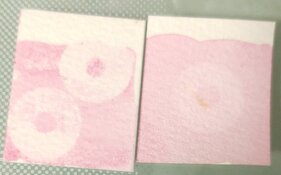
I know these are not great looking examples but...I made this APS PVA Chiba emulsion last night. The less contrasty used 5% pva in place of dry Gum and I developed it last night. The more contrasty was 5% pva and 2% CMC and I developed it this morning. That second one took 5 minutes to show any signs of having a salvageable image in it. They are very robust compared to other gum emulsions where the gum washes away if it stays too long in the water.
 

Attachments

  • IMG_20260325_065841_1.jpg
    IMG_20260325_065841_1.jpg
    173.2 KB · Views: 3
Photrio.com contains affiliate links to products. We may receive a commission for purchases made through these links.
To read our full affiliate disclosure statement please click Here.

PHOTRIO PARTNERS EQUALLY FUNDING OUR COMMUNITY:


Ilford ADOX Freestyle Photographic Stearman Press Weldon Color Lab Blue Moon Camera & Machine
Top Bottom