• Welcome to Photrio!
    Registration is fast and free. Join today to unlock search, see fewer ads, and access all forum features.
    Click here to sign up

All things Chiba and Dichromate alternatives.

Cool as Ice

A
Cool as Ice

  • 0
  • 1
  • 65

Recent Classifieds

Forum statistics

Threads
202,711
Messages
2,844,562
Members
101,483
Latest member
Mozzafiato
Recent bookmarks
0
From the brief experience I had with hide glue and CHIBA process, it didn't need any O2 barrier. The hardening happened just fine. Habib Saidane in his myriad combinations of materials/process never uses one. So it must not be critical requirement. In theory, O2 is a quencher in a free radical reaction hence the caution in the original thesis paper.

:Niranjan.
 
Is there much evidence of CO2 bubbles from the citrate decarboxylation? I'm reminded of DAS forming nitrogen during carbon transfer.

When I spray or dunk the exposed tissue to H2O2 0.3% I do see tiny bubbles form on top of the emulsion. It doesn't seem to cause big visible spots on an image though. However, I also never used an agar agar cover.
 
From the brief experience I had with hide glue and CHIBA process, it didn't need any O2 barrier. The hardening happened just fine. Habib Saidane in his myriad combinations of materials/process never uses one. So it must not be critical requirement. In theory, O2 is a quencher in a free radical reaction hence the caution in the original thesis paper.

:Niranjan.

It might be related to the fact that Chiba as I recall explored alternatives for a transfer process; the direct pigment processes don't involve a transfer. I might not remember that bit correctly though.
 
Since this is an all things Chiba, I am happy to report that indeed Iota Carrageenan can be used in the process. Not only does it harden with Ferric Ammonium Citrate and Ferric Ammonium Oxalate like the other stuff but it seems like a great material for paper sizing. PVA bonds to it tenaciously and it bonds to paper tenaciously. I tried it on plastic...not very good, it wrinkles like it was 40 below outside and you just took a shower.

On other things I've been trying to extend the tonal range of PVA Chiba. Here is my latest successful step forward:
Pigment (yellow) 0.107g
5%PVA: 3g
FAO solid powder mass: 0.15g

That's it, that's the whole recipe! so far.
Expose between 4 and 10 minutes.
The resulting image doesn't continue to dissolve away easily. In fact you can try to remove most of it with a toothbrush and you won't succeed. The image will be ruined instantaneously with a toothbrush, but you'll have to try hard to remove that very last bit.
 
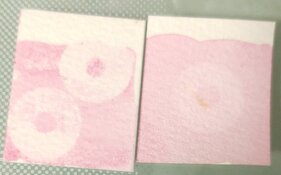
I just did my first layer using the carrageenan sizing on water color paper and the mix I mentioned on my previous post. I have a couple of extra things to mention. One is that the combination results in very much carbon-like image swelling/relief while wet. The other is about the FAO sensitizer. I've been adjusting it here and there, but the thing that seems to help the most so far is to not add citric acid and to increase the percentage of PVA. Citric Acid may help with Ferric Ammonium Citrate to make it closer to dichromate's speed, but with oxalate it decreases the tonal range. Either that, or I was putting way too much sensitizer in there in the first place. I will have to keep testing various combinations to really tell.
 
Your issue with citric acid might be related to what I once saw with sugar+starch. I have no idea on the underlying mechanism however.
With waxy maize starch, if sugar was also present in the emulsion, I observed the opposite of hardening. The exposed areas became easier to wash off. I did not manage to get proper images with this effect though.
 
I learned something today: McCormick Food Colors and Egg Dye, although it looks interesting for adding to your emulsion it seems to block UV or otherwise hinder the exposure. I got a very weak exposure using it. Once removed with all the quantities the same I got a good exposure. well on a 21 step stouffer I got step 4 solid color, 5,6,7,8 gradually reducing. The image was resistant to wash, which is good. The citric acid is back on the menu, the CMC is back.

Ideally 5-15%​
g​
g clear​
g​
g​
g​
ideally~20%​
ideally~20%​
s​
step# in wedge​
step# in wedge​
notes​
%pigment​
pigment​
PVA emulsion​
FAO​
Citric​
total mass​
$FAO-PVA​
$FAO solids​
exposure​
first shade​
Last shade​
11.69​
0.389​
2.948​
0.318​
0.062​
3.717​
17.75​
5.05​
4.00​
4.00​
8.00​
Emulsion 2parts 5% PVA, 2 parts 2% CMC and extra citric, no food dye only magenta 366 water color. Best combo so far.​
 
I'm going to try this ammonium persulfate recipe too: https://www.alternativeprocesses.org/post/the-chiba-system-a-safer-way-to-print-with-gum:

1773007184992.png
 
hmm, so this is the combination I used for that persulfate experiment:

1773364796128.png


It made a messy looking coating that was very unevenly coating. I exposed it but there was no image made at all after sprayed with dilute peroxide, it just did not dissolve but I brushed it off. I left the paint brush in it and forgot about it for a few days. Now I come back to a beaker that has a coating on the interior surfaces and a puddle of yellow chemical over it. I proceeded to wash my paint brush thinking it would just dissolve and nope.

It feels like rubber with a leathery texture. the yellow stuff was probably just FAO, APS, Citric just remaining there. anyway, this is relatively interesting because maybe there is something to be had from it. APS is supposed to have a slow dark reaction. maybe I just needed less of it. Maybe I don't need peroxide for this. I should give it a second try. if anything this could be a good sizing material maybe.
 
Photrio.com contains affiliate links to products. We may receive a commission for purchases made through these links.
To read our full affiliate disclosure statement please click Here.

PHOTRIO PARTNERS EQUALLY FUNDING OUR COMMUNITY:


Ilford ADOX Freestyle Photographic Stearman Press Weldon Color Lab Blue Moon Camera & Machine
Top Bottom