• Welcome to Photrio!
    Registration is fast and free. Join today to unlock search, see fewer ads, and access all forum features.
    Click here to sign up

A blended ferrocyanide print process

Top Floor Fun

A
Top Floor Fun

  • 0
  • 0
  • 21
Smelter Stack.jpg

H
Smelter Stack.jpg

  • 4
  • 3
  • 51

Forum statistics

Threads
202,511
Messages
2,841,695
Members
101,356
Latest member
Memo chris
Recent bookmarks
0
Welcome to Photrio; beautiful prints @Ksnbdooanndin !

+1
hi every one. this summer I read the article from @koraks and immediately tried it. my results were pretty similar to his tones, thinking "uh ok" and moved on. but two days ago I found this tread and raghu's tones are from another planet. so I tried again, and again and again. The crunchy black wasn't there. Today, on the last try I got something closer to him.
paper used was Fabriano unica, same sensitiser traditional solution A and 20% solution b plus ammonium chloride.
no PFC in the developer for the first one and some in the second one. What's interesting, while playing around I added some ammonium chloride in developer to compensate the excess of ofc and it worked!

@Raghu Kuvempunagar does it sound right?
why should I need more than normal?

I feel both a bit underexposed since there is a lot of copper and only a few of iron.
I'll might play a bit more aiming the blackest tone and then linearize it.

Ammonium Chloride serves the following purposes in FerroBlend process:

1. As a sensitiser additive, it increases the warmth of the print. As warmth is due to the formation of more Copper Ferrocyanide pigments, this also has the effect of pushing blue towards black. It has the similar effect when used as developer additive. Used this way, it functions as a creative control in printmaking. Effect obviously varies with concentration and paper.

2. When using buffered paper that doesn't take acidification well (e.g. Bristol papers), coating the paper with Ammonium Chloride before sensitising, reduces the detrimental effect of the buffer (e.g. reduces overall stain by reducing rogue pigment formation).

3. It prevents bleeding in deep shadows when using smooth papers probably due to the formation of more Copper Ferrocyanide pigments than without.

Ammonium Chlroide can be used in FerroBlend process in the following ways:
1. As a pre-coat to the paper before sensitisation.
2. As a sensitiser additive.
3. As a developer additive.

Yes, if you add Ammonium Chloride to the sensitiser/developer, it increases the warmth of the print. Adding controlled amounts of Potassium Ferricyanide to the developer further aids this.

You can also push blue towards black by toning with the toner discussed here.

Raghu, what you did is amazing!

🙏 I'm happy that you find the process interesting. Wish you continued success with the process. And do post your prints in this forum.
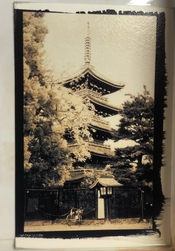
 
thank you both @koraks and @Raghu Kuvempunagar.

Raghu, I have some questions for you.
for me its easier to find bicarbonate of ammonium since they use it in the pastry industries. Will it work for the toning purpose?

what percentage of ammonium chloride do you suggest for a precoat?

Will try some prints today
 
1-2 ml of 20% Ammonium Chloride solution would be good for a precoat. That's about 0.2g - 0.4 g per A4 sized sheet.

I've not tried Ammonium Bicarbonate but I think it should also work Add till bubbling stops and a deep blue solution forms. Initially there will be a precipitate which subsequently goes back in to the solution. You can use liquid Ammonia in place of Ammoniym Carbonate but the smell of Ammonia can be very unpleasant.
 
well, today I tried to precoat the paper. I had less pigment migration but another problem appeared. Whites were not able to clean to paper white, which is some thing I didn't experienced before. I'm pretty sure my ammonium chloride is good since I use it for calotype and salt paper with great success.

@Raghu Kuvempunagar any idea?

I also tried you toning recipe. it worked pretty nice but the blacks are still a bit blue. it's that normal?
(bicarbonate of ammonium didn't worked. they sell it with other stuff inside so I went with straight ammonia)

I also noticed a strange behaviour I want to share. when washing the developed print in acidic environment it loose its deep colours and they comes back with another development. (!?)

I attach the best print today that shows the issue in the highlights I experienced. it's also toned.
 

Attachments

  • IMG_20260114_175840~2.jpg
    IMG_20260114_175840~2.jpg
    1.2 MB · Views: 55
I attach the best print today that shows the issue in the highlights I experienced. it's also toned.

The highlight issues are less than I sometimes had them. So not too bad overall, but a frustrating issue nonetheless. But, I gotta say - absolutely fantastic result overall! The density on the dmax is really nice.
 
Like a lot of photo stuff here, it can be difficult sourcing certain chemicals. I ran out of Copper Sulphate (II), and I'm hoping that Jacques at Argentix is still carrying it. I don't see it on his website (I've contacted him). I've noticed that there is Copper Sulphate on Amazon. I did order some a couple months ago, and tried it just now. Prints looks like crap. I'm wondering if it is because of this Copper Sulphate. It doesn't say that it is (II) anywhere on the package. It's blue crystals, but I noticed that there are also lighter particles mixed in with it...
 
Also, what is the shelf life of Part B? I was thinking that it would be indefinite. I'm still using stock that I had mixed up back in June...
 
Also, what is the shelf life of Part B? I was thinking that it would be indefinite. I'm still using stock that I had mixed up back in June...

I think it's close to indefinite. Just a few days ago I found an eyedropper bottle of 10% pot ferri that was something like 4 or 5 years old. It worked fine for cyanotypes -- I made several prints with it. There were a few tiny red particles suspended in the solution which probably could be filtered out but didn't seem to matter.
 
I'm trying to figure out why my highlights are once again yellowish. Back when I was first playing around with process...almost a year ago... I was running into the same issue. At the end of the day, the culprits were high workspace RH, and not contrasty enough negative. I've run out of Copper Sulphate, and ordered some from Amazon. It says Copper Sulphate (II) on the package. It's probalby not lab grade, so I am wondering if that is the issue... I'm ordering the same stuff that I initially used. Hopefully this time that that is the culprit!
As a side note, I recently realised that Canson XL Watercolour does not need to be acidified...
 
Part B should remain good for a very long time if stored away from direct sunlight.

I've used only lab grade chemicals and have little idea if Copper Sulphate sold on Amazon has any impurities. I believe Copper Sulphate has very good shelf life and aging probably doesn't cause a problem.

Does your Part A contain Ammonium Chloride? If so, would you mind making a small volume of Part A without it and check if you still get yellow highlights?
 
@Raghu Kuvempunagar, I've made prints with and without Ammonium Chloride and the same result. I went back and made a print, with Ammonium Chloride added, but this time I pre-coated the paper with 20% Ammonium Chloride. The whites were better, in fact, where they should be. Not sure why this helped. I didn't have to do this before... they only thing I can think of is that the Copper Sulfate is low grade?? Maybe contains too many impurities??
 
ok, today I made a big improvement! I don't have enough lucidity now to elaborate but want to share my print. Notice the stain in the enlargement! Very close to paper white :smile:
 

Attachments

  • Screenshot_2026-01-16-22-39-43-897_com.google.android.apps.photos~2.jpg
    Screenshot_2026-01-16-22-39-43-897_com.google.android.apps.photos~2.jpg
    498 KB · Views: 88
  • Screenshot_2026-01-16-22-39-56-296_com.google.android.apps.photos~2.jpg
    Screenshot_2026-01-16-22-39-56-296_com.google.android.apps.photos~2.jpg
    430.8 KB · Views: 85
@Raghu Kuvempunagar, I've made prints with and without Ammonium Chloride and the same result. I went back and made a print, with Ammonium Chloride added, but this time I pre-coated the paper with 20% Ammonium Chloride. The whites were better, in fact, where they should be. Not sure why this helped. I didn't have to do this before... they only thing I can think of is that the Copper Sulfate is low grade?? Maybe contains too many impurities??

Precoating mildy buffered papers with Ammonium Chloride does help the same way pre-acidification helps, except it also increases the warmth of the print. If the paper is strongly buffered, then precoating might not be adequate and hence I always prefer pre-acidification of such papers.

I am not sure what could be the impurities in commercial grade Copper Sulphate that cause problems. Light coloured particles could be just a hydration issue and not necessarily due to the presence of an impurity.

Note that Copper Sulphate readily reacts with Ferricyanide to form Copper Ferrocyanide which acts as stain. That's why Cupric ions in the developer need to be properly complexed by Citrate ions which prevents this reaction and consequent stain. The complexation is affected by pH of the developer and is most effective in a narrow pH range. If the paper is buffered and untreated, then pH can go up during development upsetting Copper-Citrate complex. Similarly, if Citric Acid is used in place of Sodium Citrate, complexation will be weaker.

Please check pH of the developer (~5.5-6.5) when you get a chance.
 
Precoating mildy buffered papers with Ammonium Chloride does help the same way pre-acidification helps, except it also increases the warmth of the print. If the paper is strongly buffered, then precoating might not be adequate and hence I always prefer pre-acidification of such papers.

I am not sure what could be the impurities in commercial grade Copper Sulphate that cause problems. Light coloured particles could be just a hydration issue and not necessarily due to the presence of an impurity.

Note that Copper Sulphate readily reacts with Ferricyanide to form Copper Ferrocyanide which acts as stain. That's why Cupric ions in the developer need to be properly complexed by Citrate ions which prevents this reaction and consequent stain. The complexation is affected by pH of the developer and is most effective in a narrow pH range. If the paper is buffered and untreated, then pH can go up during development upsetting Copper-Citrate complex. Similarly, if Citric Acid is used in place of Sodium Citrate, complexation will be weaker.

Please check pH of the developer (~5.5-6.5) when you get a chance.

Thank you for that great explanation!
When you suggested that I check the developer's pH, I remembered that I had such a metre in my chemical cabinet that I have yet to use. After calibrating it to a couple of pH targets, I checked the pH of the developer (I have been mixing up the one-shot version... .02g Copper Sulphate + 0.8g Sodium Citrate in 10ml distilled water.
The pH measured 54.4
I added another .01g Sodium Citrate which brought it to a pH of 55.9

4:30am comes quickly, so I'm off to bed (I'm an early riser!). I'll head into the darkroom, after several cups of coffee, and see what happens. I'll play around with pH.
 
(I have been mixing up the one-shot version... .02g Copper Sulphate + 0.8g Sodium Citrate in 10ml distilled water.
The pH measured 54.4
I added another .01g Sodium Citrate which brought it to a pH of 55.9

It could be a typo, you probably meant to write 0.2 g Copper Sulphate because 0.02 g is too little and can be a bit unpredictable.
 
I conducted experiments by increasing the sodium citrate to 0.9. No change. So, I'll wait for the copper sulfate to arrive from Argentix. I'll shelve this until then. I really want to play with my Hasselblad! 😆
 
I decided to give ferroblend a try after watching Andrew's video, and I just read through this entire thread from beginning to end. Most of my work in photography is digital, but I started playing around with cyanotype at the beginning of COVID lockdown. I had a lot of inkjet papers lying around that I didn't have decent profiles for, so my first cyanotypes were on inkjet paper. I find that it coats very consistently and, because it is so smooth, allows me to use negatives with tons of fine detail. I'm supposed to intoduce a gaggle of college photo students to cyanotype, and I think I will include ferroblend so that I've got multiple chances at experimentation with different papers & formulas without needing to wait between tries. My aim is to get results where the shadows are cyanotype deep blue and the midtones/highlights are copper. I've produced some on metallic inkjet paper that I really like; I'll post them when I bring them home from school later this week. My main issue with this process is the inability to maintain paper white. Anywhere the emulsion exists, even in the absense of exposure, I get a pinkish to orange color. Thanks to everyone working on this process!
 
I decided to give ferroblend a try after watching Andrew's video, and I just read through this entire thread from beginning to end. Most of my work in photography is digital, but I started playing around with cyanotype at the beginning of COVID lockdown. I had a lot of inkjet papers lying around that I didn't have decent profiles for, so my first cyanotypes were on inkjet paper. I find that it coats very consistently and, because it is so smooth, allows me to use negatives with tons of fine detail. I'm supposed to intoduce a gaggle of college photo students to cyanotype, and I think I will include ferroblend so that I've got multiple chances at experimentation with different papers & formulas without needing to wait between tries. My aim is to get results where the shadows are cyanotype deep blue and the midtones/highlights are copper. I've produced some on metallic inkjet paper that I really like; I'll post them when I bring them home from school later this week. My main issue with this process is the inability to maintain paper white. Anywhere the emulsion exists, even in the absense of exposure, I get a pinkish to orange color. Thanks to everyone working on this process!

I have to suggestion:
-stick to one paper that you know form other that works
ammonium chloride precoating change the game. did you you tried it?
 
I decided to give ferroblend a try after watching Andrew's video, and I just read through this entire thread from beginning to end. Most of my work in photography is digital, but I started playing around with cyanotype at the beginning of COVID lockdown. I had a lot of inkjet papers lying around that I didn't have decent profiles for, so my first cyanotypes were on inkjet paper. I find that it coats very consistently and, because it is so smooth, allows me to use negatives with tons of fine detail. I'm supposed to intoduce a gaggle of college photo students to cyanotype, and I think I will include ferroblend so that I've got multiple chances at experimentation with different papers & formulas without needing to wait between tries. My aim is to get results where the shadows are cyanotype deep blue and the midtones/highlights are copper. I've produced some on metallic inkjet paper that I really like; I'll post them when I bring them home from school later this week. My main issue with this process is the inability to maintain paper white. Anywhere the emulsion exists, even in the absense of exposure, I get a pinkish to orange color. Thanks to everyone working on this process!

Sounds great! Let us know how it goes with the students.

What inkjet paper have you been using?

The stain issue is generally due to the buffer in the paper which needs to be neutralised before coating. Impure Copper Sulphate and high humidity could also be other causes as noted by Andrew.
 
Last edited:
I have to suggestion:
-stick to one paper that you know form other that works
ammonium chloride precoating change the game. did you you tried it?

I certainly understand the idea behind your "stick to one paper" suggestion. I'm still in the process of finding which paper I prefer. I have not tried ammonium chloride precoating. Can you point me to an explanation of the process? Thanks!
 
Photrio.com contains affiliate links to products. We may receive a commission for purchases made through these links.
To read our full affiliate disclosure statement please click Here.

PHOTRIO PARTNERS EQUALLY FUNDING OUR COMMUNITY:


Ilford ADOX Freestyle Photographic Stearman Press Weldon Color Lab Blue Moon Camera & Machine
Top Bottom