
• Welcome to Photrio!
    Registration is fast and free. Join today to unlock search, see fewer ads, and access all forum features.
    Click here to sign up

0.6 -- standard contrast?

Recent Classifieds

Forum statistics

Threads
201,876
Messages
2,831,644
Members
100,997
Latest member
Allegroviandante
Recent bookmarks
0

BetterSense

Member
Allowing Ads
Joined
Aug 16, 2008
Messages
3,151
Location
North Caroli
Format
35mm
I have heard that "standard contrast" for negative film is 0.6, on the straight-line portion of the h&d curve. I have a couple of questions about this.

1. is this true?
2. Why 0.6 not 1?
3. Do manufacturers development data uniformly target this standard contrast value?
4. If I have papers from grade 0 to grade 5 at my disposal, how much tolerance does that give me with regards to the contrast of my negatives?

I am trying to determine if there is a development recipe that I can use with all the different films I use.
 

Bill Burk

Subscriber
Allowing Ads
Joined
Feb 9, 2010
Messages
9,473
Format
4x5 Format
Because the subject range has got 7 stops on average (2.1), and a Grade 2 paper range is 1.05 - that gives you 0.5 without being very accurate. Factoring in flare and better estimate the average negative...

That's when you get 0.62 which is also approximately what you get when you develop to ASA specifications.
 

Bill Burk

Subscriber
Allowing Ads
Joined
Feb 9, 2010
Messages
9,473
Format
4x5 Format
p.s. Stephen Benskin, just yesterday, published a chart that relates subject brightness range, to paper scale, and gives recommended contrast. His new chart includes practical adjustments appropriate for thin versus dense negatives printing on hard versus soft papers. You should look for it.
 

snapguy

Member
Allowing Ads
Joined
Jan 1, 2014
Messages
1,287
Location
California d
Format
35mm
The Big Easy

I started working as a professional darkroom wretch over 50 years ago. It appears to me that you are relying on only one part of the brain (the "one plus one equals two" department) to solve complex printing problems and make the process simple and easy. There is no easy solution. You need to use all of your brain and you need to use body English as well. Math is a small part of the mix of what is needed. Comfortable shoes help a lot, too.
 

baachitraka

Member
Joined
Apr 6, 2011
Messages
3,649
Location
Bremen, Germany.
Format
Multi Format
I go with comfortable shoes and room heaters...
 

bernard_L

Member
Allowing Ads
Joined
Feb 17, 2008
Messages
2,133
Format
Multi Format
My 2¢.
[Bill Burk] "(...)that gives you 0.5". Agree with the arithmetic, but that is not the whole story. "That's when you get 0.62" Don't see how you make the jump from 0.5 to 0.62 (the difference is catually significant).
[APUGuser19] "for those who swear by the "thin negative" school" I am also annoyed by this, and explain below.

For a long time, I've been following manufacturer's recommendations for negative development. Nothing fancy, no exotic brew, just Tri-X or FP4 in D-76 1+1, or in HC-110. Then started to realize that a typical neg of an outdoors sunny scene, with both sunlit patches and shadow areas, would require grade 3, or even 3.5, using the typical condenser (but not point source!) enlarger (Beseler 67). Which raises two questions:

1) What do I find wrong with that? Just that grade 3.5 is uncomfortably close to the limit of VC contrast, whic IMO is grade 4, with little change between grades 4 and 5 (speaking of MGIV with Ilford MG filters). I'd be more comfortable using grade 2 or 1.5 for contrasty scenes, and having the option to go to higher grades for flatter negatives.

2) Why do I find myself using grades 3-3.5 when plain arithmetic (or equally the sophisticated transfer curves) say that I should be OK with grade 2? Two reasons for that
a) The ISO exposure range for papers (the 1.05 in Bill Burk's post) is defined between points giving densities 0.1 and 0.9*Dmax; the total usable range is larger than the ISO range
b) More often than not, to obtain a good print, the scene (and negative) dynamic range is made to fit within the exposure range of the printing paper not by globally decreasing the contrast, but by masking and dodging, that preserves local contrast and brillance; such practice is completely ignored by simple arithmetic and transfer curves.
 
OP
OP
BetterSense

BetterSense

Member
Allowing Ads
Joined
Aug 16, 2008
Messages
3,151
Location
North Caroli
Format
35mm
I already know how to get what I want from my papers and films. However it requires slightly different development times for each. I would like to do a simple test of exposing a step wedge on each type of film and developing all them together for an average time. Measuring the resulting contrast of each should give me an idea if a standard development time is possible without having to make a great many test prints. For this I still need some info about the contrast of each paper grade.

I found one of PE's articles and believe I now know why 0.6 was chosen. There is no particular reason to choose a value of 1, and a lower negative contrast allows more SBR to be captured within a given film's DMAX limits.
 

gone

Member
Allowing Ads
Joined
Jun 14, 2009
Messages
5,504
Location
gone
Format
Medium Format
I suspect this is one of those times when ignorance is bliss because I have never, ever, thought about any of this. My scheme is to just print each negative as well as I can, assuming it is exposed and developed well, and go on. It reminds me of people talking about how the universe came into being. Why worry about that? Even if I knew, how does that help me today in my life? I honestly think a lot of people really over think what is a only visual medium, not a theoretical or philosophical one.
 

Xmas

Member
Allowing Ads
Joined
Sep 4, 2006
Messages
6,398
Location
UK
Format
35mm RF
Long ago on a distant part of galaxy before scanners there were two times quoted.

A) condenser
B) diffusion

To get average negatives on to grade 2

If you got 36 shots dev time is a compromise...
 

ic-racer

Member
Joined
Feb 25, 2007
Messages
16,734
Location
USA
Format
Multi Format
In the old days, before small format rollfilms were popular, a gamma of unity was the norm. Small format negatives that need to be enlarged give better results when processed to a gamma of less than unity. Enlarging papers, therefore, compensate by having a contrast greater than unity.

Commercial B&W processing machines would be calibrated to produce a negative of a certain fixed gamma. However, most fine-art photographers, and most home darkrooms have enough flexibility to process conventional silver negatives to a gamma that yields optimum prints. Frequently this will be from 0.55 to 0.85
 
Last edited by a moderator:
OP
OP
BetterSense

BetterSense

Member
Allowing Ads
Joined
Aug 16, 2008
Messages
3,151
Location
North Caroli
Format
35mm
The ISO method of determining speed does not directly use the straight-line contrast, but rather seems to define contrast in the toe region. If I understand correctly, different films, when developed to the ISO criteria for shadow speed, may then have varying straight-line contrast. Actual photographers, on the other hand, seem obliged to develop to a target contrast that looks correct. I would be interested to know what this contrast ends up being for different films when they are developed according to the ISO standard.
 

Bill Burk

Subscriber
Allowing Ads
Joined
Feb 9, 2010
Messages
9,473
Format
4x5 Format
My 2¢.
[Bill Burk] "(...)that gives you 0.5". Agree with the arithmetic, but that is not the whole story. "That's when you get 0.62" Don't see how you make the jump from 0.5 to 0.62 (the difference is catually significant).

More often than not, to obtain a good print, the scene (and negative) dynamic range is made to fit within the exposure range of the printing paper not by globally decreasing the contrast, but by masking and dodging, that preserves local contrast and brillance; such practice is completely ignored by simple arithmetic and transfer curves.

I didn't go into all the reasons how we get from 0.5 to 0.62 but your point is one of the reasons why. The best prints were found to come from having negative range slightly beyond the range of the paper - and that is factored in.
 

L Gebhardt

Member
Joined
Jun 27, 2003
Messages
2,364
Location
NH
Format
Large Format
I generally expose enough so I don't factor the toe into the contrast calculation. I find I like the open shadows I get this way. The ASA/ISO spec does include the toe, if I remember correctly. For an average scene I find a contrast of .5 to .55 is ideal with a grade 2 filter on most VC paper. That way I get results that print well on a condenser enlarger or a diffusion enlarger with slight filtration changes. I think if you target only a diffusion enlarger then .6 might be a better target.

I don't do much testing these days, but I did a lot in the past. I found that the beyond the zone system tests led me towards slightly higher contrast negatives (probably my mistakes in using the system really). I found to get the best prints then required lower contrast filtration. It also left less room for error, especially with roll film. So I simply adjusted my times until I got negatives that printed well on middle grade filtration. That's how I arrived at .52 as my target, which was measured after working backwards.
 

Gerald C Koch

Member
Allowing Ads
Joined
Jul 12, 2010
Messages
8,131
Location
Southern USA
Format
Multi Format
There is no standard gamma (Contrast Index). What you use depends on several things, such as the type of enlarger, condenser or diffusion, what processes you are using, etc.
 

Bill Burk

Subscriber
Allowing Ads
Joined
Feb 9, 2010
Messages
9,473
Format
4x5 Format
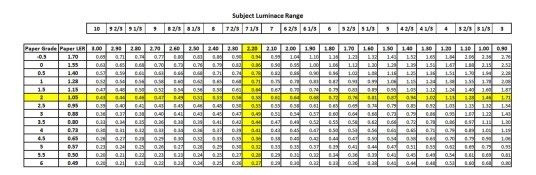
Wouldn't it be great if a chart existed which could take all these things into account and tell you the gamma (Contrast Index) to use for that sheet/roll ?

Here is the chart I have been using since he first shared this...

Post #58 of this thread is a PDF from Stephen Benskin "Contrast Index a.pdf"

(there was a url link here which no longer exists)

EDIT: Rats. That's not the right chart. I swear he posted it here and now I can't find it.

Will follow-up when I have a link.
 
Last edited by a moderator:

Bill Burk

Subscriber
Allowing Ads
Joined
Feb 9, 2010
Messages
9,473
Format
4x5 Format
Found it!

Here is the Contrast Index recommendation chart that I use: Post #38

(there was a url link here which no longer exists)

Note: Stephen Benskin is working on an update to it.

Note: This chart is based on the "0.4 Flare Model" the improvement Stephen is working on is a practical flare model which takes into account different ways flare plays when you have different subject brightness ranges.

Another Note: Far right column is 10 stops (they ran out of room and decided if you get that far, might as well jump a whole stop... and the column got mislabeled).
 
Last edited by a moderator:

Bill Burk

Subscriber
Allowing Ads
Joined
Feb 9, 2010
Messages
9,473
Format
4x5 Format
I would be interested to know what this contrast ends up being for different films when they are developed according to the ISO standard.

I'll take a stab at it. Although not exactly, because the standards aren't couched in those terms... 0.62 is very likely to be the gamma or contrast of any black and white negative film developed to ISO standards.

I believe but don't have evidence to offer, that 0.62 is what the recommended development times strive for when the rated speed is desired.

I suspect some special circumstances might be different, like Tech Pan. Certainly other special developers have different aims, like Pyro.
 

Bill Burk

Subscriber
Allowing Ads
Joined
Feb 9, 2010
Messages
9,473
Format
4x5 Format
BetterSense,

If you get to look at that chart, it also can give you an idea of the tolerance: 0.75 is good for Grade 1 and 0.52 is good for Grade 3.

If you were to dunk all your film for the same time... and that gave you anywhere from 0.52 to 0.75... As long as the subject range is "normal" 7 stops you can fit on paper from Grades 1 to 3. So you CAN develop all your film the same time.

But there is a trade-off...

For roll film, you use paper grades to accommodate varying subject brightness ranges. If you choose to be careless with development time, you take away from this tolerance. Normally you develop film to 0.62 and you are covered for brightness ranges of 6, 7 and 8 stops (you are safe for N-1, N and N+1 in Zone System terms). Examples: If subject has 6 stops brightness range, Grade 3 will fit... If it has 8 stops brightness range, Grade 1 will fit.

If you develop a particular film to 0.75 and it happens to be 8 stops subject brightness range... You'll need Grade 0.
 

RalphLambrecht

Subscriber
Allowing Ads
Joined
Sep 19, 2003
Messages
14,935
Location
K,Germany
Format
Medium Format
I have heard that "standard contrast" for negative film is 0.6, on the straight-line portion of the h&d curve. I have a couple of questions about this.

1. is this true?
2. Why 0.6 not 1?
3. Do manufacturers development data uniformly target this standard contrast value?
4. If I have papers from grade 0 to grade 5 at my disposal, how much tolerance does that give me with regards to the contrast of my negatives?

I am trying to determine if there is a development recipe that I can use with all the different films I use.

1close enough
2a result from testing what people prefer to see(early Kodak work in the 1940s)
3 mostly
4 you are all set
5 Sure, there are several standard developersID11, Rodinal and D76 to name a couple:smile:
 

bernard_L

Member
Allowing Ads
Joined
Feb 17, 2008
Messages
2,133
Format
Multi Format
[Bill Burk]
I believe but don't have evidence to offer, that 0.62 is what the recommended development times strive for when the rated speed is desired.
Kodak datasheet F-4017 states: PROCESSING. The following starting-point recommendations are intended to produce a contrast index of 0.56. Ilford does not give a CI value in their dev time tables (except old ones). Then again, I am annoyed by the tendency to low CI. Extreme example: after following Fuji's recommendation for Neopan-400 in D-76(1+1) and finding the negs quite flat, I made a posteriori sensitometric tests and found their dev time corresponds to CI 0.45. Yes, I know, I'm supposed to do my own testing to cancel all the personal factors in the equation but it would certainly help if the "recommended" values would refer to a standard CI (seee below).

@ Bill Burk. Your 0.62 is not far off the mark. The ISO standard calls for delta_D=0.8 for delta_logH=1.3, so CI = 0.8/1.3=0.615.
Thank you for providing the link to the contrast indexes table; nothing that could not be done with a spreadsheet, but convenient to have.
 
OP
OP
BetterSense

BetterSense

Member
Allowing Ads
Joined
Aug 16, 2008
Messages
3,151
Location
North Caroli
Format
35mm
The Kodak Xtol datasheet says that if you develop TMY for 9.25 minutes, that the contrast will be 0.56 at an exposure index of 400, but 0.62 at EI 800. Why would exposure index make any difference in contrast, at the same development time?
 

MattKing

Moderator
Moderator
Allowing Ads
Joined
Apr 24, 2005
Messages
55,223
Location
Delta, BC Canada
Format
Medium Format
The Kodak Xtol datasheet says that if you develop TMY for 9.25 minutes, that the contrast will be 0.56 at an exposure index of 400, but 0.62 at EI 800. Why would exposure index make any difference in contrast, at the same development time?

Because the shadows will have less detail, and be clearer on the negative, whereas the highlights will be essentially unchanged, AND

The speed point will be at a different point on the curve.
 
Joined
Jan 7, 2005
Messages
2,739
Location
Los Angeles
Format
4x5 Format
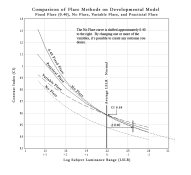
Here is the table Bill was talking about. It does reflect the my practical development model as explained in my paper "What is Normal?" While you can use the LER for any type of light source, the placement of the grades are based on contacting / diffusion enlarger. The equation to determine CI / Average Gradient is:

Paper LER / (log Subject Luminance Range - Flare)

Practical Flare Model b.jpg
 
Last edited by a moderator:
Joined
Jan 7, 2005
Messages
2,739
Location
Los Angeles
Format
4x5 Format
@ Bill Burk. Your 0.62 is not far off the mark. The ISO standard calls for delta_D=0.8 for delta_logH=1.3, so CI = 0.8/1.3=0.615.
Thank you for providing the link to the contrast indexes table; nothing that could not be done with a spreadsheet, but convenient to have.

It's 0.615 for those conditions, the ISO standards contrast parameter measures the curve differently than contrast index or average gradient. With short toed curves, the difference is minimal, but longer toed curves can have CIs and average gradients higher than 0.615 even though they fit into the ISO parameters.

The table is a spreadsheet. The difference is the flare model. Without going into detail, I've never liked how either the fixed or variable flare models work in the more extreme Luminance ranges. Here is a comparison between different flare models.

Comparison of CIs of Dev Models, changing the variables.jpg
 

Bill Burk

Subscriber
Allowing Ads
Joined
Feb 9, 2010
Messages
9,473
Format
4x5 Format
The Kodak Xtol datasheet says that if you develop TMY for 9.25 minutes, that the contrast will be 0.56 at an exposure index of 400, but 0.62 at EI 800. Why would exposure index make any difference in contrast, at the same development time?

I think it is a typographical error. Other cells of the tables on the datasheet have different times for different Contrast Index. By definition either the CI or Time is incorrect in that cell. My gut tells me the time is wrong.
 
Photrio.com contains affiliate links to products. We may receive a commission for purchases made through these links.
To read our full affiliate disclosure statement please click Here.

PHOTRIO PARTNERS EQUALLY FUNDING OUR COMMUNITY:


Ilford ADOX Freestyle Photographic Stearman Press Weldon Color Lab Blue Moon Camera & Machine
Top Bottom