
• Welcome to Photrio!
    Registration is fast and free. Join today to unlock search, see fewer ads, and access all forum features.
    Click here to sign up

Y marks on my negatives! Why?

Recent Classifieds

Forum statistics

Threads
201,902
Messages
2,831,888
Members
101,014
Latest member
photomaximo
Recent bookmarks
0

Chris Livsey

Member
Allowing Ads
Joined
Aug 10, 2008
Messages
635
Format
Medium Format
First of all, if all of your students are using the same film, from the same emulsion and some are getting it while others do not, the problem is not the film.

This was asked at the very start, but never clearly answered by the OP. I understood not all students were getting the effect but were all using, as asked above, the same batch of same film?
The maker will, quite correctly, absolve the emulsion if some workers are not getting the effect.
 
Last edited by a moderator:

GarageBoy

Member
Allowing Ads
Joined
Nov 5, 2012
Messages
994
Format
35mm
Scrap everything and start over (chemical wise)
New bottles (doesn't have to be fancy), new properly mixed dev/stop/fixer
Closely watch your temperature
Don't let anyone touch the chemicals until you finish testing
 

MartinP

Member
Allowing Ads
Joined
Jun 23, 2007
Messages
1,569
Location
Netherlands
Format
Medium Format
Initially the OP mentioned both TriX and the rebadged Foma - if that is correct, rather than a temporary misunderstanding, then it would suggest a process problem rather than materials? The other descriptions of activities suggest no control or consistency with temperatures or cleanliness so pinning down one cause, or combination of causes, will be tricky.
 

Rick A

Subscriber
Allowing Ads
Joined
Mar 31, 2009
Messages
10,032
Location
Laurel Highlands
Format
8x10 Format
Send a roll of exposed film to me for processing. I will clip it and develop half in PMK pyro and other half in D-76. I will post findings here.
 

georgegrosu

Member
Allowing Ads
Joined
Oct 15, 2007
Messages
434
Location
Bucharest, R
Format
Multi Format
mrs.martin, if you look at the emulsion in reflected light it is defective?
Emulsion shows cracks?
If we talk about the picture with seat and back wall.
In the picture shows 40-50 of defects in the form of Y and points - stains.
In a film with 36 images severity defects is about the same?
Or is it higher / lower?
When we talk about a defects may be continuous or in some portions.
If not defects comes in a film that does not mean the whole lot of film is
without no problem.
Defects can be viewed in a statistical form.

George
 

Regular Rod

Member
Allowing Ads
Joined
Aug 6, 2012
Messages
665
Location
Derbyshire
Format
Medium Format
Surely we have already explained what caused the marks?

Reticulation by too great difference of temperature during drying.

The drying temperature was too high so drops of final rinse water that remained standing caused localised differences in temperature that were great enough to cause these spots of reticulation that erupted into the Y shaped marks. In some places the damage is actually beginning to join up.

The remedy is surely to process with careful temperature control and to dry the film with little, preferably no, heat?

mrs.martin, have you tried this yet?

RR
 
Joined
Jan 21, 2003
Messages
15,715
Location
Switzerland
Format
Multi Format
Surely we have already explained what caused the marks?

Reticulation by too great difference of temperature during drying.

The drying temperature was too high so drops of final rinse water that remained standing caused localised differences in temperature that were great enough to cause these spots of reticulation that erupted into the Y shaped marks. In some places the damage is actually beginning to join up.

The remedy is surely to process with careful temperature control and to dry the film with little, preferably no, heat?

mrs.martin, have you tried this yet?

RR

Along with making sure chemistry bottles are kept separate based on what goes in them, clean, and without contamination. Darkroom cleanliness can be a real problem in a shared darkroom space.
To run a test with freshly mixed developer, stop bath, fixer, and wetting agent, stored in clean new bottles, and then exercise temperature control at all stages, including washing. Hang to dry without hot air.

Those are, in my opinion, the most likely contributors to the issue at hand.
 
OP
OP

mrs.martin

Member
Allowing Ads
Joined
Oct 2, 2014
Messages
18
Format
35mm
We do not have any heat in our cabinets - just a fan from behind that gets air circulating through a small vent at the top - no heat whatsoever.
 
OP
OP

mrs.martin

Member
Allowing Ads
Joined
Oct 2, 2014
Messages
18
Format
35mm
As far as the rest we have clean bottles, always separate. Clearly labeled - never cross contaminated. Use separate mixing jugs too!
I can't really send a roll to anyone b/c it's not every roll. It's so hit or miss. But still happening... Probably 1 out of 15.
 

Arvee

Member
Allowing Ads
Joined
Aug 23, 2006
Messages
976
Location
Great Basin
Format
Multi Format
Try a different film. I've run into manufacturing defects with Arista Premium, both the 100 and the 400. I also saw a lot of manufacturing defects with Efke film. I would expect to see the same with Foma film, although I have never used it (learned my lesson on the previous films). Went back to Ilford products and have never encountered a problem. The old saw, "You get what you pay for," comes into play here.
 

Photo Engineer

Subscriber
Allowing Ads
Joined
Apr 19, 2005
Messages
29,018
Location
Rochester, NY
Format
Multi Format
A defect like that on Tri-X? And the same defect on other products? Never happen. Something external is causing this. And, it does not appear to be reticulation.

PE
 

pdeeh

Member
Allowing Ads
Joined
Jun 8, 2012
Messages
4,770
Location
UK
Format
Multi Format
Trying to resolve this by looking at low resolution scans online is pretty much being on a hiding to nothing.

Until someone - someone who really knows what they're looking at, I mean - gets a sample under a 10x loupe, or stronger, almost every opinion (except PE's) is just so much speculation.
 

Dave in Kansas

Member
Allowing Ads
Joined
Jan 8, 2009
Messages
302
Location
Eastern Kans
Format
Multi Format
While Tri-X was mentioned in the first post, I don't think it has been confirmed that these marks appear on both films. If so, as PE stated, it's not a film issue and must be process related. However, if it only happens on the Arista then I think it is a film issue that might be eliminated with very careful processing. Maybe.
 

Photo Engineer

Subscriber
Allowing Ads
Joined
Apr 19, 2005
Messages
29,018
Location
Rochester, NY
Format
Multi Format
And so far, IDK what it is, but it sure does not look like reticulation, particularly with that mix of films.

PE
 

Simon R Galley

Member
Allowing Ads
Joined
Nov 2, 2005
Messages
2,034
Location
Cheshire UK
Format
Medium Format
I agree with PE

99% sure that this is not reticulation.

Simon ILFORD Photo / HARMAN technology Limited :
 

AgX

Member
Allowing Ads
Joined
Apr 5, 2007
Messages
29,972
Location
Germany
Format
Multi Format
It is not reticulation in the common sense of a homogeneous spread. Nor does it share shape.

But nevertheless it looks like shrunk and torn emulsion. Remarkable is the quite uniform shape, though not size and spread.

As if there are nuclei for such tearing.


But as repeatedly said, we need reflection photographs of that surface.
 
Last edited by a moderator:

cliveh

Subscriber
Allowing Ads
Joined
Oct 9, 2010
Messages
7,803
Format
35mm RF
It looks to me like some pollen related substance, perhaps blown into the emulsion during drying.
 

Regular Rod

Member
Allowing Ads
Joined
Aug 6, 2012
Messages
665
Location
Derbyshire
Format
Medium Format
Okay don't call it reticulation then if the term reticulation can only apply when the damage is spread across the entire negative. BUT it is emulsion damage that looks localised (although closer inspection reveals there is further damage near the Y marks) and could readily correspond with sites where drops of final rinse water have differed in temperature during the drying process. Has the OP tried another batch with exactly the same routine but this time no heat in the drying cabinet?

RR
 
Joined
Jan 21, 2003
Messages
15,715
Location
Switzerland
Format
Multi Format
Okay don't call it reticulation then if the term reticulation can only apply when the damage is spread across the entire negative. BUT it is emulsion damage that looks localised (although closer inspection reveals there is further damage near the Y marks) and could readily correspond with sites where drops of final rinse water have differed in temperature during the drying process. Has the OP tried another batch with exactly the same routine but this time no heat in the drying cabinet?

RR


(there was a url link here which no longer exists)

Mrs. Martin clearly states they do not use heated drying cabinets.
 

Regular Rod

Member
Allowing Ads
Joined
Aug 6, 2012
Messages
665
Location
Derbyshire
Format
Medium Format
(there was a url link here which no longer exists)

Mrs. Martin clearly states they do not use heated drying cabinets.

I had missed that post. Thank you for drawing that to my attention.

Okay assuming no naughty student turned on the heat to hurry things along... :D

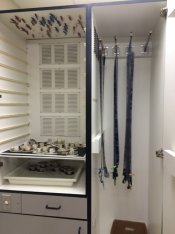
I went looking for the post and found the attached photograph of the cabinet.

To get film dry in only 45 minutes with no heat one assumes the fan is blowing strongly...

In the photograph there seems to be some contact being made by some of the films against part of the wall of the cabinet. What is the surface of the cabinet wall like? Completely smooth or with some texture?

Might it be that the few films that have made contact with the cabinet wall are the ones with the damage? Is sticky emulsion being momentarily tacked to the wall then blown free by the fan to leave tiny raised and split portions of emulsion?

If I was one of the students my film would never be hung on that left hand rail!

RR
 

Attachments

  • 95642d1412615219-y-marks-my-negatives-why-img_4333_jpg.jpg
    95642d1412615219-y-marks-my-negatives-why-img_4333_jpg.jpg
    97.7 KB · Views: 153

pentaxuser

Member
Joined
May 9, 2005
Messages
20,347
Location
Daventry, No
Format
35mm
To get film dry in only 45 minutes with no heat one assumes the fan is blowing strongly...

Might it be that the few films that have made contact with the cabinet wall are the ones with the damage? Is sticky emulsion being momentarily tacked to the wall then blown free by the fan to leave tiny raised and split portions of emulsion?

If I was one of the students my film would never be hung on that left hand rail!

RR

RR I manage to dry film in 45 mins or less in my cabinet without any heat but you may well have something in the points you make about the way of hanging and films' proximity to the left hand edge of the cabinet especially

pentaxuser
 
Joined
Jan 21, 2003
Messages
15,715
Location
Switzerland
Format
Multi Format
I agree that after looking at that picture it makes sense to see if any physical harm is done to the film at any point of the process, particularly in the drying cabinet where the film touches the side wall brace.

It would also be good to see a picture of the damaged film, on the base side, if there is any physical damage to the film base due to kinking in the film reel loading process, etc.
 

MattKing

Moderator
Moderator
Allowing Ads
Joined
Apr 24, 2005
Messages
55,241
Location
Delta, BC Canada
Format
Medium Format
The pattern of the "Y"s looks like a grate.
 

Xmas

Member
Allowing Ads
Joined
Sep 4, 2006
Messages
6,398
Location
UK
Format
35mm RF
Getting film dry in 45 minutes is fast, I use a film squeegee and it still takes 5-6 hours.

If you want or need 45 minutes you need to use the techniques the newspapers used for stop press photos.
 
Photrio.com contains affiliate links to products. We may receive a commission for purchases made through these links.
To read our full affiliate disclosure statement please click Here.

PHOTRIO PARTNERS EQUALLY FUNDING OUR COMMUNITY:


Ilford ADOX Freestyle Photographic Stearman Press Weldon Color Lab Blue Moon Camera & Machine
Top Bottom