
• Welcome to Photrio!
    Registration is fast and free. Join today to unlock search, see fewer ads, and access all forum features.
    Click here to sign up

Y marks on my negatives! Why?

Recent Classifieds

Forum statistics

Threads
201,897
Messages
2,831,855
Members
101,013
Latest member
Alena
Recent bookmarks
0

Maris

Member
Allowing Ads
Joined
Jan 17, 2006
Messages
1,594
Location
Noosa, Australia
Format
Multi Format
Here's my guess: tension cracks formed at the site of fast evaporating water drops. The swollen wet emulsion can't "adjust" itself quickly enough to stay as a continuous film as it dries and hardens. I imagine drying mud forms cracks via an analogous process.
 

AgX

Member
Allowing Ads
Joined
Apr 5, 2007
Messages
29,972
Location
Germany
Format
Multi Format
Remaining water droplets... Interesting..., but they cause stains of low densitiy with a high density rim.
 

pdeeh

Member
Allowing Ads
Joined
Jun 8, 2012
Messages
4,770
Location
UK
Format
Multi Format
Isn't this Foma film? in which case it might be helpful to send a sample of film to them at the factory and ask for their comments. More likely to get a definitive and accurate answer than by us all looking at pictures of the negatives online and guessing, however well-informed the guessing is
 

Regular Rod

Member
Allowing Ads
Joined
Aug 6, 2012
Messages
665
Location
Derbyshire
Format
Medium Format
My photography classes are processing and I've experienced these Y marks on the negatives. What causes this? I have multiple students using the same chemicals, film, timing, etc. NOT everyone, but certain rolls are getting these crystally Y's on them. FRUSTRATING! Too cold of stop bath/water? It's room temperature. Static marks? HELP! Tri-x 400 and Arista EDU 400, Kodak D76, Kodak Fixer.

Surely it's a form of very localised reticulation? A temperature shock at some stage in the processing is the likely cause...? My guess is too much heat during drying. The Y marks were maybe the sites of droplets?

RR
 

rince

Member
Allowing Ads
Joined
May 11, 2011
Messages
219
Location
Germany
Format
Multi Format
I would also vote for high temperature in drying. I remember having issues with drying foma film in a drying cabinet with any added heated air. It would come to cracks and reticulation, due to the fact that the film bends strongly during the drying process. Nowadays I will turn on the fan in the drying cabinet, but not the heat at all for foma films. Also make sure you when putting on the filmclips for hanging the film, that the film is absolutely flat in the clip and always put a counter weight at the bottom of the film.
 

250swb

Member
Allowing Ads
Joined
Apr 22, 2012
Messages
1,604
Location
Peak District
Format
Multi Format
Remaining water droplets... Interesting..., but they cause stains of low densitiy with a high density rim.

Yes, in a narrow view of what reticulation is, and if the spots are on the emulsion side of the film. I don't think this is a case of 'oops I've just dunked the film into hot water'. A wider view of what causes reticulation would look at all the possibilities for temperature difference. If you have uneven/rapid drying the temperature difference necessary to cause reticulation can come from either side, a 'hot spot/cool spot' of water will still affect the emulsion side through the thin film substrate.

Steve
 
OP
OP

mrs.martin

Member
Allowing Ads
Joined
Oct 2, 2014
Messages
18
Format
35mm
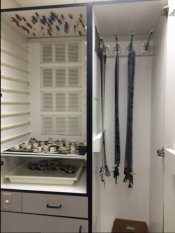
The film is dried in a tall cabinet. Film is clipped at top and weighted at the bottom - fan comes out of the unit on the left and through a small vent into the tall cabinet just to circulate the air. It does not have any heat at all. IMG_4333.JPG
The temperature of D76/water is roughly 70* and the stop bath/water is about the same. Fixer is room temperature and final wash is probably colder at maybe 65* and washes in wash tower 3-5 minutes.
I am concerned about the D76 mixture - if my water temp is not hot enough at 125* or what could be floating around in the D76 or school water!
I will post a contact sheet of a different student's who has them riddled through his entire roll! :sad:
 

Truzi

Member
Joined
Mar 18, 2012
Messages
2,685
Format
Multi Format
why does it keep rotating my images!?!?!?!

Oddly, while your thumbnails are rotated, the photos display correctly when I open them in a new tab. This is on Firefox on my work computer. On my home machine this doesn't happen (with only the version of Firefox being different).
 
OP
OP

mrs.martin

Member
Allowing Ads
Joined
Oct 2, 2014
Messages
18
Format
35mm
not sure about the negs showing Ys before drying. I will check the next batch of students. No hepa filter.
 
OP
OP

mrs.martin

Member
Allowing Ads
Joined
Oct 2, 2014
Messages
18
Format
35mm
Ys on image.jpg yet another one! :sad: I have had several students that this has happened to. We have filtered the D76 through coffee filters/colander to reduce sediment but no luck.
I have a serious concern about my use of the plastic light tight chemical bottles. I rinse them out very well, but now I'm thinking that is the problem. Maybe I shouldn't be reusing the dark brown plastic containers. Any thoughts?
 
Joined
Jan 21, 2003
Messages
15,715
Location
Switzerland
Format
Multi Format
View attachment 96178 yet another one! :sad: I have had several students that this has happened to. We have filtered the D76 through coffee filters/colander to reduce sediment but no luck.
I have a serious concern about my use of the plastic light tight chemical bottles. I rinse them out very well, but now I'm thinking that is the problem. Maybe I shouldn't be reusing the dark brown plastic containers. Any thoughts?

I don't know if it really matters, but I always keep bottles with developer, stop bath, fix, etc separate, so that they for example bottles that have had fix in them are later used to store developer.
Other than that plastic storage containers are widely used. Some people say they aren't good, but I've used the same bottles for 15 years and they have never failed me. I rinse them out once in a while, but not religiously.
 

winger

Subscriber
Allowing Ads
Joined
Jan 13, 2005
Messages
3,980
Location
southwest PA
Format
Multi Format
Plastic, per se, likely isn't the issue (many of us use plastic bottles). What may have happened is that the bottles got mixed around before this batch of chemicals was put in them.
I really wish I still worked at the lab - if I did, I'd have you mail me a frame or two and I could look at it under the scope (and maybe with other things).
I'd suggest getting new bottles and a fresh batch of D-76. Make sure that anything that touches a chemical is not reused for another one without seriously thorough washing. If the problem recurs, then at least one source may have been eliminated. The cost of chemicals is negligible compared to losing an image.
 

MartinP

Member
Allowing Ads
Joined
Jun 23, 2007
Messages
1,569
Location
Netherlands
Format
Medium Format
Earlier the OP mentioned that there was no control of temperatures during processing. I still think that someone might be using extremely hot liquid, or extremely cold, at some point in the process. It is very simple to avoid variance over half a degree and to avoid chemical contamination after all. A modicum of process-control is something that the students will have to accept, even if they wish to perhaps expand the idea in a sort of lomography-like way it would need to be deliberately recreated.
 

Chris Livsey

Member
Allowing Ads
Joined
Aug 10, 2008
Messages
635
Format
Medium Format
Whilst I cannot discount the temperature control being at fault, leading to partial reticulation as an explanation, I still cannot reconcile that this effect is so uniform across different students. Everyone, or at least a fair number, must be using the same temperature variance for the same time for this to be partial reticulation.
Samples to the manufacturer has to be the route, jpegs of prints on a forum is not going to bottom this.
 

MattKing

Moderator
Moderator
Joined
Apr 24, 2005
Messages
55,236
Location
Delta, BC Canada
Format
Medium Format
Is there a chemistry or biology classroom with a microscope in your school? Could you use that to take a closer look at the marks? Even a photomicrograph?
 

georgegrosu

Member
Allowing Ads
Joined
Oct 15, 2007
Messages
434
Location
Bucharest, R
Format
Multi Format
In order to get a response to defects in Y appeared on your film must the variant film.
Y defects can come from processing or FILM.
Problems that can occur on the film can be found here:
http://motion.kodak.com/motion/uplo..._en_motion_support_processing_h2415_h2415.pdf or
http://micro.magnet.fsu.edu/primer/photomicrography/bwprocessingerrors.html
I personally have not met on the film Y defects on film.
I saw the defects in the form of dots or spots.
When look the film emulsion defects in reflected light you see continue or a break?

George
 
OP
OP

mrs.martin

Member
Allowing Ads
Joined
Oct 2, 2014
Messages
18
Format
35mm
Film manufacture's response:

First of all, if all of your students are using the same film, from the same emulsion and some are getting it while others do not, the problem is not the film.
The problem is actually being caused by a chemical reaction.


Rick A

Subscriber
Allowing Ads
Joined
Mar 31, 2009
Messages
10,032
Location
Laurel Highlands
Format
8x10 Format
Are you getting the same marks on the Tri-X? It looks like rupture marks, like the emulsion bubbled and burst, leaving the 'Y' artifact. What dilution is the stop bath? Could it be the stop bath is too strong(improper dilution) and causing gas bubbles to form as a reaction. If I use stop for Foma film, I dilute to half recommended strength, I have had pinholes develop in the emulsion from normal stop dilution. I develop almost all Foma (Arista EDU) film in PMK Pyro these days and use two water rinses between dev and fix.
 

Xmas

Member
Allowing Ads
Joined
Sep 4, 2006
Messages
6,398
Location
UK
Format
35mm RF
Ok if you have low humidity and a forced draft you need to use more surfactant, shake reels dry until arm hurts and use a film squeegee (e.g. Kasier) when hung from clip with weight.

The squeegee needs to be cleaned before each wipe surfactant and protein scrubber - hand...

Film will dry quicker after sgueegee so they may need more separation than current.

I filter stock solutions cause they (primarily developer get contaminated by debris of the film) the fixer I dont filter much or ever. I otherwse get film chips embedded in emulsion occasionally, they never come off.

People will say they get scratches, not had one in decade, lots of film...
 
Joined
Jan 21, 2003
Messages
15,715
Location
Switzerland
Format
Multi Format
I'd suggest getting new bottles and a fresh batch of D-76. Make sure that anything that touches a chemical is not reused for another one without seriously thorough washing. If the problem recurs, then at least one source may have been eliminated. The cost of chemicals is negligible compared to losing an image.

And, clearly mark with markers that can not be erased which bottles are for developer, stop bath, and fixer... Never mix them.
 

winger

Subscriber
Allowing Ads
Joined
Jan 13, 2005
Messages
3,980
Location
southwest PA
Format
Multi Format
And, clearly mark with markers that can not be erased which bottles are for developer, stop bath, and fixer... Never mix them.

Yeah, I thought this, but didn't type it (coffee might not have been strong enough that day). The industrial strength Sharpies are great.

Also whatever containers are used to make the working solutions at the time of processing need to be marked well, not mixed around, and washed thoroughly. I know many people here use just one beaker to mix chemicals, but that really isn't going to help if the problem might be contamination. Anything that touches the chemicals between the purchased stock substance and what gets poured into the tank needs to be examined and cleaned thoroughly, or possibly replaced.

When students have had problems, what other common denominators have there been? Same person mixing those batches and not others? Water source different from the non-Y batches? Someone stirring with a wooden stick vs glass rod vs whatever else?
 

Truzi

Member
Joined
Mar 18, 2012
Messages
2,685
Format
Multi Format
Cool, I wasn't aware they still made the old-style Dymo.
 

Photo Engineer

Subscriber
Allowing Ads
Joined
Apr 19, 2005
Messages
29,018
Location
Rochester, NY
Format
Multi Format
You say earlier that this problem comes from a chemical reaction. What evidence do you have for this?

PE
 
Photrio.com contains affiliate links to products. We may receive a commission for purchases made through these links.
To read our full affiliate disclosure statement please click Here.

PHOTRIO PARTNERS EQUALLY FUNDING OUR COMMUNITY:


Ilford ADOX Freestyle Photographic Stearman Press Weldon Color Lab Blue Moon Camera & Machine
Top Bottom