• Welcome to Photrio!
    Registration is fast and free. Join today to unlock search, see fewer ads, and access all forum features.
    Click here to sign up

Xtol Oxidation

High Street

A
High Street

  • 0
  • 0
  • 11
Plato's Philosophy.

A
Plato's Philosophy.

  • 2
  • 2
  • 85

Recent Classifieds

Forum statistics

Threads
201,869
Messages
2,831,444
Members
100,992
Latest member
bob531
Recent bookmarks
0

Mainecoonmaniac

Member
Allowing Ads
Joined
Dec 10, 2009
Messages
6,297
Format
Multi Format
I do use wine bladders and they do well. I use XTOL replenished by mixing a fresh batch, splitting into half. One half I put in a wine bladder and the other half I put into a polyethylene bottle that I keep full. Replenished at 70mls per roll, the developer slowly get weaker. Towards about half way through the replenisher, subsequent negs get noticeably thinner. I just mixed a new batch and I'm going to replenish it at 90mls per roll. I don't think I can over replenish since I use the same strength developer to replenish. Another thing is that I've started to process my film through inspection. I start inspecting my film at about 80% completion then finish the rest under my film safelight.
 

Harry Lime

Member
Allowing Ads
Joined
Dec 10, 2005
Messages
495
Format
35mm RF
Are you suggesting the iron content of stainless steel catalyzes the Fenton reaction?

I'm not a chemist, just a photographer, so all I can do is relay my observations.

The vessel in question was a cheap stainless steel pasta pot that I had picked up at a discount store for the very purpose of mixing Xtol. It was made in China. I did notice that the pot became gray with age after I used it to wash my car. I'm pretty certain it wasn't pure stainless steel, since my parents have stainless steel cookware that is decades old and still looks like you would expect it to. I also had a similar problem with a water flask. It was supposedly stainless steel, but imparted a nasty taste to the water no matter how many times it was washed with scolding hot water and soap. That item was immediately retired.

Here is another observations. One time I was mixing XTOL in a plastic bucket and used an old metal coat hanger for mixing. That batch died almost immediately.

So, my layman conclusion is that XTOL does not play well with certain metals.
 

Rudeofus

Member
Joined
Aug 13, 2009
Messages
5,119
Location
EU
Format
Medium Format
Are you suggesting the iron content of stainless steel catalyzes the Fenton reaction?

Ryuji Suzuki made (there was a url link here which no longer exists) indicating that stainless steel is no good for ascorbate developers.
 

Rudeofus

Member
Joined
Aug 13, 2009
Messages
5,119
Location
EU
Format
Medium Format
But he also says it isn't a problem when the developer contains a chelating agent (Xtol has DTPA). He also seems to be referring to hot water. No idea what temperature range he's talking about.
Process chems don't spend six months in a tank, but Xtol stock solution should. You are correct, Xtol contains DTPA, but apparently it can be overwhelmed if there is too much iron ion around. A 1:1 ratio of iron to DTPA may not be enough to keep ascorbates stable.

I've been discussing this with Jerry who makes the point it is iron ions, not metallic iron we have to worry about.
If you put anything containing iron or iron ions into a container of water (and whatever else makes up a developer), some free iron ions will end up dissolved. Depending on developer composition, it may be only a few iron ions that actually stay dissolved, but if that developer contains a sequestering agent for iron, you shift the reaction balance, and fresh iron ions will enter the solution. Given enough time, all the sequestering agent will be saturated with iron, and the ascorbate will have a meeting with Mr. Fenton.
 
OP
OP

Alan Johnson

Subscriber
Allowing Ads
Joined
Nov 16, 2004
Messages
3,379
Regarding the initial tests, pH makes a difference in the keeping qualities of just about any reductant. Sulfite is an antioxidant, and it also alters the pH.

PE
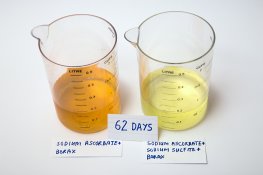
The oxidation test was repeated with the addition of Borax buffer (see attachments for color vs time).

........................................with sulfite..............................no sulfite
Sodium ascorbate......................12g......................................12g
Sodium sulfite ...........................20g
Borax decahydrate.....................10g......................................10g
Water to....................................1L........................................1L

pH start.....................................9.1.......................................9.2
pH day 38..................................8.9.......................................8.2
pH day 62..................................8.9.......................................8.2

Since the pH was the same on day 38 as on day 62 I will assume most of the ascorbate was oxidized by day 38.

(1) In absence of sulfite the ascorbate is probably oxidized first to the unstable dehydroascorbate and then to an unknown derivative colored orange.
(2) In presence of sulfite,I suggest that ascorbate and dehdroascorbate combine to produce a semiquinone (shown to the left of that labelled DHA under "Forms of ascorbate" here:
http://www.healthcare.uiowa.edu/cor...erpubs/pdf/Buettner-Ascorbate-Chemistry-1.pdf
The semiquinone is then sulfonated, as happens with hydroquinone, to a (near colorless?) ascorbate sulfonate.

This may also explain the lack of color when Xtol first oxidizes.
There might be a different explanation but IDK what.

 

Attachments

  • Ascorbate +Borax.jpg
    Ascorbate +Borax.jpg
    418.9 KB · Views: 124
  • Ascorbate+Borax 1.jpg
    Ascorbate+Borax 1.jpg
    427.2 KB · Views: 153

Photo Engineer

Subscriber
Allowing Ads
Joined
Apr 19, 2005
Messages
29,018
Location
Rochester, NY
Format
Multi Format
Nice comparison.

They mention in the article that D and E support each other in a sense, but since E is not very water soluble, we can't use it. Also, in their "pecking order" the Iron is not very important, but in ours it becomes nearly paramount.

PE
 

sfaber17

Member
Allowing Ads
Joined
Jun 1, 2014
Messages
245
Location
Illinois
Format
35mm
I didn't see any color when I tested ascorbic acid oxidation, but it was only over a period of 4 hours. The tap water solution lost 20% of its ascorbic acid already in that time as measured by titration with iodine. Once oxidized, the DHA degrades into those straight chain sugar acids in a mater of minutes. Maybe after a month you are growing orange cultures of bugs eating the sugar acids :smile:
 

Rudeofus

Member
Joined
Aug 13, 2009
Messages
5,119
Location
EU
Format
Medium Format
A few things come to mind:
  1. Sulfite doesn't buffer at all above pH 8.0. If you think you have fully oxidized Ascorbate after 38 days, pH of both liquids should be about equal, since Na2SO4 has little effect on pH in this range.
  2. There are research papers which claim that Sulfite + HQ oxidizes much slower than Sulfite or HQ alone. A similar process could be happening here.
  3. You should be able to test presence of unoxidized Ascorbic Acid by taking a droplet of your liquid, adding trace amounts of Phenidone and putting that on a film clip in broad daylight.
 
OP
OP

Alan Johnson

Subscriber
Allowing Ads
Joined
Nov 16, 2004
Messages
3,379
Rudi,
I did actually do a test similar to your part (3).
On day 62 , metol 3g/L was added to samples from both solutions and film leaders developed 1 hr stand development.There was no blackening in the without sulfite solution and minimal blackening in the with sulfite solution.
In the with sulfite solution the slight blackening could have been due to development in metol-sulfite or as you suggest, metol in residual ascorbate.Anyhow it indicated there was little activity and no significant ascorbate left.

It seems to me the key factor is that the dehydroascorbate produced by ascorbate oxidation has to undergo a different chemical reaction in the with and without sulfite solutions to give the different colors.
 

Rudeofus

Member
Joined
Aug 13, 2009
Messages
5,119
Location
EU
Format
Medium Format
The problem with your test is twofold, and 0.03 g/l Phenidone instead of 3 g/l Metol would have avoided both: first, there is a good chance that Metol develops at pH 8.9 but a lot less so at pH 8.2, so the difference could have been due to pH difference more than from difference in Ascorbate. Second, development by Metol requires Sulfite, too, so the difference could have come from the presence/absence of Sulfite.
 
OP
OP

Alan Johnson

Subscriber
Allowing Ads
Joined
Nov 16, 2004
Messages
3,379
These tests are interesting but not really relevant to my main point, that there are two different reactions, colorless to yellow (with sulfite) and colorless to orange ( without sulfite).Even if there is a little ascorbate left after 38 days, with sulfite it is still going to be the yellow reaction.Nobody has Xtol gone orange.The dehydroascorbate reacts in a different way in presence of sulfite I believe.
 

sfaber17

Member
Allowing Ads
Joined
Jun 1, 2014
Messages
245
Location
Illinois
Format
35mm
I agree with your conclusions but the colors seem backwards. I'd expect the sulfonate product to be orange and the threonic acid and oxalic acid to be colorless. If you had iron in the water that might explain it, otherwise maybe something else happens to the products after a long time. I does seem unlikely any organisms could grow in the borax solution.
 

Photo Engineer

Subscriber
Allowing Ads
Joined
Apr 19, 2005
Messages
29,018
Location
Rochester, NY
Format
Multi Format
Many sulfonates are colorless.

But the fact remains that we don't know exactly what went on and what the final products are.

Good experiment, as I said, but not enough information.

PE
 

Rudeofus

Member
Joined
Aug 13, 2009
Messages
5,119
Location
EU
Format
Medium Format
If you dilute the dark orange liquid 1:100 with water, does it have the same hue as the yellow liquid? Also, if you add Sulfite to the orange liquid, does its color change?
 
OP
OP

Alan Johnson

Subscriber
Allowing Ads
Joined
Nov 16, 2004
Messages
3,379
If sulfite is added to the orange liquid it does not bleach it.The dehydroascorbate evidently cannot be regenerated from the orange substance, that reaction is not reversed.I tried this some time ago.
The yellow is the eventual result of ascorbate and dehydroascorbate combining to make two molecules of semiquinone which is then sulfonated.If you try to make yellow from the orange stuff , even if successful it wont be the same chemical substance.
Experimentally one would like to know if there is a chemical test that could identify the presence of sulfonate in oxidized Xtol but I don't think there is.
 

Gerald C Koch

Member
Allowing Ads
Joined
Jul 12, 2010
Messages
8,131
Location
Southern USA
Format
Multi Format
Ascorbate ion oxidizes in stages. IIRC correctly, oniy the product of the first oxidation (which is colorless) can be regenerated back to ascorbate. Once past this stage all developing power is lost.
 
Photrio.com contains affiliate links to products. We may receive a commission for purchases made through these links.
To read our full affiliate disclosure statement please click Here.

PHOTRIO PARTNERS EQUALLY FUNDING OUR COMMUNITY:


Ilford ADOX Freestyle Photographic Stearman Press Weldon Color Lab Blue Moon Camera & Machine
Top Bottom