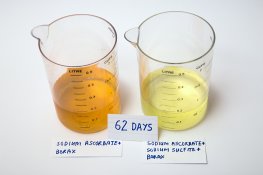
Regarding the initial tests, pH makes a difference in the keeping qualities of just about any reductant. Sulfite is an antioxidant, and it also alters the pH.
PE
The oxidation test was repeated with the addition of Borax buffer (see attachments for color vs time).
........................................with sulfite..............................no sulfite
Sodium ascorbate......................12g......................................12g
Sodium sulfite ...........................20g
Borax decahydrate.....................10g......................................10g
Water to....................................1L........................................1L
pH start.....................................9.1.......................................9.2
pH day 38..................................8.9.......................................8.2
pH day 62..................................8.9.......................................8.2
Since the pH was the same on day 38 as on day 62 I will assume most of the ascorbate was oxidized by day 38.
(1) In absence of sulfite the ascorbate is probably oxidized first to the unstable dehydroascorbate and then to an unknown derivative colored orange.
(2) In presence of sulfite,I suggest that ascorbate and dehdroascorbate combine to produce a semiquinone (shown to the left of that labelled DHA under "Forms of ascorbate" here:
http://www.healthcare.uiowa.edu/cor...erpubs/pdf/Buettner-Ascorbate-Chemistry-1.pdf
The semiquinone is then sulfonated, as happens with hydroquinone, to a (near colorless?) ascorbate sulfonate.
This may also explain the lack of color when Xtol first oxidizes.
There might be a different explanation but IDK what.