This intrigues me. I hope that there can be a wider discussion of this.
Each stop is twice or half as much light as previous. If we shine 512 units of light at a target then if there were 11 cards each with a reflectance of twice the previous then:
0=1/2
1=1
2=2
3=4
4=8
5=16
6=32
7=64
8=128
9=256
10=512
So the mid point is 5 which will reflect 16 units of light. 16 is 3.125% of 512.
The point where 18% is reflected is where the reflectance is 92.16 units of light and that is between card 7 and card 8, 2 1/2 stops less than the full 100% of 512.
If we have 6 cards and shine 16 units of light at them, then;
0=1/2
1=1
2=2
3=4
4=8
5=16
The mid point is between cards 2 and 3 which is 3 units of light. 3 is 18.75% of 16 which is close enough and is 2 1/2 stops from 100% of reflectance.
18% is always 2 1/2 stops less than whatever is 100% reflectance in the same light.
However, its not that simple. The first example above is a false representation of real life except in a lab prepared experiment.
The second example of 5 stop range is more life like.
But again its more difficult than that becasue your spot meter does more stuff to reduce the reading. It divides by approx 12.5 which is same as taking 8% of the reading.
trying to keep all this in your head when doing practical photography simply isn't necessary.
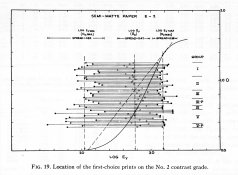
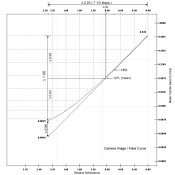
Typically the part of your subject which is in direct light will represent only a portion of that range and the other portion will be in varying degrees of shade. So where do you place your grey card if you are using one? The answer is to tear it up and forget all about grey cards and use a spot meter to measure an actual highlight and shadow, determine the range and decide whether you want to expose for a shadow or a highlight and place the exposure where you want it on your film curve. If you must use a grey card then you may as well use an incident meter which will likely be more consistently accurate due to difficulty of using a grey accurately which requires specific angles between card, light source and camera for it to give an 18% reflectance.
Personally I have adopted the methodolgy of calibrating EI and Dev to capture that full 10 stop range so thats its printable on G2 paper. I then meter for and expose for a highlight except where the range is too long in which case I expose for a shadow.
Last edited by a moderator: