
• Welcome to Photrio!
    Registration is fast and free. Join today to unlock search, see fewer ads, and access all forum features.
    Click here to sign up

What is a good, cheap handheld exposure meter ?

Recent Classifieds

Forum statistics

Threads
202,830
Messages
2,846,110
Members
101,553
Latest member
SeattleMC
Recent bookmarks
0
I have a number of meters but I usually end of grabbing my Sekonic Twinmate. Simple, small, plenty accurate for my needs. By contrast, I have a Gossen Digisix and find it to awkward to change settings. Maybe if I used it more often it wouldn't be awkward.

TTArtisans has a tiny meter like the Revini mentioned in post #21. I have one of their lenses and like the build quality (for the price). Might be worth looking into.
 
I realize this is heresy, but one of the least expensive ways to do spot metering is with a digital point and shoot with that feature. For example, the Kodak PIXPRO FZ55 sells new for $99 and includes a spot metering mode. Used models are even less.

While I've owned a Minolta Light Meter IV F for about 20 years and it works well for me, I only have the 10-degree spot meter attachment. So except for flash metering, I'm more likely to use the Pocket Light Meter app on my iPhone, which also gives me color temperature. I even have an inexpensive clip-on dome for incident light, or at least something close enough to it.
 
In these modern times, is there any cheap and accurate hand held light meter I can buy? Please advise.
Thanks.
The latest version of Sekonic L-308 you can afford. Easy direct readout. Direct or incident metering.
All the “modern” match needle meters are for hipsters with too much free time.
 
I realize this is heresy, but one of the least expensive ways to do spot metering is with a digital point and shoot with that feature. For example, the Kodak PIXPRO FZ55 sells new for $99 and includes a spot metering mode. Used models are even less.

While I've owned a Minolta Light Meter IV F for about 20 years and it works well for me, I only have the 10-degree spot meter attachment. So except for flash metering, I'm more likely to use the Pocket Light Meter app on my iPhone, which also gives me color temperature. I even have an inexpensive clip-on dome for incident light, or at least something close enough to it.

I'm like you. I used to use my Minolta IIIf with 10 degree spot only. Incident and reflective. (I thought your IV comes with a 5 degree?) Now I often use my digital Olympus E-PL1 micro 4/3 camera as a meter. It has matrix, center average, and spot. Reflective only, no incident readings.) The added advantage over dedicated light meters is that it has a histogram and blinkies. It also can be switched to BW so I can see what BW film would look like. I also use it as a director's viewfinder setting up my shots and selecting which lens to use before setting up the film camera and tripod. I also use it to take a quick video of the subject while dictating the settings I use. These can be transcribed later.
 
All the “modern” match needle meters are for hipsters with too much free time.

Great!! I've gone straight from old fart to Gen Z. I feel young again... Well, no, I don't.

I much prefer meters that have dials on them. That mine have needles instead of LCD's doesn't bother me. If I need a new meter I will probably get a Gossen Digisix.
 
I use a Gossen SCB. mine was modified by Zone VI with a zone scale and perhaps adjusted for B&W as opposed to color. I also use a Weston Master 6, it is selenium cell meter but is spot on, with a 1/2 stop of the Gossen and my Minolta 9 in average mode. The Master 6 is easy to with one hand while the Gossen I find takes two hands, one hold the meter the other to turn the dial to match the diodes. Both the Weston and Gossen have a incident meter function, with the Weston you need to the inversa cone tha clips over the light cell, while the Gossen has a small dome that slides over the cell which is handy. The Weston in incident mode matches my Sekonic incident meter while to the Gossen is almost a stop off. With older meters it is just a matter of time until the cells will no longer be accurate. Yesterday I tossed out my Weston Ranger 9s, both were over 3 stops off and I could not bring back into adjustment. I am looking for a newer digital readout meter.
 
I am back to using my 55 y/o Gossen Super Pilot CdS. It is still accurate with the proper voltage (WEIN zinc-air cell or #386 silver-oxide in MR-9 adapter) and is very capable, including down to EV -6. I also have two defunct Gossen Luna Pro SBCs. Therein lies the problem - no one in N. Am. or elsewhere will repair "legacy" Gossens, not even Gossen in Germany. So, if anything happens to my Super Pilot I'll be looking at Sekonic - they do have US service.
 
Last edited:
What is the "FE"?

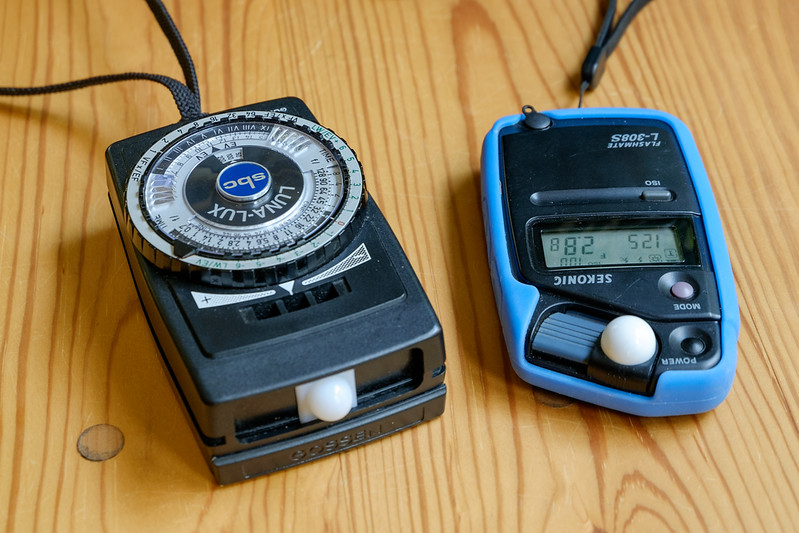
In this photo, the two meters I have don't look all that different in size, but in real life the difference is more noticeable.


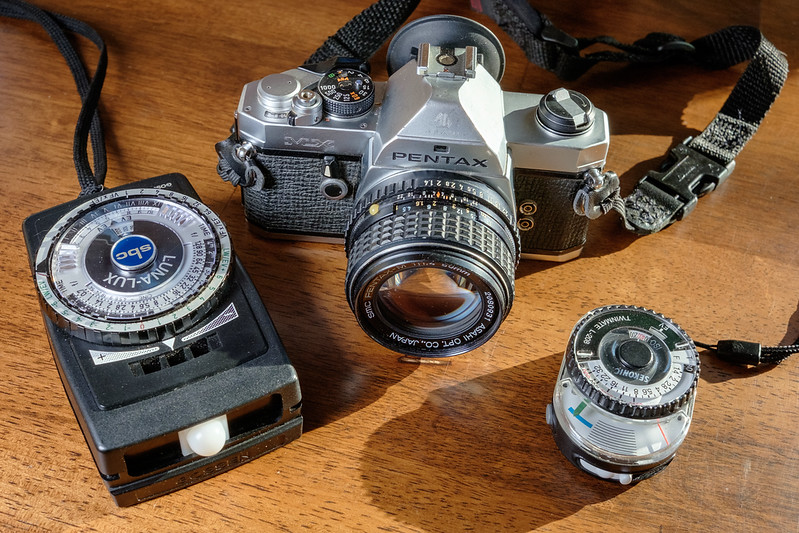
And here is the Luna-Lux compared to the smaller L-208 mentioned in posts #15 and #17

yes I see . Thank you. That Luna Lux is almost as big as an SLR. The FE is the Nikon FE SLR camera that has a very very good meter.
 
It should probably be mentioned, there are many cheap, used light meters out there which used selenium cells. Selenium was the technology used before being replaced by CdS (cadmium sulfide). And CdS was in turn replaced by silicon cells. (If you see "SBC" on a Gossen meter, that stands for Silicon Blue Cell.)

Sekonic did use a selenium cell in one of their meters up until fairly recently, but for the most part, selenium has been abandoned in favor of silicon. Today, many (most?) of the older selenium-based meters are no longer accurate. You can easily spot a selenium cell by their distinctive appearance -- a largish glassy looking panel with a bumpy surface like on the front of this old Gossen Pilot 2. I loved that meter, until it became unreliable.


Some of the selenium meters do not require a battery! Cool, but today, I would stay away from most selenium meters, unless you can find one known to be accurate.

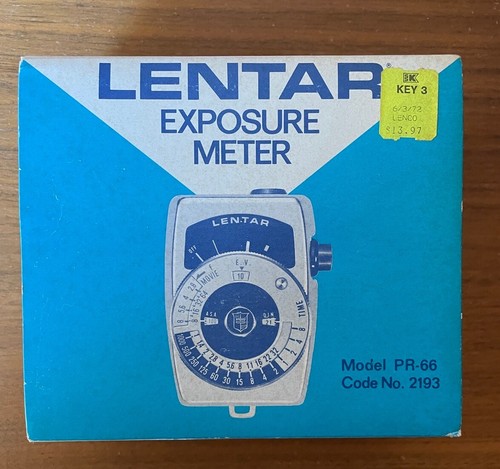
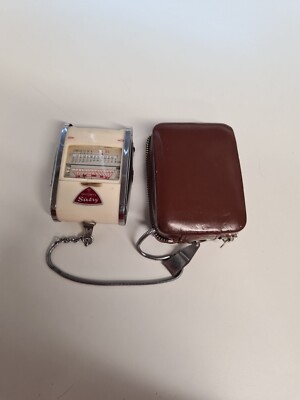
This is the kind my dad left me. Is it selenium? Even though it doesnt have the bumpy, glass block type lens on it?
 
I too strongly recommend the Gossen Lunapro SBC is a good "low cost" and accurate light meter. It can be found on ebay for ~$50 or so and it takes 9v batteries and has spot meter attachments available.
 
I use a Weston VI, it is selenium, I just checked against my Gossen SBC, spot on. In low light the SBC is much better. If you are for cheap then look for a working GE DW 68, it is a selenium cell, comes with hood. In goodlight the lid is closed, in dimer light the lib pops up, in very poor lighting the hood comes off. I have one, I still use when shooting with my Argus C3, although it matches my Watson and Gossen and I could use it all the time. The trick is making sure it is working. Somewhat fiddley to set the ASA.

All of my old CdS meters have failed or on last legs, My Soligor spot meter is dodgy, as the meters in my older cameras Pentax, Topcon, Petri, Konica. I just tossed out my Weston Ranger 9s, CdS.
1727891511674.png
 
I too strongly recommend the Gossen Lunapro SBC is a good "low cost" and accurate light meter. It can be found on ebay for ~$50 or so and it takes 9v batteries and has spot meter attachments available.

doesnt it use two 1.35v mercury batteries?
 
This is the kind my dad left me. Is it selenium?

It's a CdS meter. Anything old(ish) that takes a button cell battery uses a CdS element for sensing light. The meter will also have a press-to-read switch on the side - not definitive as Se meters with trapped needle movements can also have a switch on the side that releases the needle so you can get a reading.
 
This is the kind my dad left me. Is it selenium? Even though it doesnt have the bumpy, glass block type lens on it?
Without seeing the front of the meter, I can't tell if your Lentar meter has a selenium cell.

But looking at the owner's manual for the Lentar PR-66 <https://www.cameramanuals.org/flashes_meters/lentar_pr-66.pdf> I see it has a CdS photo cell, so no, not selenium.
 
The latest version of Sekonic L-308 you can afford. Easy direct readout. Direct or incident metering.
All the “modern” match needle meters are for hipsters with too much free time.

Funny that you suggest something like the L-308 based on time, given that I find they take too long to fiddle with to get the settings as I want. My main meters are dial-number match rather than needle match, but it is basically the same concept either way, and I find they are so much faster to work with simply because they have fewer functions and less to faff about with.

The mechanical dial scale is just easier and faster to get information back from to make decisions.

Metering in ISO 400 for my main camera but want to take the next photo on my secondary camera with ISO 100 film? Don't change settings, just twist the dial [that I'm already naturally holding in my fingers just to read the thing] back two whole stops.

Applying filter corrections to the exposure? Don't change settings, just twist the dial. [We'll ignore the risk of twisting it the wrong way... That's just me being dumb and I could totally apply that same error with digital settings I bet.]

Debating aperture vs time setting options, they're all right there on the dial for you.


Battery died and you forgot to check spares were still in today's gear bag? It is still a very useful tool for Sunny-16 eyeballing.

Physical dial meters are just better* than their fancy 'full digital display' cousins.


*Your mileage may vary and your personal needs should not be ignored for this tongue in cheek commentary.

I'm generally a fan of my Gossen Digiflash2, but dislike the lack of a back button option when changing settings or modes. And personally have found all the other modes beyond meter and flash meter to be annoying, but that would be resolved with a back button...

And yes, I do have a beard and typically wear a flat cap. Why do you ask?
 
doesnt it use two 1.35v mercury batteries?

No - the SBC version is the more modern version and it uses the 9V battery.
It is badged as a LunaPro in only one country in the world - the USA.
Everywhere else it is badged as a Profisix.
It isn't as small as my Gossen Digiflash or the simpler non-flash metering Digisix version, but it isn't as large as the photo above makes it appear.
The Profisix/LunaPro SBC is a system meter that can be used with a of number of attachments like a flash meter attachment or a spot meter attachment or an enlarging meter attachment etc.
I had and used one for years and it was great.
 
doesnt it use two 1.35v mercury batteries?

I hesitate to bring it up, because the model names for Gossen meters are such a mess. @Sirius Glass is recommending the "Gossen Lunapro SBC" -- the SBC part indicates the later model which does take a 9V battery. The older model, "Gossen Lunapro" without the SBC takes the mercury batteries.

Having said that, I believe almost every Gossen meter goes by a different model name in the US compared to the same meter sold in Europe, so it is somewhat difficult to talk about Gossen meters on an international forum.

oops, cross posted with @MattKing
 
Gossen Digisix is what I use and it's another shoe meter. They still make them, or a used one is around $100. Has incident and reflective metering, reflective isn't a spot meter but has roughly the angle of a 100mm lens.

It's a bit plasticky but I've had mine 15 years and it still works. Takes a typical large thin watch battery and lasts me a year or two on each cell. Also fits easily in a shirt pocket.

I did not realize they sold a shoe adapter for the Digisix. I found this picture on the internet. Looks nice, I might have to get one to add to my collection of small meters.

iu
 
No - the SBC version is the more modern version and it uses the 9V battery.
It is badged as a LunaPro in only one country in the world - the USA.
Everywhere else it is badged as a Profisix.
It isn't as small as my Gossen Digiflash or the simpler non-flash metering Digisix version, but it isn't as large as the photo above makes it appear.
The Profisix/LunaPro SBC is a system meter that can be used with a of number of attachments like a flash meter attachment or a spot meter attachment or an enlarging meter attachment etc.
I had and used one for years and it was great.

well now I have to get one Matt.
 
doesnt it use two 1.35v mercury batteries?

The Gossen Luna Pro uses 2 1.35V mercury batteries and it has Cds cell. The Gossen Luna Pro SBC as its name implies has Silicon Blue Cell (SBC which is simply silicon photo cell with blue filter to correct for its spectral response as silicon photo cells are very sensitive to IR and red) and uses 9V battery.
 
I have one of these: -


I never use it, but just like the design and the way it works. It is in a box somewhere.
 
The Gossen Luna Pro uses 2 1.35V mercury batteries and it has Cds cell.

Just for completeness, Gossen offers (once again) a voltage conversion device so "modern" silver cells can be used. It actually works quite good.
 
Sekonic l158 is tiny, doesn't use batteries and for $20 it a great backup to keep in your bag.
 
Photrio.com contains affiliate links to products. We may receive a commission for purchases made through these links.
To read our full affiliate disclosure statement please click Here.

PHOTRIO PARTNERS EQUALLY FUNDING OUR COMMUNITY:


Ilford ADOX Freestyle Photographic Stearman Press Weldon Color Lab Blue Moon Camera & Machine
Top Bottom