• Welcome to Photrio!
    Registration is fast and free. Join today to unlock search, see fewer ads, and access all forum features.
    Click here to sign up

Stand & Semi Stand - Is it the Best Development Technique?

between takes

H
between takes

  • Tel
  • Mar 21, 2026
  • 2
  • 0
  • 21
Tompkins Square Park

A
Tompkins Square Park

  • 9
  • 1
  • 95

Recent Classifieds

Forum statistics

Threads
202,862
Messages
2,846,733
Members
101,574
Latest member
JRSCollection
Recent bookmarks
0
I've tried it. Results can be good. But in my experience too much chance of weird streaking/fogging....


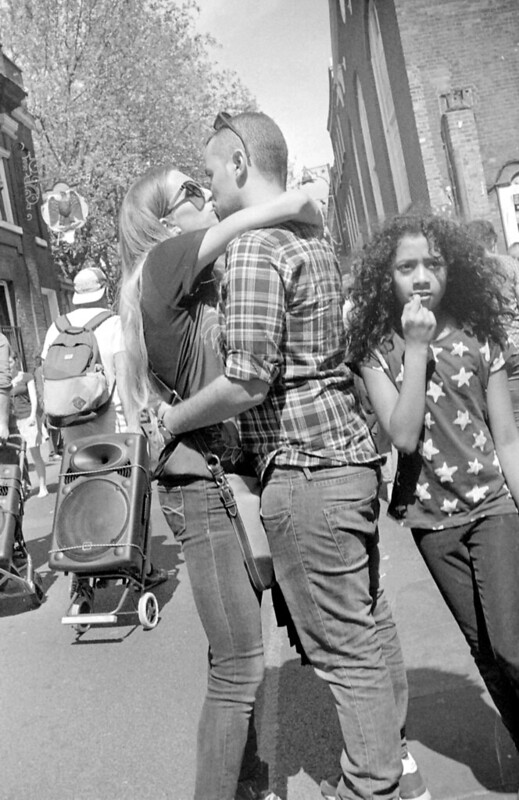
It's a good photo with decent tonality but I see the weirdness I often see when I've done stand development: sort of a fogging or haziness in some areas particularly over the kinky-haired girl's head on the right.

Fogging or haziness still there?
View attachment 157854
Ah, ah! Now, that is tricks that can't be mentioned here and I don't know none of them.
I have a cheap S word and all I do is press the button.
That is very nice Mark!
Thanks! :smile:
 
The main cost in shooting film is the film itself. Developer is cheap. Using a developing method that has problems to save a few pennies strikes me as being foolish. There is a difference in being frugal and being niggardly.*

* Yes,yes, I know that there are dumb, stupid and ignorant people who would love to repurpose this word. But it has been in the English language for several centuries meaning "to hate to spend money" and nothing else.
 
Last edited:
Ah, ah! Now, that is tricks that can't be mentioned here and I don't know none of them.
I have a cheap S word and all I do is press the button.
That is very nice Mark!
Thanks! :smile:
Giggle, yes the trick is on the edge, but with purpose.

The problem I'm trying to root out here is the popular perception that film exposure and development somehow determines what the final positive looks like. That's simply not true unless you are shooting slides or as in your particular case where you are (by default) allowing the programmer that designed the software for the scanner you use to make the printing choices for you, that's not the norm.

The reality is that a negative film exposure and development are only loosely connected to the positive we might create. In most cases a print shows only a subset of what's available on the negative and that subset is determined by the choices we make during the printing process.

For example on many of my HP-5 negatives there may be several stops of extra shadow detail and several stops of extra highlight detail that I simply choose not to print. Instead I regularly choose to print using just 6-7 stops from somewhere in the "middle" the film curve.
 
I had never heard of stand developing until this year or late last year. Reckon I'll stick to the old ways.
 
I had never heard of stand developing until this year or late last year. Reckon I'll stick to the old ways.
You mean the old ways, like the ones used by Ansel Adams (who used reduced agitation when he had the need for compensating effect)?
 
Nope-my old ways of following the manufacturer's recommendations and then tweaking in accordance with my methods of agitation and developing times. If I wanted less contrast, less developing time or went to 1:100 instead of 1:50...the "old ways".
 
A number of the "old ways" were formulated for old films no longer around. For example, you could do all kinds of things with long-scale thick-emulsion Super-XX that wouldn't work with today's thin emulsion products, like water-bath technique. On the other hand, we now have access to quite
a number of tricks and developers which previous generations didn't either discover yet, or never widely took advantage of. If good ole AA had read
the playbook of what contemporaneous color labs were doing with curve and contrast control, he'd have probably have needed to add a whole additional volume to that Basics set.
 
I've found on FP4+ the resolving power actually goes down with standing development in comparison with Rodinal 1+25 and Xtol for example. Some films overdevelop and heavily shoulder/compress the highlights and people are calling it 'compensation' when it's not, giving the opposite curve shape to what they think compensation does.

Never really had issues with streaking, fogging or uneven development though
 
Last edited:
I've found nothing that's better than Rodinal with FP-4. The tonal range is far better than any other film or developer I've used with that film. I have a royal blue trash can with black wheels and a black top. Tri-X and HP-5 will not distinguish between those two colors but FP-4 will.
 
I've found nothing that's better than Rodinal with FP-4. The tonal range is far better than any other film or developer I've used with that film. I have a royal blue trash can with black wheels and a black top. Tri-X and HP-5 will not distinguish between those two colors but FP-4 will.

Do you stand or conventionally develop?
 
If you've ever spent time on a car or motorcycle forum, you'll have seen an "oil thread" where everybody pitches in with "what has always worked for them" and proclamations that "once I changed to Pennvoline 12W65, the car just plain ran better and so it must be true.

Stand/semi-stand threads are the oil threads of photography forums. There is no consensus, because there is no best. Try it for yourself and see if it works for you.

It works for me and I can adjust my prints to the way I want them to look, so I use semi-stand nearly exclusively. I've tried pure stand and don't like it, so I don't use it.
 
I had Minor White's yellow handbook and remember that approach. I could just never figure out how you developed for the shadows while agitating for the highlights. Now, exposing for the mid-tones I understood.
 
Develop longer: Dilution plays a big role.
 
As I mentioned earlier, never did stand developing or intend to. I have good luck just following Kodak or Ilford's recommendations that usually required a decrease in developing time. With FP-4 I use 1:75 Rodinal at 7 minutes and negatives look good, printed easily and if I post an image here there's no problem.

I have found that with Tri-X and HP-5 at ASA 250 developed in HC-110 Dil H gives me great quality and I pursue that success no further. I will experiment with other developers like Xtol but usually go back to what worked for me to begin with.
 
Perhaps the manufacturers recommend time and temperature because it's the best compromise for mass commercial development.
:smile: Or more likelly, perhaps the manufacturers want people to do something that works reliably and shows their product off in the best possible way?
 
I had never heard of stand developing until this year or late last year. Reckon I'll stick to the old ways.

You're not the first person to make this comment. Outside of APUG there seems not be much interest. This fact should tell us something.
 
Last edited:
Outside of APUG there seems not be much interest

Not so sure about that.
Before I discovered APUG, just about everything I read online about development techniques advocated stand as the panacea for all ills.
It's still rife in the bigger Flickr film groups (the biggest of which dwarfs APUG in terms of membership)
 
I've found nothing that's better than Rodinal with FP-4. The tonal range is far better than any other film or developer I've used with that film. I have a royal blue trash can with black wheels and a black top. Tri-X and HP-5 will not distinguish between those two colors but FP-4 will.
Well it clearly works for you with FP4 and Rodinal but I infer from this that rodinal will not distinguish between royal blue and black with HP5+ or Tri-X or am I wrong to infer that it was rodinal with HP5+ and Tri-X? If so what was the developer with these two other films?

It just seem strange that with FP4 that there is a combination of film and developer that distinguishes between royal blue and black but two other films and developer( Rodinal or unspecified) fail to be able to make this distinction between royal blue and black.

Might it be that you simply have the exposure and development nailed with rodinal and FP4+ but have not quite managed this with HP5+ and Tri-X?

pentaxuser
 
There does appear to be a sudden obsession in more recent years with stand and semi stand development and it's mostly from less experienced photographers.

It's not ideal with smaller formats but can be more useful when contact printing LF negatives. People are expecting far more than they are getting from it and in most cases would get higher quality using standard techniques.

Ian
 
I'd be amazed if very much of the film sold now ever sees the negative stage of an enlarger.

So long as your development is reasonably even, any of the effects that stand development might have to make wet printing difficult are easily compensated for in digital post-processing after scanning.
 
Grr that stupid bloody popup!
 
Photrio.com contains affiliate links to products. We may receive a commission for purchases made through these links.
To read our full affiliate disclosure statement please click Here.

PHOTRIO PARTNERS EQUALLY FUNDING OUR COMMUNITY:



Ilford ADOX Freestyle Photographic Stearman Press Weldon Color Lab Blue Moon Camera & Machine
Top Bottom