• Welcome to Photrio!
    Registration is fast and free. Join today to unlock search, see fewer ads, and access all forum features.
    Click here to sign up

Rotary processing for roll film - streaking or uneven development more likely?

Recent Classifieds

Forum statistics

Threads
202,848
Messages
2,846,425
Members
101,564
Latest member
swedafone
Recent bookmarks
0

Michael Mutmansky

Member
Allowing Ads
Joined
Sep 7, 2002
Messages
652
Location
Sacramento
Format
Medium Format
Folks,

Over the past almost 40 years of my photography, I don't think I've ever done rotary processing of roll film. I've done the normal inversion tank approach for everything that I can recall and when I did have a Jobo, it was used for sheet film (4x5, and larger using Expert drums). I never used it for roll film processing. Above 8x10 film size, I mostly processed in trays.

I'm back to shooting film, but only 120, and I've been doing it through the traditional Jobo 1500 series tanks and using inversion processing. That works well, but I'd prefer to automate it some so I can put my attention on getting a new batch of chems ready or for other tasks in the darkroom because I realy have to be more efficient with my time.

As I see it, I have 3 main choices, with some having options within:
  1. Jobo CPE or Filmomat Light
  2. Jobo Silverbase or similar from China
  3. Heiland TAS
Two of the main options are rotary. Some options are cheaper than the third option so that is a factor, but frankly, if the Heiland is the best option, then I'll go that route.

The CPE or Filmomat Light allow a water tempering bath which could be very handy for color processing, but I doubt it is really all that necessary for B&W processing. I could just use them without the water, though, but they are a bit more bulky because of that capability.

Next on the list is the Silverbase and all of the Chinese rotary roller units out there. The sad thing is that the Jobo Silverbase is about the sme price as the Filmomat Light, so there's something attractive about just buying that one instead of what appears to be grossly inflated prices for the modern Jobo product. The Chinese products are a lot less expensive, but they are probably nowhere near as robust, so I'm not as incliined to go that route.

I care about the quality of the processing (in this respect, I mean eveneess, not absolute density conrol aspects, ala the Zone System, because I'm scanning after this step, so I don't need to be too precise with the DR of the negatives), and one thing I have seen on occasion with Jobo rotary processing is bromide drag. That never happened with the Expert drums, but I have seen it when there is laminar flow in a drum from the regular rotation. In roll film, I would be concerned more about surge marks from the spools and if the rotary motion back and fourth causes this to be in the same location al the time, it will cause density artifacts.

What I'm interested in is whether I really am better off going the Heiland TAS route for this processing and foregoing the rotary approach because I will get consistentily superior results from keeping an inversion approach for my processing. I see comments/question on here from people who have had problems with roll film in the Jobo but I feel that there isn't enough data to have a clear understanind whether this is an edge case or if it may be more common, especially when looking carefully at the negative with respect to tingls like development uneveness.

I'm looking for some advice/recommendations/experiences for people who have done rotary processing with 120 fim and how that experience compares to inversion, etc.

Many thanks,

---Michael
 
Michael, I own the #1 and #3 and I am absolutely in the Heiland TAS lovers' camp. It is superior to rotary processors in several ways except two. But first, the benefits:
  • Better agitation: rotation + inversion, with configurable pause intervals and rotation speed.
  • Tiny footprint
  • Reasonable price
  • Extremely well built. IMO it's the Leica of film processors.
And here are the drawbacks:
  • Inversion requires more chemistry than rotary processors
  • Not suitable for E-6 because there's no water bath
It is worth noting that the water bath is not needed for C-41. Before purchasing my rotary processor I've been developing C-41 in the TAS with excellent results, as verified by control strips and a densitometer. The developer temperature in a tank simply doesn't drop all that much in 3 minutes. You can run your own tests, but in my case the loss was about 1F in 3 mins, which means you need to start with 100.5F and it will be 99.5F in the end.

The only reason I've added a rotary processor to my TAS was my interest in shooting transparencies and sheet film.
 
I've done a lot of rotary processing of 120, mostly XTOL stock in 1500 series tanks in the last 10 years Jobo CPP, CPE, Duolab, and recently the Silverbase.
I used Paterson and Nikor tanks for 30 years before the Jobo.
I've not seen any differences in uniformity.
If you aren't going to process E6 you can get by without a fancy machine
I recently purchased a Silverbase, I've used it 2 or 3 times. Seems to work great. It sounds rugged, made in Germany. All you need is a tank magnet and you can use existing tanks. You can even process 6 sheets of 4x5 with the 2520 tank.
 
A word of advice: if you end up getting the TAS, you may find its speaker to be too loud. That's an easy fix: take the top cover off and you'll find the PCB with a tiny speaker on it. You can stick one of those self-adhesive furniture pads on it to make it quiet.

Regarding the uniformity of development: yes, I have seen some of that in rotary processors, and only with 120 film and only with C-41. There are 5 variables to tweak: presoak-or-not, the chemistry volume, the rotation speed, the tank diameter (2500 vs 1500), and whether you have one or two rolls on a reel. Paradoxically, people report different results for these combinations. Some are getting uneven development on faster speeds, while others report the opposite.
 
Michael, I own the #1 and #3 and I am absolutely in the Heiland TAS lovers' camp. It is superior to rotary processors in several ways except two. But first, the benefits:
  • Better agitation: rotation + inversion, with configurable pause intervals and rotation speed.
  • Tiny footprint
  • Reasonable price
  • Extremely well built. IMO it's the Leica of film processors.
And here are the drawbacks:
  • Inversion requires more chemistry than rotary processors
  • Not suitable for E-6 because there's no water bath
It is worth noting that the water bath is not needed for C-41. Before purchasing my rotary processor I've been developing C-41 in the TAS with excellent results, as verified by control strips and a densitometer. The developer temperature in a tank simply doesn't drop all that much in 3 minutes. You can run your own tests, but in my case the loss was about 1F in 3 mins, which means you need to start with 100.5F and it will be 99.5F in the end.

The only reason I've added a rotary processor to my TAS was my interest in shooting transparencies and sheet film.

I would love to have a TAS, amazing machine
 
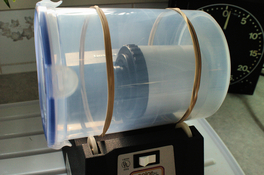
I use a Beseler rotary, reversing agitator that has been chugging along for a long time.
I use replenished X-Tol, and always develop at ambient temperature using a full, 1 litre Paterson tank - whether I am doing 1, 2, 3 (135) or 4 (120) rolls. The development time is adjusted to suit the ambient temperature.
I tend to use hand inversion for all but the first 30 seconds of the development stage - the rotary agitator handles all the rest: pre-rinse, stop, fix 1, fix 2, rinse, HCA.
I have also used rotary agitation for the development stage, but it causes one particular problem - if I want to develop two 120 rolls on the same reel (which allows me to develop 4 rolls at a time) the film moves too much in the reels during that development stage, and sometimes overlaps. Rotary agitation for all the rest of the steps doesn't seem to cause that problem.
As I prefer to use the same technique for all my film, no matter how many rolls are in the, tank, I compromise by using hand agitation for most of the development.
The alternatives available from China are probably most similar to my Beseler.
Sometimes, I even use the Beseler agitator with steel reels:

develop.jpg
 
@MattKing you can try leaving the 120 film leader under the ball bearings when loading two rolls onto a single Paterson reel. Basically don't push the outer roll all the way in. Somehow this prevents it from going deeper under rotary agitation, at least that was my experience double-loading Paterson reels.

P.S. Just like you're Matt, not M-Att, it is Xtol, not X-Tol. :smile:
 
P.S. Just like you're Matt, not M-Att, it is Xtol, not X-Tol. :smile:

I don't disagree.
The Kodak nomenclature flips back and forth: T-Max, Polymax, HC-110, XTol, D-76. To simplify my life, I tend to just insert a dash into everything!
 
The roller base like what Matt King is using is the simplest most universal setup. I've "inherited" several rollers over the years. The Beseler units have a internal plastic tab that can crack, this will disable the reversal switch, I've fixed this using a piece of plastic and a bit of strapping tape.
The Uniroller seems more durable, works great. The Simma roller, Simmons Omega roller doesn't reverse but has eccentric rollers that gently rock the tank back and forth.

I cannot justify much of anything in my darkroom from a financial standpoint.

I really like the Jobo Silverbase for 1500 series tanks, but it costs 400 USD. so far the 4 rolls of 120 I've processed have cost me $100/roll in machine cost šŸ˜‚
 
Or if you are as bored as me. You can build your own filmomat light imitation. Lots of boredom and a teeny bit of nohow goes a long way.
Built the water tub out of plexy, 12v motor ran off an arduino. Built for a 4x5 Jobo Expert drum I was gifted a while ago but never used.
Just put it all together last night. WIll test my first sheets sometime this week.
PXL_20231112_165010620.jpeg
 
Last edited:
I don't have time to spend on projects like this, even though I could easily figure it out as well. My time is limited and I need to be able to get a solution implemented and move on to actual processing and photo work.
 
I have used tanks in the past, but for over ten years I have used the Jobo PPE2 for 35mm, 120 and 4"x5" and never had a development problem since I switched over. Furthermore using the Jobo the film develops properly and consistently well. I strongly recommend the Jobo processor system.
 
Cheapest Jobo unit is CPE3, $2000 USD, this unit doesn't provide for Expert drums, it does have a lift which makes solution changes a bit more convenient.
 
I'm looking for some advice/recommendations/experiences for people who have done rotary processing with 120 fim and how that experience compares to inversion, etc.

Either rotary or inversion will work OK. The caveat is that with rotary (CPE2 with Jobo 1500 and 2500 tanks) I do need to do a pre-rinse to prevent surge marks along the edges of 4x5 sheet film and 120 film (35mm works fine without). The pre-rinse thing is a contentious topic; I'm well aware of this, but it just happens to work for me - and it doesn't work if I skip it, for the formats mentioned. Having said that, with this one adjustment to my workflow, it works fine.
I'm sure the Heiland TAS works fine, too. I never tried it out. I have done (and still often do) lots of manual inversion development and of course the TAS essentially does the same, so it's proven technology.

If you're just going to do B&W and C41, a simple roller base will do. I agree with @Steven Lee that 'fly-by temperature control' is adequate for C41, especially if you scan afterwards and if you work consistently. Having said that, I generally prefer to use the water jacket of the CPE2 to keep things stable at temperature - I've got it anyway, so might as well use it, too.
 
I'm looking for some advice/recommendations/experiences for people who have done rotary processing with 120 fim and how that experience compares to inversion, etc.

If I had the money to spend I'd go with a Heiland. In my experience rotation inversion of roll film can be extremely frustrating due to uneven negs. I had to give it up after a lot of troubleshooting.

Hand inversion works well though. Look for Andys no 8 pattern if you don't want to lift heavy tanks, works well too. The tank can rest on a table while you move it in a figure 8 pattern.

 
Last edited:
The Jobo 2500 series system will perform without issue. For 4x5, make sure you use the latest reels with the inserts.
 
The Jobo 2500 series system will perform without issue. For 4x5, make sure you use the latest reels with the inserts.

Yes, they sure do for many users. And they are high quality equipment. But they are the very tanks and reels I had to give up because I couldn't solve the issues with uneven rotary development.
 
One thing that is really nice about the TAS method is (among other things) the film is never starved for chemistry, you simply have a lot more chemistry in the tank.

All this discussion is tempting me to buy another processor 😳
 
One thing that is really nice about the TAS method is (among other things) the film is never starved for chemistry, you simply have a lot more chemistry in the tank.

All this discussion is tempting me to buy another processor 😳

Hahahaha... yes, it does, doesn't it? I think it also somewhat describes the reason I asked the question about the rotary developing with rollfilms. There are just enough problems that people experience (and at times they are persistent enough to force some to abandon rotary processing), but that others seemingly do not have problems with rotary processing.
 
Either rotary or inversion will work OK. The caveat is that with rotary (CPE2 with Jobo 1500 and 2500 tanks) I do need to do a pre-rinse to prevent surge marks along the edges of 4x5 sheet film and 120 film (35mm works fine without). The pre-rinse thing is a contentious topic; I'm well aware of this, but it just happens to work for me

Strangely enough, my experience with rotary processing is somehow the opposite of yours. Occasionally I get faint surge marks on 120 roll film when pre-wetting. I recently switched to 2500 series reels and I pour the developer into dry tanks - no more issues. I changed two variables at once though... could be the change in the reel diameter... :smile: This is exactly the weirdness of rotary processing that Michael is referring to.

Rotary is strangely non-straightforward and person-dependent. JOBO's own manuals do not recommend pre-wetting, and rotation speed variations work differently for different people. Some even recommend non-alternating rotation! With rotary it seems that everyone needs to dial in their own routine that works for them.
 
One thing I discovered is that diluted developers, like XTOL 1+1, 1+2 etc can be problematic. When I use the Jobo recommended chemistry volumes I ALWAYS use developers full strength. Otherwise bromide drag other issues crop up.

Obviously, probably the gold standard would be dip and dunk in huge tanks with automatic replenishment and control strips.

I would say the TAS system would be about as close to this as you get with a semiautomatic daylight processor.

This would allow replenishment and control strips. And absolute control of agitation.
 
I use XTOL stock or Rodinal 1:25 , one shot with 1500 series tanks, zero issues. I'm planning on using the Silverbase for black and white films instead of my big processors when I can.
 
One thing I discovered is that diluted developers, like XTOL 1+1, 1+2 etc can be problematic. When I use the Jobo recommended chemistry volumes I ALWAYS use developers full strength. Otherwise bromide drag other issues crop up.

This can't be bromide drag, you don't use stand development techniques, do you?
 
Photrio.com contains affiliate links to products. We may receive a commission for purchases made through these links.
To read our full affiliate disclosure statement please click Here.

PHOTRIO PARTNERS EQUALLY FUNDING OUR COMMUNITY:


Ilford ADOX Freestyle Photographic Stearman Press Weldon Color Lab Blue Moon Camera & Machine
Top Bottom