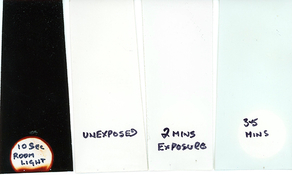
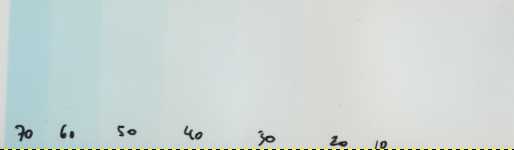
The 1st test strip was exposed to the room main light for 10 seconds. The 2nd test strip was totally unexposed paper. The 3rd test strip was exposed to the safelight only for 2 mins and that is to all intents and purposes the same as the unexposed strip, (No2 in the series). The 4th test strip was exposed to the safelight for 3.5 minutes and this when viewed in tungsten light or LED, as expected. does show a marked cyan cast.
Your 2 minute strip shows some cyan fog, which puts the time before fogging of whites occurs at something a little less than 2 minutes.
However, the time to take for the whites to go cyan is NOT a safe time. While you were doing your testing,
I happened to be doing mine.
Here's a step wedge under my safelight, which is evidently much less safe (by about 2.5 stops) than yours:
The accompanying text in the blog I linked above mentions that the 20 second wedge is the last one that shows no visible tone; the 30 second wedge shows a slight cyan discoloration, roughly similar to your 2 minute wedge.
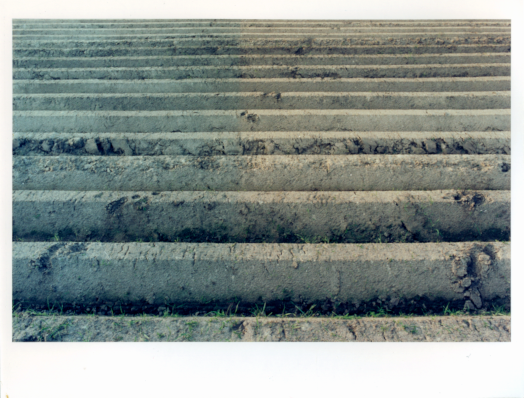
I then did a test print with one half fogged to the 'safe' 20 seconds, and one half unfogged:
Note how the borders are white, although the left side of the sheet (including borders) was fogged for the same time to the safelight. The color shift in the image area, however, is dramatic.
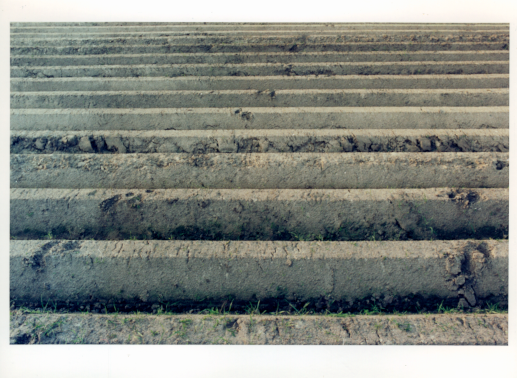
This is a further test with the safelight fogging tuned down another two stops. In your darkroom conditions, and assuming that your 2 minute wedge was unfogged, this would be a 30 second exposure - in my darkroom it was a whole lot shorter - 5 seconds. But that is inconsequential; what matters is how it relates to the time we see fog appear to the whites.
In this sheet, I fogged the left band at 2 stops below the longest time that did not produce a cyan tone to the whites. As you can tell, the color cast is still significant.
To get rid of the color cast, I'd have to go back down at least about 2 stops more or so. Translating this to your darkroom, this would give you a safe time window of less than 7.5 seconds.
The reason why you're not seeing the problem is probably because you're filtering out the color cast, and you're being reasonably consistent in how much safelight fogging you expose your paper to. However, the result of your approach is that you're printing with a reduced gamut on the paper; you cannot by definition use the full range of hues of the paper if you contaminate it all with a hint of cyan.
You're of course free to do and believe as you will, but please understand that the simple fogging test that you have performed is by no means adequate for color work. It takes a fogging test with an image exposure (before or after it, or both, if you prefer) to verify that your safelight conditions are truly safe - or rather, for what period of time they are safe. You will find the actual safe time window is substantially shorter than you believe it is.