
• Welcome to Photrio!
    Registration is fast and free. Join today to unlock search, see fewer ads, and access all forum features.
    Click here to sign up

Processing Kodak 2383/ECP-2 film as a positive cross-process

Wilhelmine

H
Wilhelmine

  • 0
  • 0
  • 14
JcI_colina.jpg

H
JcI_colina.jpg

  • 0
  • 0
  • 53

Recent Classifieds

Forum statistics

Threads
203,075
Messages
2,849,464
Members
101,637
Latest member
Yashica FX-3 fix
Recent bookmarks
0

grainyvision

Subscriber
Joined
Feb 19, 2018
Messages
697
Location
Seattle
Format
Multi Format
So I was hoping to report success, but after a number of experiments with Kodak 2383 film I only have more confusion. For reference 2383 is color cine print film, for printing ECN-2 negatives for projection. It is a negative color film that is tungsten+ECN orange mask balanced, ~3 ISO, and fairly high contrast. One would think if it can be done, it'd be an ideal though very slow slide film.

So here is what I've tried:

* C-41 process (negative) -- very strong blue cast with weird green color crossing. Interestingly it came out with absolutely no mask at all, very clear dmin, and very dark dmax. The negatives were very saturated with color.
* E-6 process -- Film came out completely clear, no density at all even in the unexposed film area
* Custom first developer+light exposure+C-41 process -- Film completely clear, like with E-6. Inspection after first development to re-expose revealed good density but an odd reddish shiny "mask" where unexposed. Looking at the film after color development revealed the film looked pretty much identical to after first development.
* Clip of custom process after first development and into fixer -- Film didn't clear at all. It looked pretty much identical to the unfixed film, but without the reddish shiny mask. One side appeared to have a negative image made of silver with milky white unexposed areas and the other side appeared black and shiny. Looking through the film to light revealed that the "dmin" here was very dark orange
* Clip of custom process after first dev, re-expose, color dev, and bleach and then put back into color dev then bleach/fix again -- Color density developed! I believe this should've just turned the film straight black, but instead did create a very dark positive image with orange "dmin" and green "dmax" with obvious blue dye shining on one side

Basically. None of this makes any sense to me. How can a film fail to fix like this? C-41 developer works fine with the color couplers despite being mismatched to the film as proven in the negative test, but then why doesn't it work after first development? Why would the film fail to fix? And I ruled out the dyes being water soluble or something by basically doing color dev after bleach, which "worked". I'm not understanding at all how this is possible.

I'm hoping someone here has some kind of insight into this in PE's absence, but ECP film seems like a very obscure material and process. I've seen pretty much nothing in regards to attempts to cross processing it or even just generally using it in-camera.

Anyone have any ideas?
 
Last edited:
Why don't you look up the official ECP2 chemical formulae and start from there? Incidentally, this film does not have an orange mask. It may be balanced for exposure through an ECN2 negative which itself has a mask, but that is a different matter. If your E6 process came out blank, maybe you should try an actual intermediate exposure rather than a chemical one.
 
Incidentally, this film does not have an orange mask. It may be balanced for exposure through an ECN2 negative which itself has a mask, but that is a different matter.

Even without knowing anything about the film, this goes without saying. The orange mask is in the base; it is not a dye that can be removed.

I've done C41 film in E6 a number of times. Results can vary but you always get an image. I'm not familiar with this film, but there are limited possibilities. In both E6 and C41 all of the silver and silver halide is removed, leaving only a dye image. If you got no dye image the dye couplers must not have reacted with the color developer. But that would mean the dye couplers were left in the film and one would expect some uniform density from that.

But perhaps the dye couplers are transparent. There is a thread on the B&W forum about developing XP2 as regular black and white. I posted a question there about the dye couplers but no one has responded.
 
For reference, the first developer formula:

* 20g sodium sulfite
* 6g hydroquinone
* 0.4g phenidone
* 12g potassium carbonate
* 0.5g sodium thiocyanate
* 1g potassium bromide
* 1ml of 1% potassium iodide solution
* 1L water

Process:

* Temperature for all solutions, 100F
* First development, 5m
* rinse
* remove film, re-expose for ~1m per side with iPhone flashlight
* C-41 color developer, ~5m
* Rinse/inspect
* C-41 bleach, 6m
* Rinse/inspect (ECP film was milky white)
* C-41 Fix, 6m
* Final wash

I processed some Kodak ECN-2 process intermediate film at the same time as a form of "control test". This film had no problems in the process, though seemed under developed since ECN-2 is a much lower contrast film.

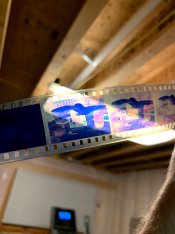
ECP film does NOT have an orange base. It is not designed to, it's a film meant for printing negatives to so that you can then project it. Basically like the RA-4 of ECN-2 film, but for cine purposes of course. For reference, I attached a simple picture of the C-41 processed negatives (note these were with an orange filter. The unfiltered ones have a very orange image, ie, blue cast in positive)

I've done a huge number of C-41 reversal and E-6 cross processing experiments. I've never completely failed to get an image until I began working with this ECP film. It's baffling because clearly C-41 will cause color to develop. But if you do a first developer beforehand then it's like C-41 doesn't touch it. However, if you bleach back, then C-41 works again for color. I really have no idea how it's possible. My only very small inkling of a thought is that the film is too heavily masked to be easily re-exposed before bleaching, but I would think in that circumstance I'd still get a weak image. I'm not sure of any fogging agents that are easily available that don't also work as a silver halide developer or would destroy the dyes so I'm unsure how to exactly test for that.
 

Attachments

  • IMG_2956.jpg
    IMG_2956.jpg
    133.1 KB · Views: 976
2/3383 is a Print film on a clear base: it does not have a mask of any kind. All the intermediate films are process ECN2 and they all have a mask. (the mask is a set of colour correction image creation technology that looks orange in areas that are unexposed.)
 
(there used to be a 5383 and 7383 also (acetate base, but I understand that they are no longer made.)
 
فوفا.jpg


Our Ukrainian friend 0 (grilled chicken lover) succeeded in that task, and he photographed that photo.
He used a movie that looked like yours but was Fuji.
The secret lies in the availability of a CD2 component. Do not tire yourself and do not waste your time. These attempts will not succeed with you without using a developer that depends on (CD2) trust me ..
- In general, I own this item, but I do not own this filme ,, and you own this film and do not own this item.
- I would like to give you a little bit of this ingredient so that you can complete your experiences. But I do not know how to use. If you have any of your friends visiting Egypt now or someday I can give him 50 grams free .
 
Our Ukrainian friend 0 (grilled chicken lover) succeeded in that task, and he photographed that photo.
He used a movie that looked like yours but was Fuji.
The secret lies in the availability of a CD2 component. Do not tire yourself and do not waste your time. These attempts will not succeed with you without using a developer that depends on (CD2) trust me ..
- In general, I own this item, but I do not own this filme ,, and you own this film and do not own this item.
- I would like to give you a little bit of this ingredient so that you can complete your experiences. But I do not know how to use. If you have any of your friends visiting Egypt now or someday I can give him 50 grams free .

Was this processed as negative or positive? I don't doubt CD2 would give better color accuracy and the official Kodak formulas are public for processing this film as expected... but nothing exists for trying to make it a positive film
 
I assume that after the first developer, you used a non-halogenating bleach to remove the developed silver image, and then re-exposed the film before submitting to the color developer? An absence of re-exposure would explain why the film came out blank.
 
I assume that after the first developer, you used a non-halogenating bleach to remove the developed silver image, and then re-exposed the film before submitting to the color developer? An absence of re-exposure would explain why the film came out blank.

no, I did re-exposure and then color development and then finally bleach
 
Try it in the order newcan1 suggested. Maybe the negative silver image is interfering with the fogging exposure.

I've tried that in a way. Basically the process I used:

* first dev
* re-exposure
* color dev (on inspection after, no color developed)
* C-41 bleach (on inspection after, film was milky white but clearly with an image on it
* re-exposure
* color dev (done in daylight in a beaker with a small clip. Color came up quickly)
* bleach
* fix

This definitely causes color development to happen, but also causes a heavily color fogged image with a dark and tinted dmin and tinted dmax. If the silver image is interferring that strongly with the fogging exposure, then I need some way of removing the developed metallic silver while leaving the undeveloped silver intact. That seems to say I'd need a B/W style reversal process, but as far as I know the B/W reversal process chemicals are quite damaging and it's unlikely that the dye couplers would survive in the film.
 
Was this processed as negative or positive? I don't doubt CD2 would give better color accuracy and the official Kodak formulas are public for processing this film as expected... but nothing exists for trying to make it a positive film
Developed as a negative film.
There is no objection to trying to develop it as a positive film.
 
Developed as a negative film.
There is no objection to trying to develop it as a positive film.

There's no big point for a lot of cross processing of things. I enjoy pain though so I do it anyway
 
Can you tell me where did you get that movie reel? And how much?
Maybe I want to get one.

It's a very cheap film to buy directly from Kodak, but you have to buy like a 1000ft reel at a time. I bought it in a short amount already put into 35mm cartridges from an ebay seller in Hong Kong. I think I paid $15 USD for 5 rolls of it. I didn't want to buy a huge reel before I figured out a way to process it

Edit:

Also, one of the big reasons I prefer to do positive development is because in many ways designing a first developer is like designing a B/W film developer. I figured that it would be easier, however dealing with these issues I think maybe it's not easier to use a reversal process. I'd like to somehow figure out a way to balance out the lack of an orange mask from the film in development, so that it can at least be shot without filtration, but it's very difficult to understand how all the layers work since the film is "backwards" from a normal film (ie, magenta on top, cyan in the middle, and yellow at the bottom)

Edit2: here is the ebay link. I give no endorsement of this seller other than that the film doesn't seem to be damaged to me or anything https://www.ebay.com/itm/35mm-Kodak...483188?hash=item364b2d22b4:g:pl0AAOSwlelb2sG-
 
Last edited:
It's a very cheap film to buy directly from Kodak, but you have to buy like a 1000ft reel at a time. I bought it in a short amount already put into 35mm cartridges from an ebay seller in Hong Kong. I think I paid $15 USD for 5 rolls of it. I didn't want to buy a huge reel before I figured out a way to process it

Edit:

Also, one of the big reasons I prefer to do positive development is because in many ways designing a first developer is like designing a B/W film developer. I figured that it would be easier, however dealing with these issues I think maybe it's not easier to use a reversal process. I'd like to somehow figure out a way to balance out the lack of an orange mask from the film in development, so that it can at least be shot without filtration, but it's very difficult to understand how all the layers work since the film is "backwards" from a normal film (ie, magenta on top, cyan in the middle, and yellow at the bottom)

Edit2: here is the ebay link. I give no endorsement of this seller other than that the film doesn't seem to be damaged to me or anything https://www.ebay.com/itm/35mm-Kodak...483188?hash=item364b2d22b4:g:pl0AAOSwlelb2sG-
If the big pulley is really cheap as you say, this will help us solve the problem of the lack of a color film in Egypt.
Whether it is settled as a negative or a positive film, this does not matter at present, and multiple tests and experiments can be done until the optimal solution is reached.
- How can we get a huge reel at a cheap price.
Our Ukrainian friend (a grilled chicken lover) was pragmatic and refused to help us in this matter and asked for a very huge price, and his reaction was disappointing. And I felt some sadness.
- I hope to find an honest seller who accepts a reasonable price to encourage Egyptian photographers to satisfy their hobbies.
I want a huge ball, whether expired or not expired.
 
It is very slow film - -3 ISO - too slow for in camera use.
The lack of an orange mask and higher than normal contrast also is a problem.
 
It is very slow film - -3 ISO - too slow for in camera use.
The lack of an orange mask and higher than normal contrast also is a problem.

3 ISO isn't too slow, it just requires special... allowances. This type of speed is the key to some very unique photography at least from my experiments in B/W. Yea, it require a tripod even in daylight if you're not shooting portraits or something, but it allows for daylight long exposures without an ND filter nor without shooting on large format.

I don't really mean that the lack of an orange mask is a problem, rather that the sensitivity of the film is designed to have the orange mask present when being exposed (ie, expecting ECN-2 film projection). This film might not be too high contrast actually, but it is very long scale.. ie in negative, shadows are almost clear and highlights are very dark. This is a problem to try to use for RA-4 printing, but is the same kind of response that slide film gives and so I think could be ideal for a positive film if it can be done. It's also extremely cheap compared to any real slide film
 
I think mohmad khatab is looking for inexpensive print film for camera use.
 
My guess is that the Intermediate films might be a better choice if you are looking for a camera negative film, they at least have the orange mask, and are processed in ECN-2. Read the data sheet as they may have the REM jet layer. it was removed from the print film to reduce water consumption in Los Angeles when their were Theatrical prints still being made. (one lab opened at Mirabel just to make theatrical prints for a while as water is not an issue in Quebec)

the movie camera films. 52xx are also a good choice, I used a lot of them when Movie production was all film, and short ends were real cheep. Frame 24 in the UK is a delaer who sometimes has recans and ends. if they have any bargain stock it will be on this page https://www.frame24.co.uk/online-store/Clearance-Stock-c27284139 (400ft colour rolls seem to be running about 170 pounds sterling)
 
My guess is that the Intermediate films might be a better choice if you are looking for a camera negative film, they at least have the orange mask, and are processed in ECN-2. Read the data sheet as they may have the REM jet layer. it was removed from the print film to reduce water consumption in Los Angeles when their were Theatrical prints still being made. (one lab opened at Mirabel just to make theatrical prints for a while as water is not an issue in Quebec)

the movie camera films. 52xx are also a good choice, I used a lot of them when Movie production was all film, and short ends were real cheep. Frame 24 in the UK is a delaer who sometimes has recans and ends. if they have any bargain stock it will be on this page https://www.frame24.co.uk/online-store/Clearance-Stock-c27284139 (400ft colour rolls seem to be running about 170 pounds sterling)

For immediately usable cine films that are cheap and give good results, Kodak 2242 (and probably 5242) is known to give good results when processed in C-41 as a negative. It gives weird color balance because it's designed to be exposed by laser and is ~1.6 ISO. I've seen some very nice pictures come from it that have an other worldly kind of feel. I believe this is the film sold by FPP as "ultra low ISO color"
 
Many color films use a silver layer as antihalation layer. These films will only show an image after bleaching&fixing.

The ECP-2 developer uses CD-2, which is more active than CD-4, and a lot more active than CD-3. In addition, it's pH 10.59 is quite a bit higher than that of C-41 CD. Since CD-2 is a lot more similar to CD-4 than to CD-3, I recommend you do some more tests with CD-4. Raise C-41 CD pH to somewhere between 10.6 and 10.8 and see what happens.

BTW: ECP-2 is known to be a very high contrast medium. Even relatively small errors in exposure will give you blank results.
 
[QUOTE

I'm hoping someone here has some kind of insight into this in PE's absence, but ECP film seems like a very obscure material and process. I've seen pretty much nothing in regards to attempts to cross processing it or even just generally using it in-camera.

Anyone have any ideas?[/QUOTE]

Hi,

I have done lots of experiments with the 2383 and 2393 film stocks.

To use the film in camera can be done, but the results are from from worth the effort. You need to use an unexposed processed piece of film as a filter on the camera lens, I used a piece of 65mm 500T to make a 52mm lens filter. Exposure times are very long even in full sun, expect to expose for 1 second or more. Obviously you will get a negative image on a clear film base which takes some tweaking in scanning.
ECN2 developer works well with processing the film, 3 mins at 38c for the dev, 30s stop, 1 min bleach and 40s Fix, all at 38c.No need to use the bleach at 27c, that's just an industry spec due to the aggressive bleach eating way at the tyres on the processing racks!.
Here is an example of a contact print using 70Y and 5M on a colour head, exposure was 1s at a distance of around 4 inches from enlarger lens to film surface.
IMG_20181012_235712.jpg

Here is an example of in camera exposure using the film base as a filter.

img612.jpg

I did not bother trying to make a contact print from the 2383 negative image to get a Pos because I would imagine further filtering would be needed using the enlarger filter pack.

Another possibility would be to process the in camera exposed film in a B&W reversal kit!. For exposure this would eliminate the need to filter the camera lens so you can expose at 3 iso. An experiment I may do in the summer when light levels are higher for these slow films.

From my experiments of contact printing from Kodak B&W films, like Plus-x onto the 2383, the images are sepia, likely due to the colour dyes in the 2383. Further experiments are needed as I used XTol and TMax fix in the test. Maybe using the ecn2 kit would produce a better B&W result.

I hope this helps you in some way and I'm open to any questions you may have as myself and a few others are doing ongoing experiments with this film stock.

As for the ecp developer, I have some that was made special order by Bellini photo. I found it impossible to balance the filter pack to get the colours correct, maybe because I'm not fully following the ECP processing steps, with things like the pre bleach!. To me, I found a way to get slide from my ecn negatives using the ecn kit which is available from Bellini at a reasonable cost and the workflow is simple and fast.

Mick

.
 
Photrio.com contains affiliate links to products. We may receive a commission for purchases made through these links.
To read our full affiliate disclosure statement please click Here.

PHOTRIO PARTNERS EQUALLY FUNDING OUR COMMUNITY:


Ilford ADOX Freestyle Photographic Stearman Press Weldon Color Lab Blue Moon Camera & Machine
Top Bottom