• Welcome to Photrio!
    Registration is fast and free. Join today to unlock search, see fewer ads, and access all forum features.
    Click here to sign up

Price of 8x10 enlargers in 2026

The Hot Waters

A
The Hot Waters

  • 0
  • 0
  • 1
The Hot Waters

A
The Hot Waters

  • 0
  • 0
  • 1

Recent Classifieds

Forum statistics

Threads
204,285
Messages
2,866,615
Members
102,207
Latest member
gustavocf
Recent bookmarks
0
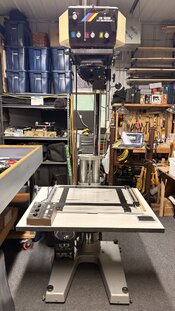
I got a Kienzle C252 with an LED head a couple years back and it was roughly $14k. Suffice to say the ROI on this has been zero...but I do love it.
 
The question I have is have you enlarged any color negatives with this lovely beast? What amazing technology, I'm jealous 😊

I have, but I have been so discouraged by the standard commercially available cut sheet paper that Fuji is selling that I've all but given up on RA4. I know I can buy better paper stocks from various vendors but it's more of a pain than clicking 'buy' from B&H.

Enlarging B&W has been a total joy. The split grade system they have is very good, though it can also be frustrating when it doesn't work.

Sadly I'm mostly printing with the Canon Pro1100. Though not so sadly, this printer is absolutely exceeding my expectations even with B&W, and I've done Piezography.
 
I have, but I have been so discouraged by the standard commercially available cut sheet paper that Fuji is selling that I've all but given up on RA4. I know I can buy better paper stocks from various vendors but it's more of a pain than clicking 'buy' from B&H.

Enlarging B&W has been a total joy. The split grade system they have is very good, though it can also be frustrating when it doesn't work.

Sadly I'm mostly printing with the Canon Pro1100. Though not so sadly, this printer is absolutely exceeding my expectations even with B&W, and I've done Piezography.

I hear you on paper. Last time I looked the Fuji cut paper that was stocked by B&H was 8x10 and 11x14, nothing larger.

Color sheet film is becoming an endangered object. Truly.

I've had great results with Canon inkjet. I don't try to scan color negative just positive.
 
I hear you on paper. Last time I looked the Fuji cut paper that was stocked by B&H was 8x10 and 11x14, nothing larger.

Color sheet film is becoming an endangered object. Truly.

I've had great results with Canon inkjet. I don't try to scan color negative just positive.

Oh just seeing Adox is supplying CA cut sheets now at B&H in all sorts of sizes
 
Well, I just ordered a 30 inch wide roll of Fuji Maxima. Now I just have to wait and see if it comes in a reasonable time or not. All the international chaos at the moment doesn't bode well for supply lines, mfg energy cost, or shipping expenses. I could always default to a roll of Super C instead and save a hundred bucks to boot, but I really want to try Maxima.

mshchem - There is PLENTY of Fuji color paper available in this country, both in product variety and in rolls widths, but nothing in cut sheet anymore except entry level CA. B&H lists only a small portion of the Fuji RA4 paper lineup. Inkjet is a whole different topic with a different look; not my cup of tea.

I still haven't seen any actual visual evidence of how well a Kienzle LED pancake head would work or hold up vs time-tested halogen colorheads, especially for large color prints. My own 8x10 color enlargers will outlive me, so I probably never will find out. But still, it's a topic worthy of curiosity. People being able to afford 8x10 color film going forward into the future, well, that's the really tough question.
 
Last edited:
Well, I just ordered a 30 inch wide roll of Fuji Maxima. Now I just have to wait and see if it comes in a reasonable time or not. All the international chaos at the moment doesn't bode well for supply lines, mfg energy cost, or shipping expenses. I could always default to a roll of Super C instead and save a hundred bucks to boot, but I really want to try Maxima.

mshchem - There is PLENTY of Fuji color paper available in this country, both in product variety and in rolls widths, but nothing in cut sheet anymore except entry level CA. B&H lists only a small portion of the Fuji RA4 paper lineup. Inkjet is a whole different topic with a different look; not my cup of tea.

I still haven't seen any actual visual evidence of how well a Kienzle LED pancake head would work or hold up vs time-tested halogen colorheads, especially for large color prints. My own 8x10 color enlargers will outlive me, so I probably never will find out. But still, it's a topic worthy of curiosity. People being able to afford 8x10 color film going forward into the future, well, that's the really tough question.

I agree about the certainty of halogen lamps and dichro filters for printing color. I've never used any LED sources for any printing, color or black and white.

I agree with you on Cibachrome, I've got 4 in my view right now, I printed myself, wonderful.

The Adox paper listed at B&H doesn't specify what it is other than Adox CA 310. No spec sheet. It would be nice if Adox would cut some really nice paper, but I doubt it.

Hopefully the Eastman Kodak reintegration of distribution and marketing will pan out well. Haven’t a clue what the market is for large format color film. We shall see.
 
Hopefully the Eastman Kodak reintegration of distribution and marketing will pan out well.

Neither Eastman Kodak nor Kodak Alaris have any say any more about RA4 paper.
Eastman Kodak left that market at the time of the bankruptcy, and Kodak Alaris sold the small amount of the remaining market it had to Sino promise.
Save perhaps any licensing revenue that might be happening if someone else decides to make the paper and wants to put the Kodak name on it, which might benefit Eastman Kodak.
 
Neither Eastman Kodak nor Kodak Alaris have any say any more about RA4 paper.
Eastman Kodak left that market at the time of the bankruptcy, and Kodak Alaris sold the small amount of the remaining market it had to Sino promise.
Save perhaps any licensing revenue that might be happening if someone else decides to make the paper and wants to put the Kodak name on it, which might benefit Eastman Kodak.

My single finger typing failed me again. I was trying to refer to sheet film from Kodak not color negative paper. I don't have a clue how much color sheet film is used these days. Hopefully EK brings out Ektacolor (and Ektapan) sheet films soon! (and people can afford it and buy it)
 
The 1840 is cosmetically dressed up a little more with some metal skirts covering the elevation gearing, etc. A few more bells n' whistles, that's all. With the 184, the bellows extension/focus motor was an option, and certainly a helpful one; also the upper column head position motor (I have both on my 184).

Horizontal projection is easy; but in that case, you'd want rails on the floor to match the sheave rollers on the enlarger.
A well-leveled and stiff floor is essential. I once used one mainly in horizontal mode.

For anyone wondering I was told that the 1840 has its optical axis further away from the column. Therefore, it can make bigger enlargements while projecting on the baseboard and without resorting to horizontal projection.
 
The Adox paper listed at B&H doesn't specify what it is other than Adox CA 310. No spec sheet. It would be nice if Adox would cut some really nice paper, but I doubt it.
It's FUJIFILM Crystal Archive and here is the datasheet: https://fujihalide-live.s3.eu-west-1.amazonaws.com/wp-content/uploads/2025/11/05130537/PIB-CA.pdf The only difference between the datasheet and the Adox paper is that the Adox paper has no back print and of course it's only available in the cut-sheet sizes distributed by Adox, not the roll sizes in the datasheet. The paper as such is the same.

Sadly I'm mostly printing with the Canon Pro1100. Though not so sadly, this printer is absolutely exceeding my expectations even with B&W, and I've done Piezography.
IMO there's nothing sad about it; as you said, those prints can be drop-dead gorgeous and then there's the enormous flexibility that digital print affords. It's a different medium from RA4, of course. They have their own strengths & weaknesses, although inkjet still sees development whereas RA4 is end-of-life, so pretty much static in terms of innovation.
 
Several more minor points. I can make up to 30X40 inch prints on my L184 in vertical position. The baseboard gets pretty close to the floor, but it's doable with an appropriate 240 mm lens. The alleged issue, therefore, is not the spacing of the lens from the center column, but the overall column height itself, which I believe to be the same with the 1840; but that should be double-checked if anyone has the spec sheets for both. You need a high ceiling either way. Different baseboard size options were available. But those are easy to modify. I have a DIY customized version with built-in masking blades.

All those brands of RA4 cut sheet out there (I've encountered four different labels, including the Adox) are the same thing, Fuji CA. The sheets per box might vary. Someone is just taking big master rolls and cutting them down. It's a decent product for some images, and quite suitable for learning and proofing purposes.

I've said it numerous times before, but if you miss the look of Cibachrome, the replacement for that is Fujiflex Supergloss. It's significantly easier to handle than Ciba, and standard RA4 processing. You start with color negs instead of chromes. It's spectacular with Ektar film, and nobody on earth is going to mistake it for an inkjet. Not always available, pricey, and only in large roll widths, but officially still in manufacture in Japan.

Alas, my aging finger joints are going to have a hard time manhandling 40 inch wide rolls of polyester base Fujiflex in the dark ever again. I still have a third of a 30 inch wide roll on hand; but it might not be good any longer. I just got notice that my 30 inch roll of RC base Maxima has now shipped, which should be quite a bit easier to handle.

IF RA4 chemical papers are nearing an endpoint, it's the endpoint of quite a bit of incrementally improving evolution since their inception. Inkjet, on the other hand, might be on a plateau for awhile, trying to recoup all the considerable R&D cost involved before attempting another significant step forward; it's also more expensive in terms of materials (ink and paper). A lot depends on which kind of workflow you prefer - darkroom or digital. "Look" is a matter of personal taste.

Since this particular thread is on 8X10 enlargers, I'd simply point out this is a great time to get into RA4 printing, especially with the cost of quality b&w printing papers skyrocketing. Color printing will be my warm season financial "diet" from the cost of black and white, which I'll have to print a lot more selectively going forward. For those who can't afford 8x10 color film, 4x5 can still make a darn nice large color print. Fortunately, I already have a stash of 8x10 Ektar in the freezer.
 
Last edited:
I currently have a Durst L1840 but if I need a replacement I’d go for a new Keinzle C252.
 
For anyone wondering I was told that the 1840 has its optical axis further away from the column. Therefore, it can make bigger enlargements while projecting on the baseboard and without resorting to horizontal projection.

Farther from the column than what other enlarger?

The L1840 has a baseboard about 40” across and with the head all the way up, the image size (8x10 negative/300mm lens) is about 40” across.
 
The Durst L1840 shares almost nothing with the Durst L184. Totally different design.

In terms of price, when I got mine, Durst Pro, was selling L1840 about 1/3 (inflation adjusted) of what it would have taken to get one from Colenta ( the USA distributor in 1980-90s).

If an L1840 shows up for less than $10,000 USA dollars (2026) it would be a good value.
 
It's FUJIFILM Crystal Archive and here is the datasheet: https://fujihalide-live.s3.eu-west-1.amazonaws.com/wp-content/uploads/2025/11/05130537/PIB-CA.pdf The only difference between the datasheet and the Adox paper is that the Adox paper has no back print and of course it's only available in the cut-sheet sizes distributed by Adox, not the roll sizes in the datasheet. The paper as such is the same.


IMO there's nothing sad about it; as you said, those prints can be drop-dead gorgeous and then there's the enormous flexibility that digital print affords. It's a different medium from RA4, of course. They have their own strengths & weaknesses, although inkjet still sees development whereas RA4 is end-of-life, so pretty much static in terms of innovation.

I just ordered some Adox packaged color paper. Weird sizes are neat. I'm doing this to try and stay competent with color. 69 years, gotta stay active!
 
My L184 has a 40 inch baseboard too, although I have another base atop it even wider, plus a set of copy lights, so I can alternatively used the same rig as a deluxe copystand. Two allegedly different designs sure look similar to me if the cover of the 1840 is removed to reveal the actual gearing mechanism. Colorheads are a different story, and were largely interchangeable all along. Their 2000 W versions ran just too hot and utility bill expensive for me - that's why I designed my own 1500 W pulsing RGB head instead.
 
For anyone wondering I was told that the 1840 has its optical axis further away from the column. Therefore, it can make bigger enlargements while projecting on the baseboard and without resorting to horizontal projection.

Further away then the durst 184. floor standing versions. Not confirmed
 
Further away then the durst 184. floor standing versions. Not confirmed
Took some rooting around to find it.
L1840: 495mm
L184: 470mm
So that's a small difference.
The baseboard size does differ a little more:
L1840: 90x110cm
L184: 70x100cm

Edit: I was texting with someone who has owned & used both types. He alerted me that the 184 has two guides for the table that affect the usable baseboard space:
1775031627809.png

This would explain why the 1840's table is significantly wider (90cm vs. 70cm) and why the usable baseboard space is significantly larger for the 1840 than on the 184, even though the distance between the optical axis and the column is almost the same.
 
Last edited:
My L184 has a 40 inch baseboard too, although I have another base atop it even wider, plus a set of copy lights, so I can alternatively used the same rig as a deluxe copystand. Two allegedly different designs sure look similar to me if the cover of the 1840 is removed to reveal the actual gearing mechanism. Colorheads are a different story, and were largely interchangeable all along. Their 2000 W versions ran just too hot and utility bill expensive for me - that's why I designed my own 1500 W pulsing RGB head instead.

Under the cosmetic covering the L1840 has a single tubular column without any counterweights, springs or cables. The head rides on a carriage with ball bearings and moves up and down with a long vertical screw gear driven from a motor at the top of the column. Nothing in common with L184.

The CLS1840 head could be fitted to the L184, perhaps you saw one of those hybrids?
 
That's exactly how my 184 column works! - a single screw-lead gear, motorized, controlling the head position - but between TWO COLUMNS THE FULL HEIGHT (no counterweights, springs, or cable). I certainly know the difference, since my 138's do have tensioning springs (no counterweights except the one I added myself due to an extra-heavy head). There seems to have been multiple versions of both the 184 and 138 over the years. The most intriguing was the "graphics"138 using a precision hexagonal column with ball-bearing contact on each of the 6 flats (pricey).

And note that my own L184 baseboard is (was) 90 cm wide; one could choose from three sizes. But I converted mine to something even bigger. It's a little more complicated in terms of optical axis on the fore-aft dimension. But with a 10X10 perfectly evenly illuminated mirror box, shifting the position of 8x10 film in the 10X10 carrier a little bit is no big deal. And since that corresponds to the shorter 8 inch dimension of the film itself, you've got ample image circle in the lens itself to work with (I have 240, 305, and 360 Apo Nikkors for this enlarger, plus shorter lenses for 4x5 applications).

There were hybrids which had a dual column L184 lower half with an oversized baseboard, but a single column 138 upper half. Just as tall as a regular 184. I could have had one of those for free too. But it would have been just as much hell to move (long story involving six of us nearly wrecking our fingers and backs lugging it up a multiple flight of stairs in one piece, right through a restaurant during business hours, and then onto an illegally parked flatbed truck. The same guy who retired the photo lab owned the entire city block anyway, including the restaurant, so bending the rules was no big deal. Having the freight elevator permanently incapacitated to make more room in the restaurant was a big deal. Last I heard, both his 90K horizontal Durst as well as the 184/138 hybrid were still entombed down there, probably till the end of time. ... If King Tut had been a photographer ...
 
Last edited:
There were hybrids which had a dual column L184 lower half with an oversized baseboard, but a single column 138 upper half. Just as tall as a regular 184.
Like this? To complete the Frankenstein configuration, mine has a De Vere 507 Dichromat MkII head.
 

Attachments

  • IMG_7558.jpeg
    IMG_7558.jpeg
    432.5 KB · Views: 60
What both Koraks and ice-racer seem to be describing is NOT a L184 chassis, but the 184/138 hybrid, which has its own specific model no. I can't remember what that is, but might stumble back onto it with a bit of search time. Durst actually has an enlarger museum with all kinds of rare and unusual examples in it. I think they made an early Commercial L as big as 12X16.
 
Photrio.com contains affiliate links to products. We may receive a commission for purchases made through these links.
To read our full affiliate disclosure statement please click Here.

PHOTRIO PARTNERS EQUALLY FUNDING OUR COMMUNITY:



Ilford ADOX Freestyle Photographic Stearman Press Weldon Color Lab Blue Moon Camera & Machine
Top Bottom