
• Welcome to Photrio!
    Registration is fast and free. Join today to unlock search, see fewer ads, and access all forum features.
    Click here to sign up

physically modified negative, how? why?

Two Horses

A
Two Horses

  • 4
  • 1
  • 10
Billboard, Cork city 1977

H
Billboard, Cork city 1977

  • Tel
  • Mar 17, 2026
  • 0
  • 0
  • 19

Recent Classifieds

Forum statistics

Threads
202,799
Messages
2,845,700
Members
101,539
Latest member
UwBouwMeester
Recent bookmarks
1

himself

Member
Allowing Ads
Joined
Apr 8, 2011
Messages
513
Format
Multi Format
First of all I'll just say that I'm not sure in which sub forum to post this, so if needs to be moved then just let me know.

And so, someone just brought me a very oddly modified negative to ask my opinion on how, and or why it would have been done. It's been (very) physically altered for some reason, but for the life of me I can not figure out how or why.

It was brought to me by a local photographer who also collects images of the local town/area that we live in, and he recently bought this negative online. The seller doesn't know much about it's history other than it was taken by a family member who used to take images for the electricity board (back when it existed).

I've photographed the negative and before I describe it a little more, here are the images:
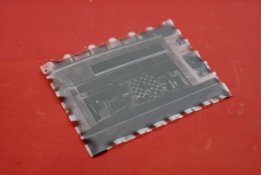
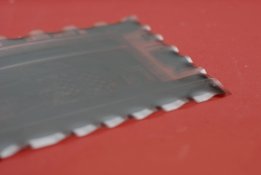
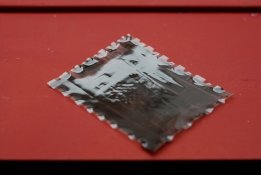
DSC_0388.JPG DSC_0389.JPG DSC_0391.JPG

As you can see it looks like it's been crimped all around it's edge.

It's very evenly and precisely done, and must have taken quite a bit of force to do because the waves are quite high, but don't go very deep back into the negative itself (about 5mm).

But other than the crimping it seems otherwise normal, the non emulsion side is maybe a bit more shiny/plastic than normal, and has a little bit of a relief to it. It's a 9x12 b/w negative and the image was taken sometime in 60s, but on what camera is anyone's guess.

So has anyone seen anything similar to this before, and if so, how is it done and to what purpose?

thanks,
Dafydd

p.s.
My initial guess was that it had been laminated, but on inspection, it's quite clearly just a base plastic layer coated in emulsion.
 
I do not think it was intentional. Anyway, it is a matter of uneven swelling, shrinking.

I got samples of similarly warped sheets of acetate foil, with the warped edges not covered over time.
 
Last edited:
I would agree with AgX; i'll bet the negative is almost desiccated and probably very fragile. It appears the negative has been exposed to heat and low humidity over an extended period of time. However, it appears that most of the image area was somehow protected and didn't take the same amount of environmental exposure; maybe sandwiched in between small glass plates or something?

Very strange...
 
Desiccation though would induce different tension structures. Here the edges rather look like swollen. One sees similar at edges of book blocks, though due to fiber orientation not symmetrically.
 
Maybe that piece of film had been framed at its edges. Thus creating an autocatalytic reaction just at the edges, causing swelling.
 
In any event, it looks as if the emulsion is ready to lift, so I'd so something quick if it is important...
 
thanks for the suggestions so far, and I thought maybe heat, but would just heat cause such a uniform and even swelling all the way around and just at the edge?
and it looks more "pressed" than swollen, if such a distinction can be made.

and just to add, other than the edge, it's in very good condition. It's still just as supple and flexible as normal and the emulsion is fine. there isn't any peeling or scratches. And from the look of it (bar the obvious) it looks like it was pretty well looked after.
 
OK, well that was a waste of time...
 
This was done on purpose. I have seen it before, but forget the details. The edge crimps are intended to hold the negative in place for work on the image itself. Note the 3rd photo. I'll bet the image is almost a relief image. I wish I could remember the details.

PE
 
OK, well that was a waste of time...

why?

I'll bet the image is almost a relief image. I wish I could remember the details.

PE

It has a slight - very slight - relief to the non emulsion side, but even saying that you have to really look to see it.
It would seem like a very specific and extreme thing to do to what is a photo of the front of an electrical goods shop. From what little is known about why it was taken, the families best guess is that the photographer was cataloguing the national electricity boards shops/holdings. They have a whole collection of them, but the gentleman who brought it to me, only bought this one because it's supposed to be of our town.

So could it have anything to do with printing (not darkroom, but rather printing for catalogues/magazines/brochures)?
 
How old is the negative? I am not one to second guess PE, but it sure looks like a lot of the nitro negs I dealt with in another life. That third image really looks like it.
 
not sure about the neg itself, but the image dates from about the 60s possibly as late as the 70s
is there anyway to tell if it's nitro?
 
Too young for Nitrate. My bad calling it Nitro. The correct term is Nitrate Cellulose.
 
not sure about the neg itself, but the image dates from about the 60s possibly as late as the 70s
is there anyway to tell if it's nitro?
The use of the word "nitro" these days in any forum might get a reply from GCHQ or at least an examination :D On a more serious level I take it you mean nitro-cellulose? If the image dates from the 60s or later I'd doubt if the film is made of nitro.

pentaxuser
 
ha, sure nitrate : )
unfortunately the date is a bit of guess, so it could be earlier I suppose.
do you know of any markings it might have? it seems to have a notch code, which can be seen in the top left corner of image 1 as you look at it, but no other markings.
 
The use of the word "nitro" these days in any forum might get a reply from GCHQ or at least an examination :D On a more serious level I take it you mean nitro-cellulose? If the image dates from the 60s or later I'd doubt if the film is made of nitro.

pentaxuser
:D

yep and yep.
 
If you are concerned snip an edge from the neg and, well away from the rest of the neg, light it. If it sparks burns it is a nitrate. If it is not it will melt.
 
looks like it was embossed and whenit was printed originally
it had a deckled edge.
ive seen it before...
 
If it sparks burns it is a nitrate

it's not my film to cut up, but I'll ask the owner to see if he's willing.
having said that the south wales electricity board (who's shop is in the photo) didn't exist before 1948, so I doubt the photo is older than the 50s at it's youngest.

and for anyone interested, the notch code is: ----u-o--
I haven't been able to find it yet, but I don't have a resource other than the 'net
 
Last edited:
looks like it was embossed and whenit was printed originally
it had a deckled edge.
ive seen it before...

but why would it have been embossed, that wouldn't be needed for a deckled edge surely?
 
but why would it have been embossed, that wouldn't be needed for a deckled edge surely?

no clue why, maybe because it was some process people were doing after reading in pop photography that it was
the latest and the greatest and whoever the author was sold weird crimpers to squish the film in when it was wet ...
there are all sorts of things in print form for similar goofy-stuff or processes in magazines and on the inter webs ..
i mean can you believe some of these goofballs suggesting people process their film in coffee ?! what will they think of next ?? :wink:
 
it's a single negative. Any chance it was put into a slide (either cardboard or plastic) and then removed? It looks like two sides of a slide frame with the negative in the middle, then crimped together to hold the pieces together. Afterwards maybe it was pulled out of the slide?
 
The use of the word "nitro" these days in any forum might get a reply from GCHQ or at least an examination :D
Over here Nitro- was indeed used for Nitrate film base and still is used for Cellulosenitrate varnish. The respective solvent is called Nitro Thinner, available in each DIY store.
 
Photrio.com contains affiliate links to products. We may receive a commission for purchases made through these links.
To read our full affiliate disclosure statement please click Here.

PHOTRIO PARTNERS EQUALLY FUNDING OUR COMMUNITY:


Ilford ADOX Freestyle Photographic Stearman Press Weldon Color Lab Blue Moon Camera & Machine
Top Bottom