• Welcome to Photrio!
    Registration is fast and free. Join today to unlock search, see fewer ads, and access all forum features.
    Click here to sign up

My PC-512 Borax Developer

St Ives - UK

A
St Ives - UK

  • 4
  • 1
  • 96
Across the Liffey

H
Across the Liffey

  • Tel
  • Feb 25, 2026
  • 1
  • 2
  • 72

Recent Classifieds

Forum statistics

Threads
202,445
Messages
2,840,943
Members
101,333
Latest member
shanhw1978
Recent bookmarks
6
Do you throw away the mixed developer after 1 film or can you save it a while and develop a 2nd film later? Do you have to extend the total development time for the 2nd film? How many films in theory could be processed before development times are not practical or the working solution is exhausted?
It's a one shot developer.
They are not recommended for re-use.
Even for one shot Rodinal 1:50 users have reported variations in negatives from re-use.
 
Gave PC-512 a shot today. Completely bungled my first roll where embarrassingly I forgot to mix my concentrate with the borax solution. I think I must have autopiloted as if using HC-110. Turns out that the developer does NOT work without borax 🤣

But the second roll turned out pretty well.

HP5+ in 120 (6x4.5) shot at 400, deved for 6:45.

Couple things stood out.

1. The color of the dev when pouring it out was black!
2. There is more base fog, but the contrast is more than fine.
3. Mixing the ascorbic acid took WAY longer than I expected. I ordered a magnetic stirrer.
4. My PG was super smelly, and worse once heated. I thought PG was supposed to be odorless but this was uncomfortable. I reached out to artcraft where I bought it from.
5. There is grain, but it’s got a kind of soft easy quality to it. I usually develop HP5 in HC-110 and I dislike the way the grain in the highlights looks. This is nicer.
 

Attachments

  • IMG_3521.jpeg
    IMG_3521.jpeg
    943.2 KB · Views: 88
  • IMG_3522.jpeg
    IMG_3522.jpeg
    1.1 MB · Views: 72
  • IMG_3523.jpeg
    IMG_3523.jpeg
    1.1 MB · Views: 79
@aconbere I have also forgotten to dilute with the borax solution 😆 ...and it's because of the stubbornness of Ascorbic Acid going into solution, that I too picked up a magnetic stirrer. Heating up to at least 50C helps a lot, too. My PG has no odour. Did you use the 1+50 dilution with HP5?
 
@aconbere I have also forgotten to dilute with the borax solution 😆 ...and it's because of the stubbornness of Ascorbic Acid going into solution, that I too picked up a magnetic stirrer. Heating up to at least 50C helps a lot, too. My PG has no odour. Did you use the 1+50 dilution with HP5?

I did use the 1+50, I should have mentioned.

I did heat to 80c, but it was still very challenging. It also took a long time to get to 80c on my hot plate. Maybe my new one will be speedier.

I am… concerned about the odor. I’ve had nothing but good experiences with artcraft. But if all else fails there are many sources.
 
If one were to mix up PC-512 from dry chems alone, sans glycol, for immediate use, what would be the proportions of ingredients?
 
If one were to mix up PC-512 from dry chems alone, sans glycol, for immediate use, what would be the proportions of ingredients?
From the original recipe in https://imager.ie/a-simple-phenidone-ascorbic-acid-concentrate-developer/
For 1 litre of working strength developer. You need the equivalent of 1/50 litre = 20cm3 of concentrate A, i.e.
(20/100) x 12g ascorbic acid = 2.4g ascorbic acid
(20/100) x 0.5g phenidone = 0.1g phenidone
and solution B (1 litre) contains 21.7 (22?) g of borax.

The phenidone is IMO awkward to measure in such small quantity; better measured from a known solution (5%??) in... propylene glycol.

What you propose saves some propylene glycol and the trouble of dissolving the ascorbic acid in hot propylene glycol. As far as I'm concerned I would not go the trouble of weighing the powders for each development.

Plus, who knows? maybe the glycol plays a role in the success of the recipe? Obviously not? not until demonstrated.
 
Weighing errors start to bite doing this. A scale reading to 0.01g gives 10% error on 0.1g. And if it is a digital scale that last digit is rounded, so it is at best +-0.005g. At 0.5g you are at a more reasonable 2% error.

The propylene glycol mix will last for at least a year (verified personally). It is a bit of an effort to mix up, but I'd rather do it once for a batch.
 
From the original recipe in https://imager.ie/a-simple-phenidone-ascorbic-acid-concentrate-developer/
For 1 litre of working strength developer. You need the equivalent of 1/50 litre = 20cm3 of concentrate A, i.e.
(20/100) x 12g ascorbic acid = 2.4g ascorbic acid
(20/100) x 0.5g phenidone = 0.1g phenidone
and solution B (1 litre) contains 21.7 (22?) g of borax.

The phenidone is IMO awkward to measure in such small quantity; better measured from a known solution (5%??) in... propylene glycol.

What you propose saves some propylene glycol and the trouble of dissolving the ascorbic acid in hot propylene glycol. As far as I'm concerned I would not go the trouble of weighing the powders for each development.

Plus, who knows? maybe the glycol plays a role in the success of the recipe? Obviously not? not until demonstrated.

Thanks!
 
Weighing errors start to bite doing this. A scale reading to 0.01g gives 10% error on 0.1g. And if it is a digital scale that last digit is rounded, so it is at best +-0.005g. At 0.5g you are at a more reasonable 2% error.

The propylene glycol mix will last for at least a year (verified personally). It is a bit of an effort to mix up, but I'd rather do it once for a batch.

Thanks.
 
better measured from a known solution (5%??) in... propylene glycol.

Phenidone stock solution also works well in 91% isopropyl alcohol -- in North Carolina, that's about $2 a liter at Food Lion. I've used 2%, but I don't know any reason 5% wouldn't also work.
 
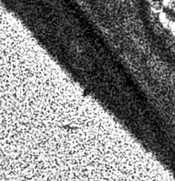
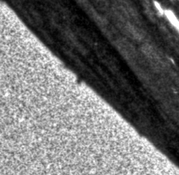
I compared PC-512 Borax with FX-1, blue sky, orange filter.

PC-512 Borax


FX-1


PC-512 clearly gives less grain . An assessment of sharpness seems to depend on whether the relatively smooth edges with PC-512 appear sharper than the ragged but clearly defined edges with FX-1.
The resolution of my scanner ,~80 lppm, is a limitation in the attachments, which are from about 1mm squares of negative.
 

Attachments

  • PC-512 Borax Efke 100 2a.jpg
    PC-512 Borax Efke 100 2a.jpg
    81.9 KB · Views: 68
  • FX-1 Efke 100 2a.jpg
    FX-1 Efke 100 2a.jpg
    107.8 KB · Views: 54
Last edited:
I developed Delta 100 shot with a Fuji zoom date f2.8 in half strength (1+49+50) PC-512 Borax using the time for full strength multiplied by 1.8.


FP4, HP5+, Delta 400 and Delta 100 have all been shot in the half strength version using the time multiplier of (full strength time) x 1.8
The factor of 1.8 seems about right from the limited number of tests.
 
I compared PC-512 Borax with FX-1, blue sky, orange filter.

PC-512 Borax


FX-1


PC-512 clearly gives less grain . An assessment of sharpness seems to depend on whether the relatively smooth edges with PC-512 appear sharper than the ragged but clearly defined edges with FX-1.
The resolution of my scanner ,~80 lppm, is a limitation in the attachments, which are from about 1mm squares of negative.


Just tuned in on this.

I don't find this specific result shocking. In my experience - granted it is fairly limited - FX-1 is a fairly high acutance developer best suited for larger formats where the "pop" of the sharpness isn't undermined by a lot of visible grain. Ditto, highly dilute D-23, D-76, and HC-110.

It would be interesting to see grain comparisons of PC-512 Borax with Pycrocat-HD[C]. Every time I go off to try a new magic elixer, I find myself returning to HDC.

Pyrocat - to my eye anyway - strikes a very good balance between sharpness and grain. This sharpness can be further amplified with higher dilution and using standing/EMA techniques.

Again, this is, for me, only relevant for 35mm. For 120 and larger, all developers I've tried deliver very good results. This includes Pyrocat, D-23, D-76, DK-50, HC-110, PMK, 510 Pyro, Beutlers, FX-1...
 
I developed Delta 100 shot with a Fuji zoom date f2.8 in half strength (1+49+50) PC-512 Borax using the time for full strength multiplied by 1.8.


FP4, HP5+, Delta 400 and Delta 100 have all been shot in the half strength version using the time multiplier of (full strength time) x 1.8
The factor of 1.8 seems about right from the limited number of tests.


Looks great, @Alan Johnson !

Sorry I missed the FX-1 comparison while I was on holiday in early August, as well. I personally find the smooth "sharpness" of the PC-512 Borax much more appealing than FX-1 here. Good to see the crops, too!

Just tuned in on this.

I don't find this specific result shocking. In my experience - granted it is fairly limited - FX-1 is a fairly high acutance developer best suited for larger formats where the "pop" of the sharpness isn't undermined by a lot of visible grain. Ditto, highly dilute D-23, D-76, and HC-110.
What I'm seeing there is that FX-1 is delivering worse sharpness in favor of harsher grain. Of course, limited by crop resolution as Alan said.

It would be interesting to see grain comparisons of PC-512 Borax with Pycrocat-HD[C]. Every time I go off to try a new magic elixer, I find myself returning to HDC.

You should do that comparison since you are an HDC user. It would be great to see the comparison.
 
Is everyone getting box speed with pc512 borax?
 
I am working on the basis of using box speed and relying on the film latitude rather than attempting to determine a personal EI. This would depend on the contrast of the scene being photographed as discussed in Barry Thornton's book Edge of Darkness p86. Likely it could be a constant multiplier of the EI with D-76 but I never measured such a multiplier.
 
I’ve been shooting everything at box speed (T-max 100, T-max 400, Delta 100, Delta 400, HP5) and none of my shadows have looked thin yet (but I’m not measuring). If anything, my eye would say there’s a little extra density in the shadows.
 
Phenidone stock solution also works well in 91% isopropyl alcohol -- in North Carolina, that's about $2 a liter at Food Lion. I've used 2%, but I don't know any reason 5% wouldn't also work.
Going a little off topic, but I've always wondered about whether the 9% water in IPA matters for storage purposes. ( for things you might otherwise preserve in pure ethanol or PG... ) For measuring purposes it makes sense!
 
There is no such thing as pure ethanol, either, at any kind of reasonable price. There's a good reason Everclear is 190 proof (95% ABV) -- and that's because distillation can't make ethanol stronger than that ("absolute alcohol" requires another process, such as a molecular sieve, to remove the rest of the water). The limiting percentage differs for different alcohols, but is generally above 90%.

Whether that small percentage of water causes trouble, I don't know -- but it's certainly easier to dissolve chemicals in high-proof ethanol or IPA than in the much more viscous PG.
 
I compared PC-512 Borax with FX-1, blue sky, orange filter.

PC-512 Borax


FX-1


PC-512 clearly gives less grain . An assessment of sharpness seems to depend on whether the relatively smooth edges with PC-512 appear sharper than the ragged but clearly defined edges with FX-1.
The resolution of my scanner ,~80 lppm, is a limitation in the attachments, which are from about 1mm squares of negative.


Can I ask: At what size of print might the less grain of PC-512 be evident in say a 35mm neg and then a 645 neg? To my eyes( possibly less discerning?) the FX1 full size scan looks better in the sense of having more detail than the PC-512 one

Thanks

pentaxuser
 
Photrio.com contains affiliate links to products. We may receive a commission for purchases made through these links.
To read our full affiliate disclosure statement please click Here.

PHOTRIO PARTNERS EQUALLY FUNDING OUR COMMUNITY:


Ilford ADOX Freestyle Photographic Stearman Press Weldon Color Lab Blue Moon Camera & Machine
Top Bottom