• Welcome to Photrio!
    Registration is fast and free. Join today to unlock search, see fewer ads, and access all forum features.
    Click here to sign up

Minimum Quantity of Perceptol Needed

Recent Classifieds

Forum statistics

Threads
201,748
Messages
2,829,526
Members
100,925
Latest member
greenfroggy
Recent bookmarks
1
OP
OP

pentaxuser

Member
Joined
May 9, 2005
Messages
20,333
Location
Daventry, No
Format
35mm
Nice post. Great to see justification to follow the recommended amount of 250 ml Perceptol.
Are you saying that neither negative has the correct amount of stock but the one using 125ml is better but still not up to the standard you'd expect from 250. Neither neg was developed with 250ml of stock from the notation and I had always thought
that the "conservatives" were arguing that anything less than 250ml of stock was sub optimal.

It may be my inexperienced eyes but as a negative I can see little difference between 60 and 125ml in the two top halves . Are there 4 negatives shown here? The bottom two halves seem different from the top two and yes the bottom right does appear to have what will be lighter highlights in the sky and what appears to be the same range of hills(?) but how will this turn out as a print. With VC paper will the difference be noticeable?

Thanks

pentaxuser
 

Billy Axeman

Member
Allowing Ads
Joined
Aug 18, 2017
Messages
523
Location
Netherlands
Format
Digital
@pentaxuser - I guess only one sheet of 8x10 is developed (actually half of it) which needs less stock?

@bvy - IDK what happened here. The recommended development time is applied (I guess at EI 100) which isn't shortened for rotary agitation, but there is still very little contrast. Perhaps due to flat lighting? However, the right side looks even flatter, which is the opposite what you expect. The right side also looks fuzzy, which is conform the notion that a solvent developer gives less sharp results, but to me this is quite extreme for 8x10.
 

bvy

Member
Allowing Ads
Joined
Jul 22, 2009
Messages
3,285
Location
Pittsburgh
Format
Multi Format
Are you saying that neither negative has the correct amount of stock but the one using 125ml is better but still not up to the standard you'd expect from 250. Neither neg was developed with 250ml of stock from the notation and I had always thought
that the "conservatives" were arguing that anything less than 250ml of stock was sub optimal.

It may be my inexperienced eyes but as a negative I can see little difference between 60 and 125ml in the two top halves . Are there 4 negatives shown here? The bottom two halves seem different from the top two and yes the bottom right does appear to have what will be lighter highlights in the sky and what appears to be the same range of hills(?) but how will this turn out as a print. With VC paper will the difference be noticeable?

Thanks

pentaxuser
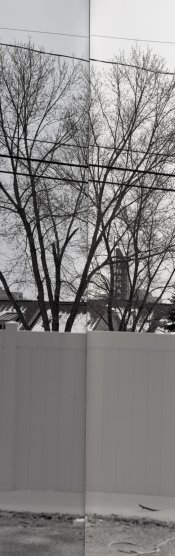
I took one image on a sheet of 8x10 film. In the darkroom, I used a paper cutter and cut it in half -- two 4x10 half sheets of film. The recommended minimum amount of stock Perceptol is 250ml per 8x10 sheet, which equates to 125ml per 4x10 sheet. I processed one half sheet (right side) using the minimum recommended amount (125ml stock + 125ml water), and the other half sheet (left) using half the minimum recommended amount (62.5ml stock + 62.5ml water).

I exposed the film at EI 50 -- 1/25 at f/22 (metered EV15 at ISO100). The camera was focused at infinity so no bellows compensation was applied. Ilford's recommended time for Delta 100 in Perceptol 1+1 at EI50 is 13:00. I reduced development time by 15% to account for the constant agitation (11:00). Yes, the image is a little soft. Could be camera shake, but more likely it's the focus -- the buildings in the far distance appear relatively sharp. I'm including an inverted transparency scan of a portion of the image. (The scan above is reflective.)

I do have to admit I was a little careless with temperature. It was around 65F in my workspace, and I wanted to process at 68F to eliminate a third variable. I used my Paterson color thermometer and set the temperature to 69F at the start of each development to allow for drift. What I didn't take into account was (I guess) thermal mass. I took another temperature reading at the end -- the left side (125ml TOTAL solution) measured 66F; the right side (250ml) 67.5F. So on average, there's about a three-quarter of a degree difference between the two developments, the left side being slightly cooler. So I guess we can only speculate if the difference in density is due to that fractional degree difference or the amount of stock solution. Even so, the differences is not so egregious that I wouldn't consider economizing a little if necessary.
perceptol2z.jpg
 

Billy Axeman

Member
Allowing Ads
Joined
Aug 18, 2017
Messages
523
Location
Netherlands
Format
Digital
It's plausible that Ilford has a built-in margin in it's numbers, but the original question was if one can use 70 ml of stock as a minimum instead of 250 ml for 80 in^2. That's less than in bvy's experiment. The problem is that if you nibble off small quantities of developer you will also see small effects, which are hard to judge, but you can bet that it harmfully influences the result.

Until now I have done a limited number of HP5+ in stock Perceptol instead of ID-11, but I see only gradual differences depending on contrast of the scene and developing time. Until now my conclusion is that the effect of Perceptol on grain and perhaps other properties is also quite subtle (contrary what some may suggest). Which makes it difficult to design a good test.
 
Last edited:
OP
OP

pentaxuser

Member
Joined
May 9, 2005
Messages
20,333
Location
Daventry, No
Format
35mm
Thanks the print makes it clear what I had erroneously thought might be 4 negs is in fact a fence and the "hills"in the lower half are the bottom of the fence. If the fence is closer to the lighter colour as in the stock 125 ml then it would seem that highlights are not as bright as they should be but allowing for what you have said as to the development factor differences plus the benefit of VC paper I do wonder what the practical differences might be in a print.

60ml was what I used in a 250ml tank at 1+3 for a 135 film but Ilford did tell me that 70ml was the minimum, based on a 280ml tank. Maybe 280ml was a standard size when llford came up with its 70ml but most would have used or still use 300ml so that's 75ml - 15 ml more than my 60ml - which might make a safety factor kind of difference.

In your case that's still 40 sq inches of negative for 125ml or 60ml economy style. In a 36 frame 135 film I'd assume the developer is in fact developing say the equivalent of 40 frames or 60 sq inches so even economy style it should be 60ml + 50% of 60 ml so 90 ml stock for my 135. If Ilford stated that 70ml stock was the minimum and my prints looked OK ( to me at least) then it does suggest that there is considerable leeway in what is minimum stock.

I think I recall some of the negs on that particular 60ml stock at 1+3, I must try and find them again plus the prints and re-examine them

pentaxuser
 

Sal Santamaura

Member
Allowing Ads
Joined
Nov 21, 2005
Messages
7,535
Location
San Clemente, California
Format
Multi Format
...the benefit of VC paper I do wonder what the practical differences might be in a print...
The paper I currently find most aesthetically pleasing is ADOX LUPEX. It's not VC. It's only available in grade three.

The practical difference in prints when respecting the minimum 250ml stock solution of Perceptol per 80 square inches of film is that, unlike ignoring the requirement by using less stock, negative densities are completely predictable once calibrations have been performed, irrespective of scene content, and by extension, so are print densities. Exhaustion of the active ingredient won't happen, irrespective of scene content. Thus, once calibrations have been performed, one can with confidence develop negatives that will match LUPEX's scale.

Confidence or crap shoot. The choice continues to be each individual photographer's. I choose predictable confidence.
 

bascom49

Member
Allowing Ads
Joined
Oct 14, 2010
Messages
231
Format
Medium Format
The test doesn't prove anything regarding the minimum amount of stock solution required to fully develop a given area of film. But I'm just as happy for the test to reinforce some beliefs. :D
There is a noticeable difference, and I am not convinced that this thread has demonstrated otherwise.
Given the time that I spend to shoot, process and print, working on the conservative side and using the minumum amount suggested, following the manufacture's directions is what I do.
My hunch from reading this thread is that the performance and benefit of Perceptol is compromised, possibly a third to two thirds of a stop.
For those that are willing to compromise the full performance of the developer, why use such a specialized developer at all ?

As a side note, the maximum benefit in terms of grain, sharpness, etc would be for the 35mm format to increase the ability to make enlargements beyond what may be typical. At four 36 exposure films per liter that is 144 images per liter.

For medium format 48, 40, or 32 depending on camera.

For 8x10 you are looking at mural size prints to appreciate what Perceptol can do.

However, for those of you that use the lower amount and are producing prints that meet your personal aesthetic and make you happy, exactly what is it that we are debating ? For those of us that use the recommended amount and are achieving our goals aesthetically why do we care how someone else cares to implement the same tool. What is important is the final image and if that image is something that you and others enjoy call it a day and move on to make more prints.
 
Last edited:

Sal Santamaura

Member
Allowing Ads
Joined
Nov 21, 2005
Messages
7,535
Location
San Clemente, California
Format
Multi Format
...For 8x10 you are looking at mural size prints to appreciate what Perceptol can do...
Not quite. I only contact print 8x10 negatives. Here's what Perceptol does for me.

Perceptol enables development of sheet film in Jobo Expert drums, at the high ambient air and water temperatures common here during summer, using the optimum approximately 45 r.p.m. drum rotation rate, for times that are long enough to avoid uneven results. I can process four 8x10 sheets in a 3004 drum using one liter of Perceptol stock. With sunlit scenes containing a full range of tones, in order to obtain negatives compatible with ADOX LUPEX (only available in grade three), I haven't found any other developer capable of doing this that doesn't require sub-four minute times, leading to streaks and similar artifacts.
 

bascom49

Member
Allowing Ads
Joined
Oct 14, 2010
Messages
231
Format
Medium Format
Not quite. I only contact print 8x10 negatives. Here's what Perceptol does for me.

Perceptol enables development of sheet film in Jobo Expert drums, at the high ambient air and water temperatures common here during summer, using the optimum approximately 45 r.p.m. drum rotation rate, for times that are long enough to avoid uneven results. I can process four 8x10 sheets in a 3004 drum using one liter of Perceptol stock. With sunlit scenes containing a full range of tones, in order to obtain negatives compatible with ADOX LUPEX (only available in grade three), I haven't found any other developer capable of doing this that doesn't require sub-four minute times, leading to streaks and similar artifacts.

Sal, thanks for sharing those technical benefits and considerations. I also develop using the Jobo, I may be getting benefits that I had not realized.
 

hacked - sepiareverb

Member
Allowing Ads
Joined
Feb 17, 2007
Messages
1,103
Location
St J Vermont
Format
Multi Format
Just out of the darkroom here after a trip away for a few days. I ran four tanks of different films in different developers at my standard times. The first two tanks worth are hanging in the dryer, and I see no difference in density or contrast between a single roll of 120 FP4+ (at 125) run in DD-X 1:4 in a 500mL metal tank and ORWO UN54 )at 100) run in Perceptol 1:1 (I ran four 135-36 rolls in a 1L metal tank, 500mL of stock Perceptol, so 125mL per roll). Some PanF+ in DD-X 1:4 and some HP5+ in R09 Spezial (Agfa Studionol) are still in the wash. Not a definitive test, not backed up by ph testing or a densitometer, but simply 35 years of developing and printing b&w film, and taking the time to dial in personal ISO and development. Feel free to disregard my anecdotal results, I am not claiming anything other than the appearance of complete development using 125mL of Perceptol per roll in my darkroom using my times. I regularly print from negatives developed just as above without any need of excessive contrast or development for normal scenes, across all the film/development combos listed above. Print times and contrast are pretty darn consistent.

I will note that the leader of the UN54 is certainly maximum black.

Edit:
Rest of the films are out of the wash and in the cabinet. The PanF+ in DD-X looks quite the same in density, as does the HP5+, tho one roll of HP5+ was shot with a Nikon 28Ti with flash on a pre-dawn walk through Chinatown in NYC, and is a touch more contrasty on many frames. Nothing that will make for huge difficulty in the printing stage should any frame make it that far. I did make one error on a 120 roll of HP5, where I did not change exposure when stepping back and included a brightly lit sidewalk in the frame of a privacy fence. Some heavy burning will be required there. Some of the PanF+ shot through a car window will need some added contrast, but those frames not exposed through extra (and dirty) glass have the same density as the UN54.

My takeaway is that, once again, testing is the key. Finding your own exposure and development regimen is the correct way to answer questions such as this.
 
Last edited:
OP
OP

pentaxuser

Member
Joined
May 9, 2005
Messages
20,333
Location
Daventry, No
Format
35mm
Thanks for sharing the results of your tests. My routine based on 1+3 dilution for a 120 roll which requires 485 mls in a 120 Jobo tank would also use just under 125mls. However I should just remind all viewers of this thread that the whole thread started with my summary of what llford had said to me about the minimum quantity of Perceptol needed for a roll of film. That was 70mls of Perceptol so even in a 135 tank holding about 280mls a dilution of 1+3 is possible.

I appreciate that some believe that 250 mls of stock is needed and that's fine. It would also seem that 125mls of stock is OK for some. However the key to providing evidence for the actual minimum of stock is what happens to the level of outcome when only 70mls is used as is the case at 1+3 in a 300 mls tank.

60/63 mls( the Jobo tank's recommended is 240 mls but for round figures I usually use 250 mls) at +3 in a 250 mls tank for a 135 film worked OK for me but it would certainly help potential users of Perceptol at 1+3 if there were any other users who have tried or are willing to try say 75 mls of stock at 1+3 for a 135 film then compare it to 125 mls of stock at 1+3 in a 500 mls tank

I should also repeat that Ilford felt that I was on the very limit with 60 mls and while the negs and subsequent prints looked OK to me I concede that a drop to 60mls might be going a bit too far

pentaxuser
 

Doc W

Member
Allowing Ads
Joined
Nov 7, 2009
Messages
955
Location
Ottawa, Cana
Format
Large Format
Not quite. I only contact print 8x10 negatives. Here's what Perceptol does for me.

Perceptol enables development of sheet film in Jobo Expert drums, at the high ambient air and water temperatures common here during summer, using the optimum approximately 45 r.p.m. drum rotation rate, for times that are long enough to avoid uneven results. I can process four 8x10 sheets in a 3004 drum using one liter of Perceptol stock. With sunlit scenes containing a full range of tones, in order to obtain negatives compatible with ADOX LUPEX (only available in grade three), I haven't found any other developer capable of doing this that doesn't require sub-four minute times, leading to streaks and similar artifacts.

This is my motivation as well, i.e., avoiding short development times in a Jobo. Perceptol (and my home-brew version of Perceptol) solve this problem I develop 4x5, 5x7 and 8x10 in an Expert Drum and never use less than the 250mm limit of stock per 8x10 sheet.

I am still using HC-110 in a Paterson tank for 120 film (just because I am cheap and want to use it up). Earlier in this thread, quite a few people complained that there were no one 1 litre tanks, but I have something called a "Paterson Tank 5" which holds two 120 reels and 1 litre of chemistry. I thought that these were common but I guess not.
 
Photrio.com contains affiliate links to products. We may receive a commission for purchases made through these links.
To read our full affiliate disclosure statement please click Here.

PHOTRIO PARTNERS EQUALLY FUNDING OUR COMMUNITY:


Ilford ADOX Freestyle Photographic Stearman Press Weldon Color Lab Blue Moon Camera & Machine
Top Bottom