
• Welcome to Photrio!
    Registration is fast and free. Join today to unlock search, see fewer ads, and access all forum features.
    Click here to sign up

Methodology and Curve Interpretation

Cool as Ice

A
Cool as Ice

  • 0
  • 1
  • 63

Recent Classifieds

Forum statistics

Threads
202,708
Messages
2,844,538
Members
101,482
Latest member
Jeremizzle
Recent bookmarks
14
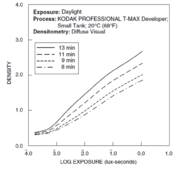
I think this falls under the general umbrella of methodology and the characteristic curve analysis. I found some interesting looking curves in Kodak's PDF document F-4001, which concerns the T-MAX P3200 film. On page 8, the characteristic curves appear to be wrong. I am attaching them here. They seem to be more for an ISO 100 film, rather than the ISO 1000-1200 that the P3200 appears to be. Another small issue is the very low B+F density, which appears to be significantly lower than the current 135 version of the film. This is not a big deal, but I thought it was interesting. I wonder if this was just an innocent mistake, and, if so, how it ended up in the wrong document.

You might be misreading the notation. -2.50 vs bar 2.5
1673836238405.png
antilog -2.50 = 0.08 , antilog bar 2.5 = 0.0016
 
Last edited:
You might be misreading the notation. -2.50 vs bar 2.5 View attachment 326791 antilog -2.50 = 0.08 , antilog bar 2.5 = 0.0016

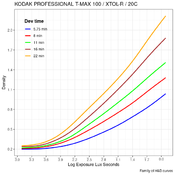
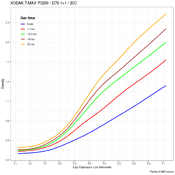
I thought so at first, but then I recalculated the entire plot using both bar and non-bar notation. That ancient notation can be tricky. To me, the speed point looks to be around bar3.9, which would make it about an ISO 100 film. In my own test, in XTOL, I got slightly above ISO 100 (see below). I also located another Kodak TMZ 3200 curve in an old PDF, and this one seems much closer to what it should be (my test was bar4.83 in D76, whereas Kodak's curve looks around bar4.9). The reason I asked about people's preferences about presenting the curves was to see if there's any consensus, as the literature is full of inconsistencies. It's not a big deal, but it's an interesting historical quirk, I guess.
Edit: I am also attaching my plot of P3200 for comparison.


tmax100XTOLFamily.pngkodak_tmax_3200_0.pngkodakTmaxP3200_Combinedraw_data.png
 
Thanks! I have written the program from scratch, but, of course, I have used existing libraries for things like printing to a PDF device and writing PNG images to disk. I am currently working on a JavaScript-based user interface, so the program can be used from any web browser or via a mobile app.

Would it be possible to incorporate automated data entry using this device?

 
Would it be possible to incorporate automated data entry using this device?


If you plug the Printalyzer Densitometer into a USB port, it tells the computer that it's a keyboard. Thus, it can squirt measurements directly into a text file or spreadsheet. To help with this, there's a setting in the device to terminate each measurement with a carriage-return or tab (and probably other options I don't recall).

Mark
 
I think this falls under the general umbrella of methodology and the characteristic curve analysis. I found some interesting looking curves in Kodak's PDF document F-4001, which concerns the T-MAX P3200 film. On page 8, the characteristic curves appear to be wrong. I am attaching them here. They seem to be more for an ISO 100 film, rather than the ISO 1000-1200 that the P3200 appears to be. Another small issue is the very low B+F density, which appears to be significantly lower than the current 135 version of the film. This is not a big deal, but I thought it was interesting. I wonder if this was just an innocent mistake, and, if so, how it ended up in the wrong document.

You're right the curves in F4001.pdf look weird. The "low B+F" you mention looks about 0.2 and would be a gray antihalation base. That part makes sense to me.
But you're right that the curves aren't labeled in a way that supports an ISO 800 rating. If it were 800 the film would have 0.1 density above B+F at -3.0 log mcs, and it's more like a 100 film which would have it at -2.1 log mcs (calculator).

My guess is that someone labeled the x-axis wrong.

There was one graph in post #38 that uses Bar-Mantissa notation. Fig. IV-1 Sensitometric D Log E Curve (It's from Todd-Zakia Photographic Sensitometry).
You'll see Log E markings that look like someone doesn't know how to subtract 0.3 from 0.0 (on a calculator the Log E for Step Number 17 would be -0.3 . In Bar-Mantissa notation the graph is correct to show 1 bar .7

Kodak skirts the issue by only marking whole bar or negative numbers (whole numbers are the same either way). Others like Ilford mark "relative" log exposure, just another way to steer clear of bar-mantissa
 
Why graph the film base density? It has no image forming properties.
 
If you plug the Printalyzer Densitometer into a USB port, it tells the computer that it's a keyboard. Thus, it can squirt measurements directly into a text file or spreadsheet. To help with this, there's a setting in the device to terminate each measurement with a carriage-return or tab (and probably other options I don't recall).

Mark

Mark,

Thanks for that information! I am seriously thinking of purchasing the Printalyzer and that is good to know...
 
If you plug the Printalyzer Densitometer into a USB port, it tells the computer that it's a keyboard. Thus, it can squirt measurements directly into a text file or spreadsheet.

I just recently purchased one of these little jewels.....it's basically a copy and paste deal. You make your measurements, it loads the measurements automatically to a table, you click the "copy table" button when finished, then go to your spread sheet and paste the table data where you need it. It can be pasted either vertically or horizontally.
 
I just recently purchased one of these little jewels.....it's basically a copy and paste deal. You make your measurements, it loads the measurements automatically to a table, you click the "copy table" button when finished, then go to your spread sheet and paste the table data where you need it. It can be pasted either vertically or horizontally.

Can you tell me if it is LED based? I have been looking at X-Rite alternatives, but usually, just ONE bulb replacement will negate any cost savings on buying an older densitometer.

The bulbs for older densitometers are getting rare and can run into the hundreds of dollars, so even if this unit cost 4x a used one, it would be more cost effective in the long run...
 
You're right the curves in F4001.pdf look weird. The "low B+F" you mention looks about 0.2 and would be a gray antihalation base. That part makes sense to me.
But you're right that the curves aren't labeled in a way that supports an ISO 800 rating. If it were 800 the film would have 0.1 density above B+F at -3.0 log mcs, and it's more like a 100 film which would have it at -2.1 log mcs (calculator).

My guess is that someone labeled the x-axis wrong.

There was one graph in post #38 that uses Bar-Mantissa notation. Fig. IV-1 Sensitometric D Log E Curve (It's from Todd-Zakia Photographic Sensitometry).
You'll see Log E markings that look like someone doesn't know how to subtract 0.3 from 0.0 (on a calculator the Log E for Step Number 17 would be -0.3 . In Bar-Mantissa notation the graph is correct to show 1 bar .7

Kodak skirts the issue by only marking whole bar or negative numbers (whole numbers are the same either way). Others like Ilford mark "relative" log exposure, just another way to steer clear of bar-mantissa
That makes perfect sense. Digging a little deeper (I couldn't help myself :smile:), I compared those curves to those in the PDF for T-MAX 100, and I think they are the same curves. It might be that someone simply pasted the wrong curves into the document before it was published. I hope the person didn't get in trouble for that. It was probably an innocent mistake. Here's the T-MAX 100 page (p. 8) from the PDF (F-4016):
 

Attachments

  • f4016_tmax_100Page8.pdf
    125.4 KB · Views: 151
Can you tell me if it is LED based? I have been looking at X-Rite alternatives, but usually, just ONE bulb replacement will negate any cost savings on buying an older densitometer.

The bulbs for older densitometers are getting rare and can run into the hundreds of dollars, so even if this unit cost 4x a used one, it would be more cost effective in the long run...

Yes it is. I monitored the thread wherein Derek was designing this unit, and he uses LEDs for illumination. Thus, this device should last indefinitely.

Mark
 
Thank you Chuck_P and Albada; I thought it might be so, but good to get confirmation.
 
Yes it is. I monitored the thread wherein Derek was designing this unit, and he uses LEDs for illumination. Thus, this device should last indefinitely.

Mark

That is really a huge benefit over the old densitometers, such as my X-Rite 810. I have one spare part left, and I recently discovered that the foam inside the box rotted away, leaving a layer of goo all over the bulb. I need to clean it. I have isopropyl alcohol, denatured alcohol, acetone, and soldering flux cleaner. Just not sure which will work best.
 
That is really a huge benefit over the old densitometers, such as my X-Rite 810. I have one spare part left, and I recently discovered that the foam inside the box rotted away, leaving a layer of goo all over the bulb. I need to clean it. I have isopropyl alcohol, denatured alcohol, acetone, and soldering flux cleaner. Just not sure which will work best.

Oh man! I believe those bulbs are quartz halogen, so you have to be extremely careful nothing penetrates the surface of the glass or the bulb will blow very quickly.

I wouldn't use anything that leaves a residue (from the solvent itself).

I would try to physically scrape off all you can with a toothpick or an orange wood stick before trying to clean it off with a dry microfiber towel. Maybe a very, very light rub with a cotton swab dampened in alcohol at the very end to try to remove any traces of goo, but not enough to really wet the surface...

It may take some physical scrubbing (so to speak) to wipe it all off, but I would avoid any solvents unless absolutely necessary.

The bulbs for the X-Rite we use at work cost over $250 USD each and I don't know where we will find our next few replacements. We bought a Heiland PM densitometer as a backup, but I personally do not like it as much as the X-Rite.

Just my opinion; others think its good.
 
Why graph the film base density? It has no image forming properties.

Base density tells you the expected minimum density, whether it’s clear and maybe 0.05 or gray and maybe 0.25, it helps to know so you don’t freak out seeing what you think is fog if it’s not.

Families of curves look a little different when you zero on base plus fog versus when you zero on air. Speed points graph as a diagonal line if you join them (when you zero on air). BTZS graphs them that way. It tells you something .

I like to zero on base plus fog, then note for each curve what that was.
 
To me, and any software I use, including film base density makes a mess of things. I always zero the densitometer to the film base; I thought that was standard practice.

Measuring film base fog to know about 'film base fog' is a different test. Since the film base has no image forming properties, I wold not include it in a test of films image forming properties, i.e. the H&D curve.
 
I scan my film. My scanner has a densitometer to check various portions of the film scan.

What value is that to me? How could I use this information to improve my scans?
 
I scan my film. My scanner has a densitometer to check various portions of the film scan.

What value is that to me? How could I use this information to improve my scans?

You can use the densitometer tool like an “after-the fact” spotmeter to see what high and low densities you have in a particular negative.

Especially if you found that negative came out really nice or was particularly easy to work with.

And then you can come up with a plan to make more of your negatives come out close to that good one.
 
You can use the densitometer tool like an “after-the fact” spotmeter to see what high and low densities you have in a particular negative.

Especially if you found that negative came out really nice or was particularly easy to work with.

And then you can come up with a plan to make more of your negatives come out close to that good one.

Thanks Bill. It does seem complicated and I wonder if there's any benefit.

Right now, I try to determine empirically if it's a good exposure. If it looks good on the negative or chrome, scans easily and can be edited easily, then I'm happy. (Right now I'm not printing) I look to see what I did from the notes I took when I shot it and try to repeat the exposure determination process in the future or change it if there's a problem.

I'm not sure how knowing various densitometer readings would improve upon that. How could I use them to improve my current method?
 
Thanks Bill. It does seem complicated and I wonder if there's any benefit.


I'm not sure how knowing various densitometer readings would improve upon that. How could I use them to improve my current method?
If you’re developing yourself and want to be consistent there’s a benefit. You don’t have to go all the way into the rabbit hole of test, test, test and never take any real pictures.

I tell a story of a test you can do that doesn’t even waste film. You’ve heard of bracketing, right? Next time you’re out, bracket a shot two stops.

Then when you get the negatives look to see that they are about one stop apart in density.

That should work because negative are usually processed to about 0.5 contrast if you just follow the formulas.
 
If you’re developing yourself and want to be consistent there’s a benefit. You don’t have to go all the way into the rabbit hole of test, test, test and never take any real pictures.

I tell a story of a test you can do that doesn’t even waste film. You’ve heard of bracketing, right? Next time you’re out, bracket a shot two stops.

Then when you get the negatives look to see that they are about one stop apart in density.

That should work because negative are usually processed to about 0.5 contrast if you just follow the formulas.

When I shoot medium format, I always bracket my shots just in case I make a mistake figuring exposure. With 4x5 which I started during COvid, I got cheap and rarely bracket. What does the .5 contrast tell me?
 
It’s not like bracketing that you do all the time. Once in a while is good enough.

Finding 0.5 contrast (density goes up one stop across two stops increase in exposure) tells you the negative is developed for the right time in that developer for a decent normal picture.

Thinking this way leads to questions. Is 1 1/3 stops increase (0.4 density increase) over two stops exposure increase even better? Yes, but you’re starting to push it (0.67 contrast). Is 2/3 stops good? No, you’re starting to under develop (0.33 contrast). Somewhere between 0.5 to 0.6 is the sweet spot. Don’t want to be below 0.4 contrast because that usually leads to uniformity issues. Above 0.7 is for pushing and graphic arts (when you want it you know).
 
Will this information allow me to take better photographs?
 
When I shoot medium format, I always bracket my shots just in case I make a mistake figuring exposure. With 4x5 which I started during COvid, I got cheap and rarely bracket. What does the .5 contrast tell me?

Bracketing should be occasional not a life style.
 
Photrio.com contains affiliate links to products. We may receive a commission for purchases made through these links.
To read our full affiliate disclosure statement please click Here.

PHOTRIO PARTNERS EQUALLY FUNDING OUR COMMUNITY:


Ilford ADOX Freestyle Photographic Stearman Press Weldon Color Lab Blue Moon Camera & Machine
Top Bottom