• Welcome to Photrio!
    Registration is fast and free. Join today to unlock search, see fewer ads, and access all forum features.
    Click here to sign up

Kodak Plus X- How I Miss This Film

Recent Classifieds

Forum statistics

Threads
202,825
Messages
2,846,027
Members
101,548
Latest member
Underexposed
Recent bookmarks
0
I think it came in bags as well, did it not? I revived an old thread on this developer.

1682311942089.png

Photographer's Formulary sells a packaged version.
 
Mark. Since FP4 is the closest thing to Plus X, how would you proceed to get that look out of FP4?

Other posters contributed a couple of possibilities. I think you want an upsweep in the curve, and a developer that's well buffered and diluted some might do that. The formula for DK-50 has 10 g/L of metaborate, so it's well buffered. That looks promising.

Mark
 
Like others, I have a stash of plus x. It has been frozen for years and I wonder if it will be any good. I had a lot of fun working out a procedure for making positive transparencies, and they really looked good. When it was discontinued I just stopped experimenting. I don't know whether to go ahead and use it up or hoard it, and work on a different film. Has anyone else had experience making slides from plus x?
 
Curious. Would I get the same curve using DK-50 and HP5+ too? This might be my solution for killing two birds with one stone.
 
Someone said DK-50 gives similar results to HC-110. I already have some HC-110. Is this applicable to my needs or should I continue looking for DK-50? Also is there an aftermarket DK-50 being made? Or is it only from Kodak old stock on Ebay?
 
I really liked plus-x in super 8. Didn't use much in still photography but I liked what i did use and would agree it's different to FP4 and anything else currently on the market.

I would hope that it's on Kodak's radar to re-introduce plus-x....once they've sorted out all their other supply and demand issues....which may well take another couple of years or more.
 
I miss Plus-X too, though I never found it quite as useful a film as Tri-X. It did have good latitude and slightly better grain than TX, and some unique aspects. (My dad the old pro: "I've had Plus-X negs so thin that you could read a newspaper through... yet they made good prints on number five paper.") I tried FP4 again recently in my OM-2 and Pen F... and it's just NOT Plus-X. I don't care for its look.

I used TMX for years as my standard film in my Minox, souped in D-76 1:1. It does have fine grain... but also narrow latitude, harsh contrast, blown-out highlights. It's a great film, but as others have said, it's no "replacement" for Plus-X.

But you know, the film I miss even more than Plus-X (and this is a strange thing for a lifelong-Kodak-everything guy like me to say) is 90s Agfapan APX 100. That was a simply gorgeous film with wide latitude, fine grain (finer than PX), and a unique "luminous" quality.

Here's a 1995 shot of my son, APX 100 in a Minox IIIs (no meter, exposure estimated), dev'd in D-76 1:1, scanned from a 4x5 print. Darn nice from a negative the size of your pinky nail!

DAV1095.JPG
 
Last edited:
It's probably just nostalgia but I sure miss Plus-X too, and I've shot my last of it.
 
Curious. Would I get the same curve using DK-50 and HP5+ too? This might be my solution for killing two birds with one stone.

As I mentioned on page two of this thread, I use DK-50 1+1 with HP5 for Carbon Transfer printing. It bends the shoulder upwards, giving better highlight separation. It also has lower B+F (which is best for said process).
 
So much sturm und drang about film, when the real loss is papers. Everything today is full of OBAs, excessively shiny and coated on one single base from Schoeller. Anyone wishing to recapture the superior image characteristics of last century would do better to lobby Hahnemuhle rather than wasting their time fantasizing about Kodak. :smile:
 
So much sturm und drang about film, when the real loss is papers. Everything today is full of OBAs, excessively shiny and coated on one single base from Schoeller. Anyone wishing to recapture the superior image characteristics of last century would do better to lobby Hahnemuhle rather than wasting their time fantasizing about Kodak. :smile:

Some of us don't use gel silver papers (I haven't since I got into Alt printing 16 years ago). By the way, I use Hahemuhle PR for alt printing 😉
 
Courtesy of a contact I have in the film industry:

Essentially, all black and white films since the very early days of film manufacture are “two-emulsion”, or more, films. In order to obtain films with speeds fast enough for indoor photography, films required multiple sized grains and for a film to become panchromatic, that meant that grains of different sizes would require dying to record red, green or blue light. Each of those dyed grain “sets”, in their own emulsion could then be mixed into one large emulsion to coat or split up to coat in several layers.

Another means of making a “two-emulsion” black and white film would be to split the grain sizes into small to mid-sized and mid-sized to large each set to its own emulsion, and mixing all three dyed silver grains together for a slow-to-mid and a mid-to-fast emulsion. All panchromatic black and white films manufactured for still film photography have been manufactured like this for a very long time, perhaps 40 years or more.

Why?

Separating the grain sizes gives the advantage for the film manufacture to better control the film speed when the emulsions are made, and also when they are coated. Light absorbing dyes can be added to optimize a specific region of the DlogE curve’s speed by dying the specific emulsion, which will lead to better consistency and linearity in the product. These are tools that the manufacturer would not have if all the speeds were coated “all as one”.


And yes, due to their physical characteristics, the emulsion components with different speeds are usually coated one on top of the other.

Thanks for the info on 120 - I don't recall ever using it in that format, but certainly used it in 127, 620 and 616.

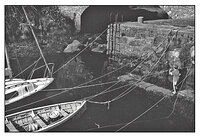
The two emulsion layers is what made Verichrome Pan so versatile and forgiving when used in box cameras.
 
I never used Pan F, Panatomic X and have only shot a few rolls of Plus X.
 
I don't think Kodak plans to produce PlusX again. Kodak's continued price hike leads to a slow decline in volume sales in favour of Ilford. Tankfully Ilford continues to offer a complete and wide range of product at a reasonable price. The recent availability of Kentmere in 120 format is a wise and forward-looking choice from Ilford. I see a continued decline in Kodak business...
 
I don't think Kodak plans to produce PlusX again. Kodak's continued price hike leads to a slow decline in volume sales in favour of Ilford. Tankfully Ilford continues to offer a complete and wide range of product at a reasonable price. The recent availability of Kentmere in 120 format is a wise and forward-looking choice from Ilford. I see a continued decline in Kodak business...

Whether there is a decline in business or not, historically companies have not reintroduced the greats of the past (yes i remember Acros ll) I'd say there's a snowball's chance in the hot place of seeing Panatomic X again. On a realistic note, yes there has been an upsurge in film use, but not to the level of the pre-digital era. Azo, Portiga, Brilliant (Boespflug & Guiilemot), Forte, Pan X, Verichrome Pan, Agfapan 25, Agfa MCC-110, et al, sadly gone the way of the dodo.....
 
I think some version of HIE and/or EIR were under consideration for revival, before the pandemic intervened.
 
Whether there is a decline in business or not, historically companies have not reintroduced the greats of the past (yes i remember Acros ll) I'd say there's a snowball's chance in the hot place of seeing Panatomic X again. On a realistic note, yes there has been an upsurge in film use, but not to the level of the pre-digital era. Azo, Portiga, Brilliant (Boespflug & Guiilemot), Forte, Pan X, Verichrome Pan, Agfapan 25, Agfa MCC-110, et al, sadly gone the way of the dodo.....

Just to point out, pre-digital era film was being consumed not by photographers but really by people taking snapshots on point and shoots and disposables. Fill will never be in every home again and that's not the goal of the film community. Cameras will never again be in every home either. The day of the camera and film has passed, the same can be said for many things like personal computers and landlines. That doesn't mean there is room for growth and improvement. People still paint with brushes and write with pens. People still ride motorcycles and manual vehicles. Horses are still ridden for fun and still have a use for work. Film will join the ranks of tools once used by all but now have a specific use.

I think Plus-X may come back because it fills in a gap in Kodaks line. Unless they start marketing Double X to fill that gap which is fine by me too.
 
I never used Pan F, Panatomic X and have only shot a few rolls of Plus X.

I disliked Pan X because the emulsion was thin, and would cause Newton rings on the glass. I liked Plus X well enough, but found Tri-X more versatile so I built my shooting around it.I shot only a few rolls of Verichrome Pan, through a homemade meniscus lens cannibalized from a Vest Pocket Kodak and mounted on a Rollei SL66, and LOVED the film on that camera -- got great halation effects which I attributed to the lens, but gather now through this thread was owed in part to the film itself.
 
One can hope.

I think 'dream' is the operative word.
We see a 'gap' or place in the Kodak line.... but the accounting dept at Kodak likely sees Tmax 100 and TMY2, & Tri-X....& doesn't see a 'gap.'
 
Photrio.com contains affiliate links to products. We may receive a commission for purchases made through these links.
To read our full affiliate disclosure statement please click Here.

PHOTRIO PARTNERS EQUALLY FUNDING OUR COMMUNITY:


Ilford ADOX Freestyle Photographic Stearman Press Weldon Color Lab Blue Moon Camera & Machine
Top Bottom