• Welcome to Photrio!
    Registration is fast and free. Join today to unlock search, see fewer ads, and access all forum features.
    Click here to sign up

Is pre-exposing negs a useful tool or a complete waste of time?

High Street

A
High Street

  • 5
  • 1
  • 43

Recent Classifieds

Forum statistics

Threads
201,871
Messages
2,831,493
Members
100,994
Latest member
SheWoDun
Recent bookmarks
0

Xmas

Member
Allowing Ads
Joined
Sep 4, 2006
Messages
6,398
Location
UK
Format
35mm RF
Whilst it has been common to illustrate this concept of pre-flashing and flare as changing the shape of the curve, with the flashed toe starting parallel & above the un-flashed toe, the reality is that the curve remains constant. The silver responds appropriately to a given amount of exposure.

The placement of ALL the subject matter simply moves right along the curve with more exposure.

Illogical

If you do the ISO speed test on a non pre-flashed and a pre-flashed film they won't be the same.

Preflashing is no different to any of the other sensitisation techniques.
 

markbarendt

Member
Allowing Ads
Joined
May 18, 2008
Messages
9,422
Location
Beaverton, OR
Format
Multi Format
Illogical

If you do the ISO speed test on a non pre-flashed and a pre-flashed film they won't be the same.

Preflashing is no different to any of the other sensitisation techniques.

Preflashing doesn't change how the emulsion/the silver responds to exposure or the chemical reactions when developed, it just adds more exposure.

The H&D curve, for a given film, in a given development scheme, is fixed. To change the H&D curve you have to change the film or the development.

Exposure only changes where things fall (their placement) on the curve from right to left.

A given amount of exposure (whether single or multiple) will beget a given placement on the curve.
 

Rudeofus

Member
Joined
Aug 13, 2009
Messages
5,119
Location
EU
Format
Medium Format
Mark, there is a threshold, i.e. a minimum number of photons required) to make a silver halide grain developable, and that number is higher than one. You can therefore not interpret preflash+exposure as linear superposition of exposures.

At very low exposure levels, we have three stages:
  1. One silver atom is created, but neither stable nor developable. Unless another silver atom is created within a very short time frame, it will likely turn into silver ion. This is the effect which causes reciprocity failure.
  2. Two silver atoms are created and form a cluster, which is stable but not developable. In this case you have time to convert such clusters into larger clusters which are developable.
  3. Three or more silver atoms form a cluster, which is both stable and developable. Once you have reached this stage, preflashes and postflashes will add density but not sensitivity.

A preflash converting stage 1 clusters into stage 2 or 3 clusters will be tricky, as it would have to be applied within seconds or less before or after the actual exposure, but obviously the additional effective sensitivity could make it worth the effort. A preflash which converts stage 2 clusters into stage 3 clusters will definitely add ISO speed, albeit less than a stage 1 ---> stage 3 preflash, and such a preflash should be quite easy to dial in.

You can argue that none of these tricks alter the light sensitivity of film, and you are right. These trick do change the sensitivity to image forming light, though.

 

Xmas

Member
Allowing Ads
Joined
Sep 4, 2006
Messages
6,398
Location
UK
Format
35mm RF
Additional flare from a SC lens is concurrent with the main exposure and could be in any or each of the three cases.

I rely on met forecast whether I take SC or MC lenses.
 

markbarendt

Member
Allowing Ads
Joined
May 18, 2008
Messages
9,422
Location
Beaverton, OR
Format
Multi Format
Mark, there is a threshold, i.e. a minimum number of photons required) to make a silver halide grain developable, and that number is higher than one. You can therefore not interpret preflash+exposure as linear superposition of exposures.

At very low exposure levels, we have three stages:
  1. One silver atom is created, but neither stable nor developable. Unless another silver atom is created within a very short time frame, it will likely turn into silver ion. This is the effect which causes reciprocity failure.
  2. Two silver atoms are created and form a cluster, which is stable but not developable. In this case you have time to convert such clusters into larger clusters which are developable.
  3. Three or more silver atoms form a cluster, which is both stable and developable. Once you have reached this stage, preflashes and postflashes will add density but not sensitivity.

A preflash converting stage 1 clusters into stage 2 or 3 clusters will be tricky, as it would have to be applied within seconds or less before or after the actual exposure, but obviously the additional effective sensitivity could make it worth the effort. A preflash which converts stage 2 clusters into stage 3 clusters will definitely add ISO speed, albeit less than a stage 1 ---> stage 3 preflash, and such a preflash should be quite easy to dial in.

You can argue that none of these tricks alter the light sensitivity of film, and you are right. These trick do change the sensitivity to image forming light, though.

I don't disagree with what you are describing. You are right I'm sure.

All I'm suggesting is that all that incipient stage stuff is happening on the flats left of the toe on the curve.

As exposure reaches a point where it gets stable we are probably getting close to the bottom of the toe.

Exposure doesn't change the curve. The shape of the curve is fixed by the film and the development, the placement on the curve, right to left, is controlled by the total (stable) exposure received.
 

Rudeofus

Member
Joined
Aug 13, 2009
Messages
5,119
Location
EU
Format
Medium Format
As exposure reaches a point where it gets stable we are probably getting close to the bottom of the toe.

Exposure doesn't change the curve. The shape of the curve is fixed by the film and the development, the placement on the curve, right to left, is controlled by the total (stable) exposure received.

An exposure "where it gets stable" is the very very first trace of density that shows up at all in your characteristic curve. If light doesn't create stable development centers, you get nothing except fog. By the time you are in the bottom region of the toe, a substantial number of silver halide grains must have reached enough exposure to form stable and developable silver clusters.

The curve you write about describes the response of film to a single short (but not too short!) duration exposure, and this curve will not necessarily stay that way in case of multiple exposures, or exceedingly weak or strong light levels (with adjusted exposure times). I have already provided the prevailing theory, why a weak homogeneous exposure immediately followed by the image forming exposure will create higher sensitivity to image forming light. If my theory sounds too dry, have a bite at Athiril's delicious practical results, which clearly show that the effect is there.
 

Rudeofus

Member
Joined
Aug 13, 2009
Messages
5,119
Location
EU
Format
Medium Format
Additional flare from a SC lens is concurrent with the main exposure and could be in any or each of the three cases.

I rely on met forecast whether I take SC or MC lenses.

Athiril reports that he had to dial in preflash levels very accurately in order to get visible benefits. Replicating this with lens flare sounds like a hit or miss strategy to me, and I wonder how that would have fared in the the test image @EI12800 which Athiril posted in this thread.
 

Patrick Robert James

Member
Allowing Ads
Joined
Jul 31, 2012
Messages
3,419
Format
35mm RF
You can post flash as well. I believe Vestal used to hang his film up in the darkroom for a while before he developed it. I don't remember where I read that but it was probably in one of his books. He had a formula for it and I believe he used a green safelight. I could totally be wrong though so check for yourself.

The film doesn't care whether it is pre or post flashed, it only cares how much light hits it. (Actually, the film doesn't care, we do, but you get the gist...)
 
Joined
Jan 7, 2005
Messages
2,739
Location
Los Angeles
Format
4x5 Format
ISO film speed is determined using a defined criterion which doesn't include flashing. Although you could say pre-exposure will change your EI.

As for changing the shape of the curve. This is a very good question. The general idea is that exposure is superimposed upon the fixed curve for a given set of development conditions. That does assume the curve has been defined using a given set of sensitometric exposure conditions. One way to look at pre-exposure/flashing is to introduce enough non-image forming exposure to reach the inertia point where any additional exposure will begin to produce density. The primary exposure is then added. This would simply be a case of including an extra flash/flare curve to the camera image curve and superimposing them both onto the standard sensitometrically exposed film curve?

On the other hand, when testing for intermittency effects, the sensitometric exposure would need to incorporate multiple exposures to mimic the effect which would create a different curve shape under the same set of development conditions than a standard sensitometric exposure. Other photographic effects such as Herschel and Sabattier use non-imaging forming exposure in addition to the primary exposure which is similar to pre-exposure/flashing. I'm not sure how everything would be properly diagrammed. Would it include a standard sensitometrically exposed film curve with additional quadrants for the exposure effects?
 
Last edited by a moderator:

Gerald C Koch

Member
Allowing Ads
Joined
Jul 12, 2010
Messages
8,131
Location
Southern USA
Format
Multi Format
You can post flash as well. I believe Vestal used to hang his film up in the darkroom for a while before he developed it. I don't remember where I read that but it was probably in one of his books. He had a formula for it and I believe he used a green safelight. I could totally be wrong though so check for yourself.

The film doesn't care whether it is pre or post flashed, it only cares how much light hits it. (Actually, the film doesn't care, we do, but you get the gist...)

What you describe is called latensification.
 

Gerald C Koch

Member
Allowing Ads
Joined
Jul 12, 2010
Messages
8,131
Location
Southern USA
Format
Multi Format
I find it interesting that no one has noticed the difference between pre-flashing and hyper-sensitization. In hyper-sensitization a long exposure to a very dim light of a specific region of the visible spectrum is used while in pre-flashing a brief exposure to a much higher intensity illumination is used. Or that hyper-sensitization can be achieved without exposure to light. The reason why is because the two processes are different on the atomic level. Yet people still attribute aspects of one to the other.

"Preflashing is not strictly a hypersensitizing technique but it was often used in conjunction with Kodak's spectroscopic emulsions, sometimes together with hypering. It involves a brief, uniform, low-intensity flash of light sufficient to produce a small increase in the unexposed fog level."

This is in contrast to hyper-sensitization which involves the creation of more activation sites in the silver halide lattice. Time is needed for these sites to migrate through the crystal matrix. Hence the much longer exposure, on average > 2500X longer than pre-flashing. In addition the effect of hyper-sensitization decays very rapidly and any gain in film speed is lost within hours.
 
Last edited by a moderator:

markbarendt

Member
Allowing Ads
Joined
May 18, 2008
Messages
9,422
Location
Beaverton, OR
Format
Multi Format
What the pre-exposure does is alter the shape of the film's initial ("native") characteristic curve, raising and flattening it.

What I'm saying is that adding exposure just moves subject matter from the left edge rightward.

How could exposure do anything else?

For any point on a given film, that receives a certain total amount of exposure (via one dose or two), that is developed in a given development scheme; that point should result in a certain amount density.

What an H&D curve doesn't show well is the difference between good density and fog.

The raising and flattening you speak of isn't a change in the curve, it's an accounting trick to factor out the fog.
 
Joined
Jan 7, 2005
Messages
2,739
Location
Los Angeles
Format
4x5 Format
Stephen, not sure how intermittency would be accounted for. But since the pre-exposure is just an additional (known) flare factor, in the tone reproduction transitions I'd either superimpose it onto the standard sensitometrically exposed film curve first, before the subject flare factor, or superimpose both flare factors onto the standard curve in one step.

Michael, that's how I basically see it too. Just going over all the possibilities.
 

Xmas

Member
Allowing Ads
Joined
Sep 4, 2006
Messages
6,398
Location
UK
Format
35mm RF
It is simpler looking at Athirils shots.
 

Patrick Robert James

Member
Allowing Ads
Joined
Jul 31, 2012
Messages
3,419
Format
35mm RF
What you describe is called latensification.

Yes Gerald, very true. I probably should have been more distinct. I tend to lump together all the methods of eeking out every last bit of sensitivity. Flashing, latensification and fuming. I never do any of them to film of course, but I am just lazy. I always thought latensification sounded great as a nice passive process. I don't shoot much in dark conditions though. Fuming always seemed to me to be too much work, and as you laid out in your following post, not very long lasting either.
 

markbarendt

Member
Allowing Ads
Joined
May 18, 2008
Messages
9,422
Location
Beaverton, OR
Format
Multi Format
Adding additional image forming exposure moves everything up the curve. Adding non image forming exposure (pre exposure) changes the shape of the curve for the subsequent image exposure, lifting and flattening the low exposure densities. Flare does the same thing as pre-exposure, but does it simultaneously with the image exposure.

Think about it in the same way as flashing printing paper. When you do that, you get a slightly faster, lower contrast paper.

This is one of the (many) reasons why the negatives we end up with are not what we think we're ending up with. When you do a ZS-style EI/development test, you're essentially coming up with a flare-free characteristic curve. However under actual shooting conditions, flare is a wild card. Every frame on the roll (or every sheet, whatever) puts the image on a different characteristic curve, depending on how much flare is present in each scene.

Another way to think about is: The "native" curve + non image forming exposure give you a revised curve, onto which the image forming exposure values fall.

I guess I'm thinking that the "movement" is to the right, and always along the curve, rather than "up".
 

Xmas

Member
Allowing Ads
Joined
Sep 4, 2006
Messages
6,398
Location
UK
Format
35mm RF
I guess I'm thinking that the "movement" is to the right, and always along the curve, rather than "up".

No flashing increases the dynamic range of film there is no detectable difference in mid tones to highlights.
You are modelling the process like it was a digital sensor.
 

markbarendt

Member
Allowing Ads
Joined
May 18, 2008
Messages
9,422
Location
Beaverton, OR
Format
Multi Format
No flashing increases the dynamic range of film there is no detectable difference in mid tones to highlights.
You are modelling the process like it was a digital sensor.

1-Nope, not thinking digital.
2-Actually believe the technique works in a practical sense.

How does adding exposure change the shape of film curve? I don't believe it does.

A given amount of exposure, on a given film, at a given point, in a given development scheme, should result in a given density,

My thought is that the subject matter in question just slides right on the curve. That extra bit of shadow detail we are trying to get at is simply forced right far enough to reach the toe where it can start increasing in contrast between itself and its neighboring tones.
 

RobC

Member
Allowing Ads
Joined
Nov 5, 2007
Messages
3,880
Location
UK
Format
Multi Format
1-Nope, not thinking digital.
2-Actually believe the technique works in a practical sense.

How does adding exposure change the shape of film curve? I don't believe it does.

A given amount of exposure, on a given film, at a given point, in a given development scheme, should result in a given density,

My thought is that the subject matter in question just slides right on the curve. That extra bit of shadow detail we are trying to get at is simply forced right far enough to reach the toe where it can start increasing in contrast between itself and its neighboring tones.

You are not taking into consideration the fact that the photographic exposure scale is an exponential scale and not a linear scale. When you have factored that in you will understand.

exactly the same principles apply when flashing paper.

You are correct that everything moves up the scale but the signficance and effect of that is far more in the shadows than the highlights because we are working with an exponential scale. Result is shadow contrast is reduced BUT very importantly this pre-flash is only being done because the main exposure which follows it would otherwise not include the shadow detail so the result is actually adding shadow information pushing information up from below what would have been recorded into the the shadow area with detail.

If you consider the following:

zone 0 = 1/2
zone 1 = 1
zone 2 = 2
zone 3 = 4
zone 4 = 8
zone 5 = 16
zone 6 = 32
zone 7 = 64
zone 8 = 128
zone 9 = 256
zone 10 = 512

each zone which is 1 stop more than the next requires twice as much light as the previous.

If we pre-flash at a zone 1 level then each zone gets just one more unit of light so we get:

zone 0 = 1 1/2
zone 1 = 2
zone 2 = 3
zone 3 = 5
zone 4 = 9
zone 5 = 17
zone 6 = 33
zone 7 = 65
zone 8 = 129
zone 9 = 257
zone 10 = 513

if you were to graph these using a logarithmic curve you will see that the lower zones have been pushed up far more than the higher zones.
 
Last edited by a moderator:

markbarendt

Member
Allowing Ads
Joined
May 18, 2008
Messages
9,422
Location
Beaverton, OR
Format
Multi Format
I understand the logrythmic scale and theory.

I'm suggesting that it fits on the normal curve and there is no special curve.
 

markbarendt

Member
Allowing Ads
Joined
May 18, 2008
Messages
9,422
Location
Beaverton, OR
Format
Multi Format
So, would it be fair to say that the overlay curve assumes a different starting point than the normal curve? Essentially that the log scales for the base and the overlay curves aren't the same or ...

Would I be thinking correctly in that; if the same starting point was used the curves would match? The "dots" that represent certain points in the scene, would simply land in different spots on the base curve.
 

Bob Carnie

Subscriber
Allowing Ads
Joined
Apr 18, 2004
Messages
7,735
Location
toronto
Format
Med. Format RF
To the OP 's question I would say that some find it useful and you would need to test for yourself and see if it does something to help you.

Regarding Flashing paper - I find this invaluable, but I am sure there are those who would argue against this .. so I would suggest give it a try.


What would be the effect lets say in Bresson's case where he was timing his exposures by the length of time he smoked a cigarette... would this time
change if he pre flashed the film thus making him use a smaller cigarette and would we be able to tell the difference in his work? .. specifically the night photography...

I think so but I have never did this test so I am only guessing.
 

RobC

Member
Allowing Ads
Joined
Nov 5, 2007
Messages
3,880
Location
UK
Format
Multi Format
If in doubt, try it out.

My bet is most times you will get muddy looking shadows.

There are times when it should work quite well and others when it won't. It will really depend on the brightness distribution in your subject and how far apart your shadows are from the main subject you are using for your main exposure.

In the case of the colour example which was shown above, the push will increase film contrast. This shortens useable dynamic range and if the exposure is for the top part of that, i.e. the mid to highlight values, then the shadows will become blocked by the push. The pre-flash will push them back up.

However, in other circumstances, particularly if you aren't pushing, then you are likely to bring some shadows up onto the curve but also move shadows already on the curve up a bit. This will make your result look muddy.

So it depends on your development contrast and the subject brightness range as to whether you will get the desired result or not. And your level of accuracy in exposure calibration. I think a fair amount of practice and pre-flash bracketing will be required to master this method and it will be peculiar to each subject circumstance.

It would be much easier to use fill flash or proper lighting of your subject or expose for the shadows and handle highlights when printing. If you get the preflash wrong you have a useless negative. If you expose for shadows and sort it in printing then you can have as many goes at it as you like.

You may even try painting with flash to bring the shadows up but that is a bit hit and miss.
 
Joined
Jan 7, 2005
Messages
2,739
Location
Los Angeles
Format
4x5 Format
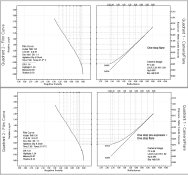
This is what Mark is suggesting.

Pre-exposure and flare.jpg

The top example has one stop flare. The bottom has one stop pre-exposure and one stop flare. The changes are in the camera image curve and the exposure is superimposed upon a fixed film curve.

Mark, I think the situation is basically how the testing is conducted and semantics. If it's like the above or if there's an extra quadrant added for the pre-exposure curve, then you will have a fixed film curved derived from the standard sensitometric exposure. If the film is flashed before making the sensitometric exposure so that the test incorporates the low intensity reciprocity failure that will be experienced in practice (which also has the option of being another quadrant), then the curve will have changed in relation to the standard sensitometric exposure; however, the primary exposure will still be superimposed upon the film curve.
 

markbarendt

Member
Allowing Ads
Joined
May 18, 2008
Messages
9,422
Location
Beaverton, OR
Format
Multi Format
Yes, Quadrant 2 demonstrates what I'm suggesting. The film curve remains constant, the placement of subject matter changes.
 
Photrio.com contains affiliate links to products. We may receive a commission for purchases made through these links.
To read our full affiliate disclosure statement please click Here.

PHOTRIO PARTNERS EQUALLY FUNDING OUR COMMUNITY:


Ilford ADOX Freestyle Photographic Stearman Press Weldon Color Lab Blue Moon Camera & Machine
Top Bottom