
• Welcome to Photrio!
    Registration is fast and free. Join today to unlock search, see fewer ads, and access all forum features.
    Click here to sign up

How to get grain-free black and white negatives?

Emi on Fomapan 400

A
Emi on Fomapan 400

  • 5
  • 2
  • 65
Venice

A
Venice

  • 3
  • 0
  • 74

Recent Classifieds

Forum statistics

Threads
201,796
Messages
2,830,348
Members
100,957
Latest member
Tante Greet
Recent bookmarks
0

naaldvoerder

Member
Allowing Ads
Joined
Apr 4, 2004
Messages
713
Format
35mm
I would shoot digital, if grain wasn't wanted. Grain is what makes analog, analog..
 

RobC

Member
Allowing Ads
Joined
Nov 5, 2007
Messages
3,880
Location
UK
Format
Multi Format
I would shoot digital, if grain wasn't wanted. Grain is what makes analog, analog..

No wet printing in a darkroom is what makes analog analog. Many people delude themselves that using film and then scanning for inkjet output is analog.

If it wasn't becasue I love printing black and white in the darkroom I would use digital. But I also hate digital editing so if I couldn't print in the darkroom I would probably give up photography as a serious interest.
 
Last edited by a moderator:

Xmas

Member
Allowing Ads
Joined
Sep 4, 2006
Messages
6,398
Location
UK
Format
35mm RF
Speed methodology has changed multiple times over the last 100+ years (since Hurter and Driffield's Inertia Speed). What made the fractional gradient superior is that it was rooted in psychophysics. In Berg's Exposure: Theory and Practice, he writes, "With this criterion, we complete the circle which started from a purely academic linking of the speed with an almost entirely arbitrary property of the characteristic curve, then led us to the purely practical concept of speed, to end up with what appears to be the most successful attempt so far of connecting print quality with a characteristic of the negative material."

The Zone System methodology didn't change because Adams probably didn't understand. The correlation between the ZS EIs and the fractional gradient speeds wasn't a coincidence. Adams corresponded with Mees and credits him in The Negative. Let's not forget Adams thought the K factor was some sort of conspiracy so the company you find yourself in is questionable. :smile:

Saying the 1960 standard didn't account for normal photo practices is simply an opinion based on personal taste. If you don't like the change, fine. It's up to you how you like to expose. The fact is, the reason why it was changed was to update it to reflect the current general use with the newer technology and the greater use of 35mm format.
You have lumped me in with Ansell I'm ever so pleased thanks.
Most people lump me in with Lucifer...

But I still suggest the change did not comply with normal practice in 1961, and if you don't like underexposed it is no better today.
 

georg16nik

Member
Allowing Ads
Joined
Aug 3, 2010
Messages
1,101
Format
Multi Format
ISO 6:1993 is the standard for determining the speed of negative black and white material. It deals with "how to" as does most standards. You will need to read the scientific papers behind the standard to understand the theory. Start with Loyd Jones' seminal papers and the concepts of limiting gradient, fractional gradient method, and print speeds. Two papers that relate to the 1960 standard are Simple Methods for Approximating the Fractional Gradient Speeds and Safety Factors in Camera Exposure. These two papers will explain the reduction of the safety factor, exposure constants, and the Delta-X Criterion of speed determination which the current standard uses. They can be found at http://64.165.113.140/content/benskin/.

Yes, I am aware of the grand argument behind the safety factor reduction, exposure constants, Delta-X, etc.
At the end of the day; I judge my prints and vote with my money.

In regards to Kodak T-maxes and whether they should half the big number on the box - Hey, I am not alone in this.
We could argue about the T-max granularity, local contrast, etc., at EI 100 or 50 as long as there is APUG.

I guess RobC was right. You have no idea what you're talking about...
When you are the only person in the room who's right, you're in the wrong room.
 

MattKing

Moderator
Moderator
Allowing Ads
Joined
Apr 24, 2005
Messages
55,167
Location
Delta, BC Canada
Format
Medium Format
Michael is definitely not the only person in the room.
 

ColColt

Member
Allowing Ads
Joined
May 26, 2015
Messages
1,824
Location
TN
Format
Multi Format
I have the answer to this T-Max problem argument...just shoot Tri-X. Grain and analog are synonymous and lovely.
 

Ian Grant

Subscriber
Allowing Ads
Joined
Aug 2, 2004
Messages
23,409
Location
West Midland
Format
Multi Format
I wouldn't be arguing with you if it was about what EI you prefer, or image structure. I'm simply arguing that:

a) EI is not the same as ISO emulsion speed, therefore an EI test does not reveal "real" film speeds
b) Zone System EIs will vary from ISO speeds in predictable ways (if the ZS test is done carefully)
c) TMX and TMY-2 are ISO 100 and 400 respectively. They are not slower than other films with the same ISO speeds.

I beg to differ yet again.

First Zone system or BZST tests for normal EI don't vary in a predictable way from ISO speeds, that may be close to the case with a range of films from a manufacturer though, but not between different manufacturers.

Secondly testing for personal (normal) EI's does reveal vast discrepancies between manufacturers box ISO's and real world usage. That leads on to the next poinrt

Thirdly Tmax 100 & 400, and all Foma film's used at box ISO lack shadow detail compared to films from Afga and the now defunct Agfa, and Fuji.

You have an inability to explain why Agfa APX100, at 100 EI, and Tmax100 and EFKE 25 both at 25 EI produce negatives with the same tonal rangel all print on the same grade of paper. That's experience from shooting hunfreds of rolls of Tmax 100 &400, APX100, and large quantity of sheet film.

Also explain why if I shot an image using APX100 @100 EI and Tmax100 @ 50 EI and processed both in the same tank (so same development time) I'd get negatives that were remarkably similar when it came top printing. Then take in that I'd sometimes use EFKE 25 and gain no difference.

Ian
 

flavio81

Member
Allowing Ads
Joined
Oct 24, 2014
Messages
5,241
Location
Lima, Peru
Format
Medium Format
Flavio, to some extend Kodak Tmax 100 reminds me of Kodak P3200 TMZ, the Ilford Delta 3200, the Foma you mentioned, etc.
These films carry misleading optimistic numbers on their boxes, so that they appeal to customers.

This is not the case with Delta 3200 and Tmax P3200. In both films the datasheet explicitely says that the real ISO is not 3200. "3200" in the box is not an optimistic number but an usable number since the film was not intended to be used for nice shadow detail, but for situations where you need really high speed.

Foma's datasheet also tells you the ISO in different developers and it's clear as water that it is not 400 in D76. In this case i agree with you, to say the film is 400 is optimistic and misleading. However i still love Foma.
 

georg16nik

Member
Allowing Ads
Joined
Aug 3, 2010
Messages
1,101
Format
Multi Format
This is not the case with Delta 3200 and Tmax P3200. In both films the datasheet explicitely says that the real ISO is not 3200. "3200" in the box is not an optimistic number but an usable number since the film was not intended to be used for nice shadow detail, but for situations where you need really high speed...

Then whats the use of the “really high speed” if there is no nice shadow detail?

I wouldn't be arguing with you if it was about what EI you prefer, or image structure. I'm simply arguing that:

a) EI is not the same as ISO emulsion speed, therefore an EI test does not reveal "real" film speeds
b) Zone System EIs will vary from ISO speeds in predictable ways (if the ZS test is done carefully)
c) TMX and TMY-2 are ISO 100 and 400 respectively. They are not slower than other films with the same ISO speeds.

a) does not apply for all films.
b) possibly.
c) For me, that was never the case.
 

flavio81

Member
Allowing Ads
Joined
Oct 24, 2014
Messages
5,241
Location
Lima, Peru
Format
Medium Format
Then whats the use of the “really high speed” if there is no nice shadow detail?

I think that if you, for example, had worked as a concert photographer inside dimly lit jazz clubs, you would have understood the big usefulness of films like Delta 3200 when rated at EI 3200. And you would have not worried at all about shadow detail, if you could get an usable (sale-able) image.
 
Last edited by a moderator:

georg16nik

Member
Allowing Ads
Joined
Aug 3, 2010
Messages
1,101
Format
Multi Format
I think that if you, for example, had worked as a concert photographer inside dimly lit jazz clubs, you would have understood the big usefulness of films like Delta 3200 when rated at EI 3200. And you would have not worried at all about shadow detail, if you could get an usable (sale-able) image.

Delta 3200 is good name for a jazz club.
 

Sirius Glass

Subscriber
Joined
Jan 18, 2007
Messages
50,814
Location
Southern California
Format
Multi Format
[h=2]How to get grain-free black and white negatives?[/h]
Shoot a larger format film. If you shoot 35mm then shoot 4"x5". If you shoot 4"x5" then shoot 16"x20"
 

RobC

Member
Allowing Ads
Joined
Nov 5, 2007
Messages
3,880
Location
UK
Format
Multi Format
Then whats the use of the “really high speed” if there is no nice shadow detail?

What makes you think there is no shadow detail with delta 3200?
 

georg16nik

Member
Allowing Ads
Joined
Aug 3, 2010
Messages
1,101
Format
Multi Format
What makes you think there is no shadow detail with delta 3200?

Delta 3200 (format 135) @ EI 3200, well depends on your expectations...
In a thread about grain-free, Delta 3200 or even Trix are ominous.
 

TheFlyingCamera

Membership Council
Advertiser
Allowing Ads
Joined
May 24, 2005
Messages
11,599
Location
Washington DC
Format
Multi Format
Grain-free negatives? Try a rice-based film or other gluten substitute :smile:

As to Tri-X, are we talking about 35mm only or are we also including medium-format? I get tons of detail in my Tri-X 400 in 120, and virtually no grain, shot at 400, developed in Pyrocat HD.

sidecourtyardlouvre.jpg


Also, as an FYI for those who don't know, Delta 3200 (and its now-discontinued cousin Kodak Tmax 3200) aren't actually 3200 speed films. They're really 800-1000 speed films, pushed in development. If you want them to have gobs of shadow detail, shoot them at 1000, then pull the development relative to box recommendation.
 
Last edited by a moderator:

RobC

Member
Allowing Ads
Joined
Nov 5, 2007
Messages
3,880
Location
UK
Format
Multi Format
Delta 3200 (format 135) @ EI 3200, well depends on your expectations...
In a thread about grain-free, Delta 3200 or even Trix are ominous.

You haven't answered the question. Perhaps you have never used Delta 3200 so you really have no idea.
 

flavio81

Member
Allowing Ads
Joined
Oct 24, 2014
Messages
5,241
Location
Lima, Peru
Format
Medium Format
For the record, last time I used HP5 pushed at 1600 with Microphen, shadow detail was good enough for my uses.
 

georg16nik

Member
Allowing Ads
Joined
Aug 3, 2010
Messages
1,101
Format
Multi Format
Grain-free negatives? Try a rice-based film or other gluten substitute :smile:

As to Tri-X, are we talking about 35mm only or are we also including medium-format?...

IMHO, in MF don't see how grain could be an issue.

You haven't answered the question. Perhaps you have never used Delta 3200 so you really have no idea.


In format 135 Delta 3200 @3200 is not my cup
Actually everything above t-max 100 in format 135 is in the Lo-Fi category (for me)
At 16x20 and beyond there are not many films in format 135 that don't fall apart.
 

Sirius Glass

Subscriber
Joined
Jan 18, 2007
Messages
50,814
Location
Southern California
Format
Multi Format
Grain-free negatives? Try a rice-based film or other gluten substitute :smile:

As to Tri-X, are we talking about 35mm only or are we also including medium-format? I get tons of detail in my Tri-X 400 in 120, and virtually no grain, shot at 400, developed in Pyrocat HD.

I have virtually grain free photographs with Kodak Tri-X 400 in 120 developed replenished XTOL.
 

RobC

Member
Allowing Ads
Joined
Nov 5, 2007
Messages
3,880
Location
UK
Format
Multi Format
In format 135 Delta 3200 @3200 is not my cup

Once again you haven't answered the question. I think you have never used D3200 but you are telling people what they'll get from it. You haven't got a clue.
 
Joined
Jan 7, 2005
Messages
2,739
Location
Los Angeles
Format
4x5 Format
Essentially you're saying the same as I am, that personal EI is a different approach to using the film's box ISO.

I am.

I do have a problem; however, with the term EI. It's too broad creating frequent misinterpretations. EI can refer to everything from effective film speed, which is an accurate film speed using sensitometric criteria and adhering to the ISO testing criteria, to simply how a person sets their meter without any form of testing. Here's a fun fact. The pre 1960 ASA speeds using the fractional gradient method are really EIs. Fractional gradient speed is the speed at the fractional gradient point: 1/Es. The ASA speed was determined using 0.25 / Es. For a 125 film speed using the ISO criteria, the fractional gradient speed would be 313. The pre-1960 ASA speed would be 78.

This concept leads into the idea of how the testing method affects the resulting film speed. And by "testing method," I'm including evaluation. The same test data plotted on the same curve will result in a different speed value depending on the method applied. Inertia speed will be different from fractional gradient speed which will be different from fixed density speeds. Whether any of these produce similar results with a particular film depends on the curve shape. Jones compared the results from the Inertia speed method to print speeds and found that depending on the curve shape of the film, Inertia speeds could vary by two stops.

Added to this is the actual physical testing methodology. How the film is tested also will influence the results. How nobody seems interested in breaking down the various influences of each step in any of the popular methods is bewildering to me. Because the testing method affects the results, it's always a good idea to indicate method that produced a result. That's what the ISO prefix is for. Placing the ISO be for a speed value indicates that the ISO criterion was used to test the film.

The best method of determining film speed is doing a psychophysical test using test prints. The print is the final result of the photographic process. The negative exposure that produced the best print directly relates exposure to quality. Everyone who does their own printing does this type of evaluation to some degree. Jones found there is a range of negative exposure that produces high quality prints. Finding the point where a change in exposure produces a change in quality gives a point of reference. As should be obvious from the earlier example, this point is used to determine the EI value for the ASA/ISO speed and that there was never any intention for the shadow exposure to falling on the first excellent print point / fractional gradient speed point.

For general purpose developers, the ISO speeds give people a good reference point from which to determine a working EI.
 
Last edited by a moderator:

MattKing

Moderator
Moderator
Allowing Ads
Joined
Apr 24, 2005
Messages
55,167
Location
Delta, BC Canada
Format
Medium Format
I am.

I do have a problem; however, with the term EI. It's too broad creating frequent misinterpretations. EI can refer to everything from effective film speed, which is an accurate film speed using sensitometric criteria and adhering to the ISO testing criteria, to simply how a person sets their meter without any form of testing. Here's a fun fact. The pre 1960 ASA speeds using the fractional gradient method are really EIs. Fractional gradient speed is the speed at the fractional gradient point: 1/Es. The ASA speed was determined using 0.25 / Es. For a 125 film speed using the ISO criteria, the fractional gradient speed would be 313. The pre-1960 ASA speed would be 78.

This concept leads into the idea of how the testing method affects the resulting film speed. And by "testing method," I'm including evaluation. The same test data plotted on the same curve will result in a different speed value depending on the method applied. Inertia speed will be different from fractional gradient speed which will be different from fixed density speeds. Whether any of these produce similar results with a particular film depends on the curve shape. Jones compared the results from the Inertia speed method to print speeds and found that depending on the curve shape of the film, Inertia speeds could vary by two stops.

Added to this is the actual physical testing methodology. How the film is tested also will influence the results. How nobody seems interested in breaking down the various influences of each step in any of the popular methods is bewildering to me. Because the testing method affects the results, it's always a good idea to indicate method that produced a result. That's what the ISO prefix is for. Placing the ISO be for a speed value indicates that the ISO criterion was used to test the film.

The best method of determining film speed is doing a psychophysical test using test prints. The print is the final result of the photographic process. The negative exposure that produced the best print directly relates exposure to quality. Everyone who does their own printing does this type of evaluation to some degree. Jones found there is a range of negative exposure that produces high quality prints. Finding the point where a change in exposure produces a change in quality gives a point of reference. As should be obvious from the earlier example, this point is used to determine the EI value for the ASA/ISO speed and that there was never any intention for the shadow exposure to falling on the first excellent print point / fractional gradient speed point.

For general purpose developers, the ISO speeds give people a good reference point from which to determine a working EI.

Stephen:

Would I be correct in understanding that the tests that led up to the ISO standard used un-manipulated (no dodging and burning) prints?
 
Joined
Jan 7, 2005
Messages
2,739
Location
Los Angeles
Format
4x5 Format
Stephen:

Would I be correct in understanding that the tests that led up to the ISO standard used un-manipulated (no dodging and burning) prints?

They would have to be to keep slight differences in printing from skewing the print judgement.

In Jones' The Evaluation of Negative Film Speeds in Terms of Print Quality, section X. Evaluation of Speed, he works through the definition of what film speed should be. I think it is somewhat relevant with the current discussion. "As a beginning it might be said: The speed of a negative material should be expressed in terms of the exposure required to produce a good negative." He continues a little later in the paragraph with, "It is possible and probably desirable to eliminate from the definition of the speed of a negative material all mention of the characteristics of the negative. As a matter of fact, it seems logical to take the position that the characteristics of the negative may be anything so long as a satisfactory positive can be made therefrom."

And a few sentences later, "Returning then to a formulation of what speed should mean, it might be said: The speed of a photographic material should be expressed in terms of the exposure required to produce a negative from which a satisfactory print can be made. But even this is not sufficiently specific and it does not result in a single unique value of speed for a given material. With many photographic materials, the exposure may be varied over a wide range of values and still yield negatives from which prints of very good quality can be made."

He then concludes, "Finally, it seems logical to conclude that in the amateur field, at least, the formulation should be as follows: The speed of a photographic negative material should be evaluated in terms of the MINIMUM exposure which will yield a negative from which a satisfactory print can be made."

The second "definition" could be considered a definition of a personal EI, but as Jones' points out, the wide range of acceptable exposures makes it hard to determine a single speed value. The third definition is film speed.
 
Last edited by a moderator:

Bill Burk

Subscriber
Allowing Ads
Joined
Feb 9, 2010
Messages
9,464
Format
4x5 Format
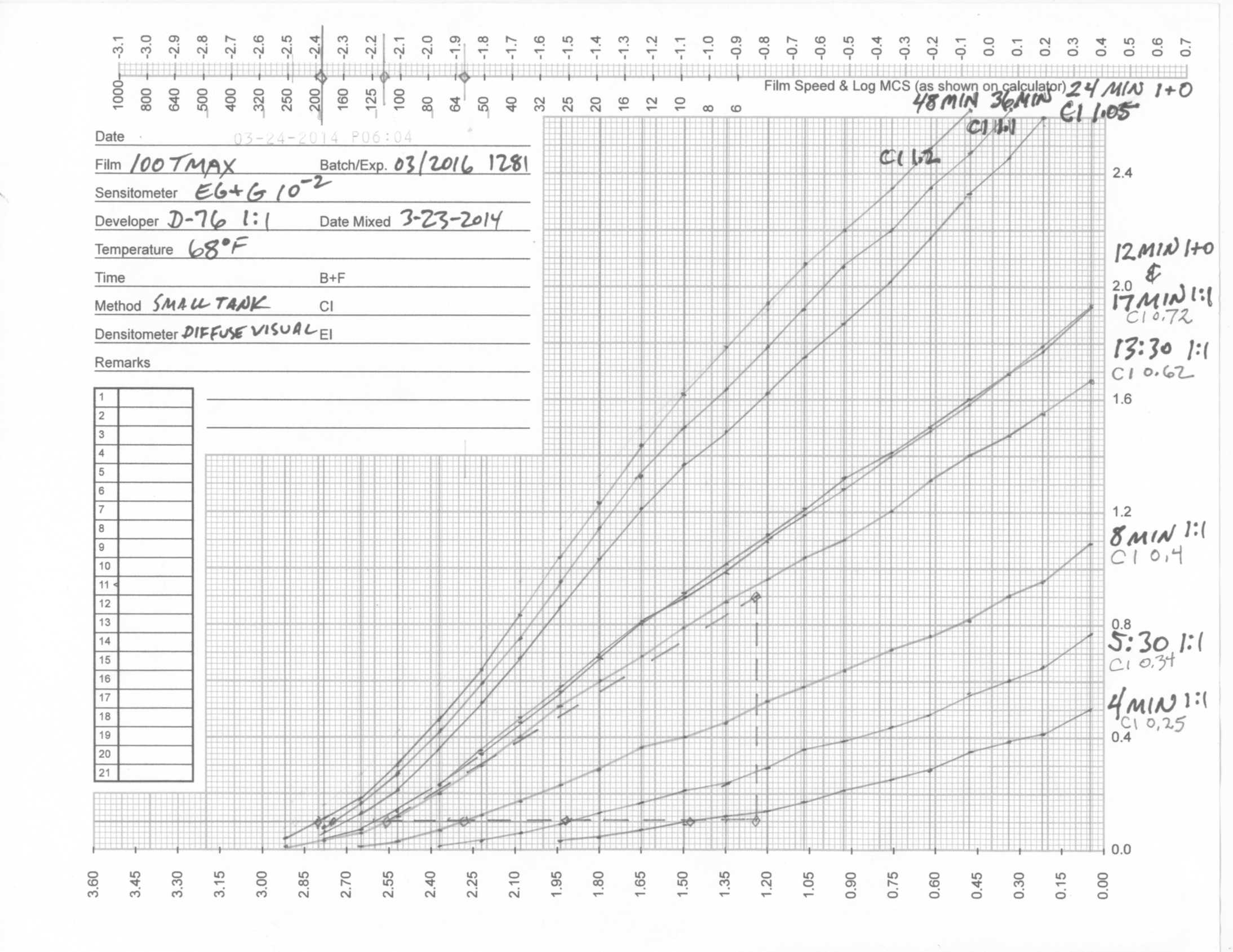
As far as the "real" speed of TMAX-100, I've found it to be 100 based on sensitometric tests that loosely follow ASA specifications. Loosely because there are some clear "mistakes" that I make in procedure: I don't keep track of hold time, and it's pretty short. I develop the film right after exposing it. I don't necessarily use D-76 at the right age. I don't use a thermal bottle with film taped to a sheet of glass. So my lab work is not definitive, it is only illustrative.

Anyway, here's my family of curves. Notice that the speed is above 100 when the ASA triangle is closely met... Notice that I can give 120% more development without much, if any, increase in speed. This means, to me, that it's hard to get it up to speed.

Then look how quickly the speed drops. When I give 60% of my normal developing time, I get EI 50. This means, to me, that it's not hard to lose speed.

So all your stories make sense...

tmxfamily.jpg


p.s. I work for Kodak but in a completely different department. I do this stuff for fun. The opinions and positions I take are not necessarily those of EKC.
 
Photrio.com contains affiliate links to products. We may receive a commission for purchases made through these links.
To read our full affiliate disclosure statement please click Here.

PHOTRIO PARTNERS EQUALLY FUNDING OUR COMMUNITY:



Ilford ADOX Freestyle Photographic Stearman Press Weldon Color Lab Blue Moon Camera & Machine
Top Bottom