

- Joined
- Apr 4, 2004
- Messages
- 716
- Format
- 35mm
I would shoot digital, if grain wasn't wanted. Grain is what makes analog, analog..

I would shoot digital, if grain wasn't wanted. Grain is what makes analog, analog..
You have lumped me in with Ansell I'm ever so pleased thanks.Speed methodology has changed multiple times over the last 100+ years (since Hurter and Driffield's Inertia Speed). What made the fractional gradient superior is that it was rooted in psychophysics. In Berg's Exposure: Theory and Practice, he writes, "With this criterion, we complete the circle which started from a purely academic linking of the speed with an almost entirely arbitrary property of the characteristic curve, then led us to the purely practical concept of speed, to end up with what appears to be the most successful attempt so far of connecting print quality with a characteristic of the negative material."
The Zone System methodology didn't change because Adams probably didn't understand. The correlation between the ZS EIs and the fractional gradient speeds wasn't a coincidence. Adams corresponded with Mees and credits him in The Negative. Let's not forget Adams thought the K factor was some sort of conspiracy so the company you find yourself in is questionable.
Saying the 1960 standard didn't account for normal photo practices is simply an opinion based on personal taste. If you don't like the change, fine. It's up to you how you like to expose. The fact is, the reason why it was changed was to update it to reflect the current general use with the newer technology and the greater use of 35mm format.
ISO 6:1993 is the standard for determining the speed of negative black and white material. It deals with "how to" as does most standards. You will need to read the scientific papers behind the standard to understand the theory. Start with Loyd Jones' seminal papers and the concepts of limiting gradient, fractional gradient method, and print speeds. Two papers that relate to the 1960 standard are Simple Methods for Approximating the Fractional Gradient Speeds and Safety Factors in Camera Exposure. These two papers will explain the reduction of the safety factor, exposure constants, and the Delta-X Criterion of speed determination which the current standard uses. They can be found at http://64.165.113.140/content/benskin/.
When you are the only person in the room who's right, you're in the wrong room.I guess RobC was right. You have no idea what you're talking about...


I wouldn't be arguing with you if it was about what EI you prefer, or image structure. I'm simply arguing that:
a) EI is not the same as ISO emulsion speed, therefore an EI test does not reveal "real" film speeds
b) Zone System EIs will vary from ISO speeds in predictable ways (if the ZS test is done carefully)
c) TMX and TMY-2 are ISO 100 and 400 respectively. They are not slower than other films with the same ISO speeds.

Flavio, to some extend Kodak Tmax 100 reminds me of Kodak P3200 TMZ, the Ilford Delta 3200, the Foma you mentioned, etc.
These films carry misleading optimistic numbers on their boxes, so that they appeal to customers.
This is not the case with Delta 3200 and Tmax P3200. In both films the datasheet explicitely says that the real ISO is not 3200. "3200" in the box is not an optimistic number but an usable number since the film was not intended to be used for nice shadow detail, but for situations where you need really high speed...
I wouldn't be arguing with you if it was about what EI you prefer, or image structure. I'm simply arguing that:
a) EI is not the same as ISO emulsion speed, therefore an EI test does not reveal "real" film speeds
b) Zone System EIs will vary from ISO speeds in predictable ways (if the ZS test is done carefully)
c) TMX and TMY-2 are ISO 100 and 400 respectively. They are not slower than other films with the same ISO speeds.
Then whats the use of the “really high speed” if there is no nice shadow detail?
I think that if you, for example, had worked as a concert photographer inside dimly lit jazz clubs, you would have understood the big usefulness of films like Delta 3200 when rated at EI 3200. And you would have not worried at all about shadow detail, if you could get an usable (sale-able) image.

Then whats the use of the really high speed if there is no nice shadow detail?
What makes you think there is no shadow detail with delta 3200?


Delta 3200 (format 135) @ EI 3200, well depends on your expectations...
In a thread about grain-free, Delta 3200 or even Trix are ominous.
Grain-free negatives? Try a rice-based film or other gluten substitute
As to Tri-X, are we talking about 35mm only or are we also including medium-format?...
You haven't answered the question. Perhaps you have never used Delta 3200 so you really have no idea.
Grain-free negatives? Try a rice-based film or other gluten substitute
As to Tri-X, are we talking about 35mm only or are we also including medium-format? I get tons of detail in my Tri-X 400 in 120, and virtually no grain, shot at 400, developed in Pyrocat HD.
In format 135 Delta 3200 @3200 is not my cup

Essentially you're saying the same as I am, that personal EI is a different approach to using the film's box ISO.
I am.
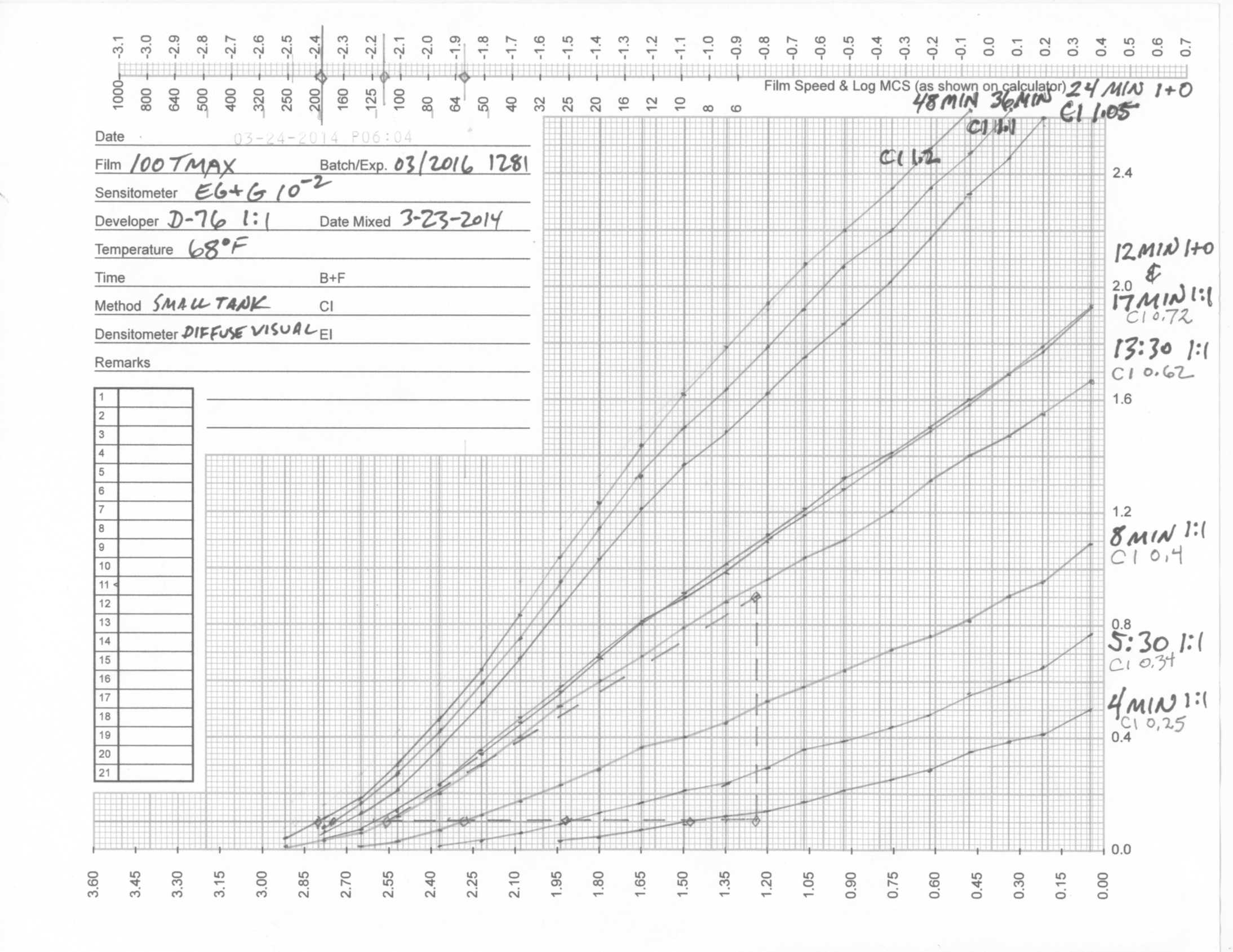
I do have a problem; however, with the term EI. It's too broad creating frequent misinterpretations. EI can refer to everything from effective film speed, which is an accurate film speed using sensitometric criteria and adhering to the ISO testing criteria, to simply how a person sets their meter without any form of testing. Here's a fun fact. The pre 1960 ASA speeds using the fractional gradient method are really EIs. Fractional gradient speed is the speed at the fractional gradient point: 1/Es. The ASA speed was determined using 0.25 / Es. For a 125 film speed using the ISO criteria, the fractional gradient speed would be 313. The pre-1960 ASA speed would be 78.
This concept leads into the idea of how the testing method affects the resulting film speed. And by "testing method," I'm including evaluation. The same test data plotted on the same curve will result in a different speed value depending on the method applied. Inertia speed will be different from fractional gradient speed which will be different from fixed density speeds. Whether any of these produce similar results with a particular film depends on the curve shape. Jones compared the results from the Inertia speed method to print speeds and found that depending on the curve shape of the film, Inertia speeds could vary by two stops.
Added to this is the actual physical testing methodology. How the film is tested also will influence the results. How nobody seems interested in breaking down the various influences of each step in any of the popular methods is bewildering to me. Because the testing method affects the results, it's always a good idea to indicate method that produced a result. That's what the ISO prefix is for. Placing the ISO be for a speed value indicates that the ISO criterion was used to test the film.
The best method of determining film speed is doing a psychophysical test using test prints. The print is the final result of the photographic process. The negative exposure that produced the best print directly relates exposure to quality. Everyone who does their own printing does this type of evaluation to some degree. Jones found there is a range of negative exposure that produces high quality prints. Finding the point where a change in exposure produces a change in quality gives a point of reference. As should be obvious from the earlier example, this point is used to determine the EI value for the ASA/ISO speed and that there was never any intention for the shadow exposure to falling on the first excellent print point / fractional gradient speed point.
For general purpose developers, the ISO speeds give people a good reference point from which to determine a working EI.
Stephen:
Would I be correct in understanding that the tests that led up to the ISO standard used un-manipulated (no dodging and burning) prints?

| Photrio.com contains affiliate links to products. We may receive a commission for purchases made through these links. To read our full affiliate disclosure statement please click Here. |
PHOTRIO PARTNERS EQUALLY FUNDING OUR COMMUNITY:  |
