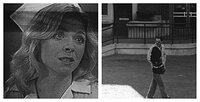
I like that one; that's a nice parallel!
I understand what you say about control vs. intentionality, although that already starts shifting the sands. Whether your criteria is about one or the other - either could be the case. But they're different things!
There's two issues here I'd like to highlight before making a point which I think is crucial to understanding my reflection on
@cliveh's earlier statement.
The first is that you speak of a 'proper photograph'. The adjective 'proper' implies a normative judgement. I have no problem with that; you can think of anything being better or lesser than something else if you please. But I do want to signal that this kind of normative-hierarchical thinking easily creeps into the line of reasoning without being acknowledged. Let's at least acknowledge it. It's interesting and can inform further discussion. Just putting it there and pretending like it doesn't exist, doesn't get us very far.
Then there's the 'clear immediacy'. I think that word group is inherently problematic. If one were to pick apart my earlier argument and also the statement of
@cliveh about 'immediacy' being a relevant criterion, I think the inescapable step would be to discuss what that term means. It's not clearly defined. It's fuzzy and probably highly subjective. Hence, speaking of 'clear immediacy' brings to mind the saying 'clear as mud'. We'd have to sift the mud first. I suspect that immediacy means something else to you than it does to me.
This is one of the definitions that I can scrape off of the internet (apparently Wikipedia) for 'immediacy':
So 'direct experience', 'without intervening medium', 'perception of time and reality', 'urgency or importance in the present moment.
Let's have a look at those elements:
Direct experience: well, inherently not. It's a photograph. So that one's out.
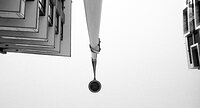
Intervening medium: that one is very dominant in the presentation in the way the tonal relationships are twisted by the medium. We're looking as much at the medium as at the original scene.
Perception of time and reality: reality is visible in shape, but the same could be said for my colorful photograph/image (it just happens to be a very abstract shape - it's still real). Then again, the color is constructed artificially and most certainly not real. This affects the overall impression the image makes. Time is perhaps a little more forgiving here - referring back to
@cliveh's mention of the transient nature of the light, and the dominant role it plays in this image, there's a kind of time-specificity in the image.
Urgency or importance of the present moment: it's not the
present moment, of course. There's that. Importance is probably subjective and could be tied to being familiar with the person and the moment depicted, but I'd refer to an image that expresses something I would associate with activities such as reflection, pondering or perhaps daydreaming as the opposite of 'urgent'.
Would I attribute a high degree of 'immediacy' to this image? I guess not. It doesn't add up. But...perhaps the 'immediacy' of a photograph is inherently limited if we critically look at this definition. We can compromise, of course, and argue that immediacy is not a binary quality. It can be attributed
to an extent. Still, I would state that this photograph has a limited immediacy, and that more importantly the choice in editing (sabattier) has reduced its degree of immediacy significantly. That's of course subjective. You may disagree. But at least, given the above unraveling of the fuzzy subject, we can make the disagreement more concrete than a blunt 'yay or nay'.
Now for the one point I'd like to stress: in the above, I try to (1) make any normative judgement explicit and (2) make it more tangible by unraveling one of the fickle concepts involved. This makes it possible to
reason about things that evidently still have a clear emotional and subjective dimension. This will always be there, but I think that in some cases, even emotional and subjective matters can follow some sort of logic. I find that interesting, because this logic may not always answer to the kind of mathematical logic that the term strictly refers to. What I spotted in
@cliveh's statement about editing affecting immediacy in photographs is a logic that seems clear enough to me - but at the same time, I'm confronted with a recent example published by the same person that in my view goes against that same logic. I don't deny that both can exist next to each other: Clive can have this conviction, and at the same time he may not always act on it. I find that interesting and I wanted to highlight the discrepancy. Apparently, the normative frameworks we build for ourselves, and present to others, are not as strict or robust as suggested by the way they're positioned.
My criticism of what
@cliveh said is not about whether or not I find immediacy a relevant criterion. I'm interested in the inconsistency between what he says and what he does, which suggests that what he really thinks or feels is a lot more nuanced (and therefore more interesting) than he lets on. There's breathing room in the nuance he refuses to talk about, leaving just the anoxic environment of some blunt, axiomatic statements.
It's a pity, though. There's a conceptual richness underlying what we do. When all the shop talk about stop baths and whatnot has been addressed, that's the base layer that remains so fascinating.