

Pieter12
Member
But sometimes I pre-edit my pre-visualization posthaste and not push the shutter button....
And the would be editing, too.
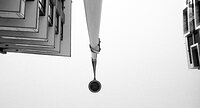
But sometimes I pre-edit my pre-visualization posthaste and not push the shutter button...

And the would be editing, too.

I like that one; that's a nice parallel!"The funk is in the holes."
There's two issues here I'd like to highlight before making a point which I think is crucial to understanding my reflection on @cliveh's earlier statement.I personally still consider the image by @cliveh a proper photograph, with clear immediacy (!)
So 'direct experience', 'without intervening medium', 'perception of time and reality', 'urgency or importance in the present moment.the quality of being immediate or the direct experience of an event without any intervening medium. It can also relate to how we perceive time and reality, emphasizing a sense of urgency or importance in the present moment.
It's a pity, though. There's a conceptual richness underlying what we do. When all the shop talk about stop baths and whatnot has been addressed, that's the base layer that remains so fascinating.All this analysis is a bit beyond me, I just press the shutter.

We can compromise, of course, and argue that immediacy is not a binary quality. It can be attributed to an extent.

Whether they like an image is informed by how the maker approached the process. I can understand that tendency, but I think it's more productive to separate these matters
I like that one; that's a nice parallel!
I understand what you say about control vs. intentionality, although that already starts shifting the sands. Whether your criteria is about one or the other - either could be the case. But they're different things!

I definitely like this.
I can really frustrate my wife some times.
I'll be at a scene that has potential, I'll move around and check several slightly different views and check several slightly different options with respect to depth of field and exposure and optimum plane of focus and camera position and, and, and - and decide that nothing works exactly the way I want it to, lower the camera, and walk away without releasing the shutter.
My exasperated wife calls it futzing
If you replace "must" with "can", then I agree. Taken as it's formulated, literally, I think it flies in the face of how much art comes into being. There's a lot of mucking about especially in the 'fuzzy front-end' of the artistic process, that constitutes a search for intentionality and direction. And the degree of control by artists of the process involved is really very variable. Some like to be in that position (and manage it), quite a few don't. Artists are a rather motley crew, it seems to me. They appear to defy generalizations. Perhaps, if anything, that's their most defining characteristic. That, and being overall utterly allergic to anyone saying the word 'must' in their vicinity. Tends to freak them out pretty badly, much of the time.The artist must be intending to make the art and the process must be intentionally under their control.

If you replace "must" with "can", then I agree. Taken as it's formulated, literally, I think it flies in the face of how much art comes into being. There's a lot of mucking about especially in the 'fuzzy front-end' of the artistic process, that constitutes a search for intentionality and direction. And the degree of control by artists of the process involved is really very variable. Some like to be in that position (and manage it), quite a few don't. Artists are a rather motley crew, it seems to me. They appear to defy generalizations. Perhaps, if anything, that's their most defining characteristic. That, and being overall utterly allergic to anyone saying the word 'must' in their vicinity. Tends to freak them out pretty badly, much of the time.
If it's for you own use, or for generic aesthetic art, do whatever you want to your own photos. I don't think there's much lower in the world of online photography debate than judging people for cropping their own pictures.
Until someone views a picture and it's is affected mentally or emotionally, it's not art, only a photo. Self gratification isn't sex. It takes two to Tango.
Artists working for other people are doing so in the name of Commerce, Propaganda, Journalism, Pornography, Praise, or Fame. But that's not art.

Artists working for other people are doing so in the name of Commerce, Propaganda, Journalism, Pornography, Praise, or Fame. But that's not art.
Yet sometimes there are artistic aspects of the resulting products...

I think you just covered the Robert Mapplethorpe bingo card...
I'm not convinced that this criteria is valid as a definition for art. Artists have produced art on commission for a very long time.Sure, there are artistic aesthetics possible with each of these, but the in each example, the purpose is no longer is to produce art for its own sake but something for other people.
Yep...But what do I know, I am arts snob
and Caravaggio.
I'm not convinced that this criteria is valid as a definition for art. Artists have produced art on commission for a very long time.
Yep...
Ansel Adams
My unproven opinion...I think the survival factor is coming into play here. Art that has come to us from the past is the art that has survived the test of time...the junk has fallen aside and been forgotten, We live in the present -- our junk has yet to be filtered out by time....
As an aside, it is my (unprovable) opinion that this is why so much contemporary "art", especially music, has become simpler and simpler (dumber) since the dawn of the mass media era. ...
Yes, but that was artistic methods in the service of commerce and making a living. It's hard to make the case that they would have done the same work had they not been paid for it.

As another example, I consider Yosuf Karsh's portraits among the greatest I've ever seen. The technique is breathtaking and his grasp of his subjects worthy of the greatest master painters. It's still not art.
Norman Rockwell and N C Wyeth created images for advertising that are almost the definitive look of their time and had a huge cultural impact. It's silly to not consider that work art.Almost all the classical fine art that we measure present day work against was all done on commission -- usually for the Church, civil leaders, or the rich. Perhaps one had a patron that supported one's work.
| Photrio.com contains affiliate links to products. We may receive a commission for purchases made through these links. To read our full affiliate disclosure statement please click Here. |
PHOTRIO PARTNERS EQUALLY FUNDING OUR COMMUNITY:  |
