What should the correct CI be when developed for the same time at speed 800 compared to 400. Can this be worked out?
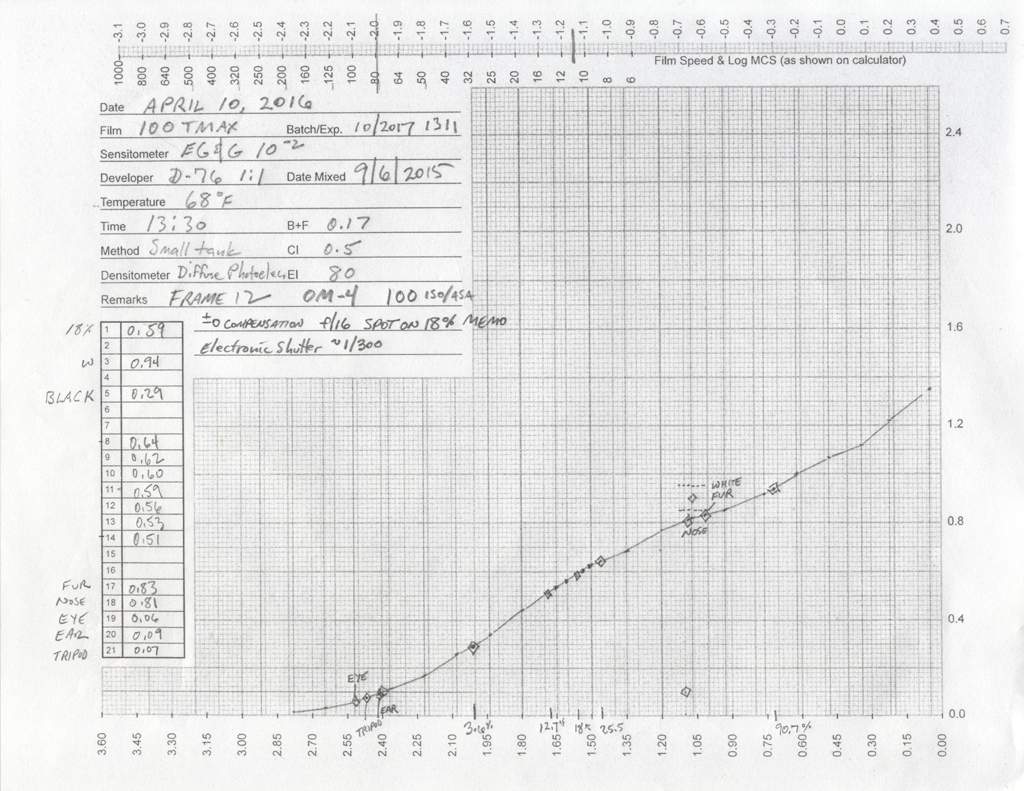
If you develop the same time you obtain the same CI, see this graph:
Blue bar shows the right exposure as recommended by meter at EI400, and aprox 8 min gives the ISO normal contrast of 0.62 CI gradient: density woud rise additional 0.2D for each stop of additional exposure, If yo don't change the development (8min) you always have the sensitometric response labeled "8 min".
At the bottom I placed a sample scene dynamic range in
green of 3 stops latitude, in
red shows the range that it would take the same scene if closing 1 stop the diafragm. If using EI 800 you will have the same gradient but densities would be lower.
If the CI remains the same because the development time is the same then what will be the changes in a 800 negative compared to the identical negative exposed at 400 and will these changes be noticeable in the prints from the 400 neg and 800 neg respectively?
If you don't change development (say you alwys use 8min), a lower EI will produce lower densities, for the gren range (EI400) the 8min curve shows the densities you will obtain, at EI 800 (red range in x axis) densities will be lower.
________
A sensitometric curve tells what density you will reach for each level of exposure, exposure is shown as the decimal Logrithm of the exposure in Lux*second (in the horizontal axis).
"-3" is 0.001 lux · second, so 0.001 Lux during 1 second (or 1 lux reaching the film during 1/1000 second)
-2 is 0.01 lux · second
-1 is 0.1 Lux · second
0 is 1 Lux · second
1 is 10 Lux · second
-_______
So for each exposure level, you take the right curve in the family of curves for the development time, and that curve says what density you obtain for each level of exposure.
_________________
If you are interested in that I'd recommend you Beyond The Zone System Book, by Phil Davis.