• Welcome to Photrio!
    Registration is fast and free. Join today to unlock search, see fewer ads, and access all forum features.
    Click here to sign up

Gelatin recipe to simulate emulsion?

Somewhere...

D
Somewhere...

  • 2
  • 1
  • 63
Iriana

H
Iriana

  • 6
  • 1
  • 123

Recent Classifieds

Forum statistics

Threads
202,740
Messages
2,844,935
Members
101,493
Latest member
aekatz
Recent bookmarks
0

M Carter

Member
Allowing Ads
Joined
Jan 23, 2013
Messages
2,149
Location
Dallas, TX
Format
Medium Format
I need to test HVLP spraying of liquid emulsion (using Fomaspeed for now and maybe Liquid Light down the line, FOMA is out of stock until at least june and who knows these days...)

I understand (and have used) coffee creamer and dilute gesso to practice coating and so on, but gelatin is a unique substance, and I'm concerned with how it might spray, if it might dry while airborne, what effect hardeners have and so on. I'd prefer to use hardener in this application, FOMA ships with its own hardener (they recommend 15ML per liter of emulsion), no idea what it is though. I do have Glyoxal.

So to dial in spraying, my guess is using grocery store gelatin (vs. using up my expensive photo gelatin) might be a good idea. Do I just bloom and mix a 10% batch, maybe add hardener and photoflo as if sizing paper? Or is there any sort of standard mix that would simulate emulsion characteristics? thanks for any help!
 
I don't have specific advice, however an emulsion is less viscous than a plain solution of gelatin of the same percentage gelatin. As a starting point, I would reduce the gelatin by about half compared to the concentration of gelatin in the emulsion. I don't know what the concentration of gelatin is in the emulsions you mentioned, but I'd guess around 10%, so I'd try something like 5% for your test coating. You can add various surfactants like ethanol to modify the coating properties. If you add glyoxal (and even if you don't), be careful not to breathe in the aerosols. What surface are you coating onto? Sounds interesting. Good luck!
 
Emulsion doesn't spray very well (not personal experience, but many reports). Why do you want to? Just curious. Perhaps you can find a better coating alternative. As far as coating practice goes, 2 teaspoons tapioca starch in a quart of water, heated and stirred until it gels, and then cooled, works well.
 
Emulsion doesn't spray very well (not personal experience, but many reports). Why do you want to? Just curious. Perhaps you can find a better coating alternative. As far as coating practice goes, 2 teaspoons tapioca starch in a quart of water, heated and stirred until it gels, and then cooled, works well.

I spent a decade spraying emulsion commercially, it's not easy and there's a need for protective gear like an air-line respirator. Although the emulsion we made was designed for spraying we also did some work with Ilfospeed Gd 3 emulsion given to us by Ilford who hoped to supply us.

Our application was typically2 ftx2ft to maybe 5ft x 15ft, it wouldn't be practical for say glass plates although initial tests emulsions were coated with an airbrush.

Ian
 
I spent a decade spraying emulsion commercially, it's not easy and there's a need for protective gear like an air-line respirator. Although the emulsion we made was designed for spraying we also did some work with Ilfospeed Gd 3 emulsion given to us by Ilford who hoped to supply us.

Our application was typically2 ftx2ft to maybe 5ft x 15ft, it wouldn't be practical for say glass plates although initial tests emulsions were coated with an airbrush.

Ian


Please listen to Ian!
I have done spraying foma and rollei emulsio. with success and in a big space using a small compressor and spray nozzle for water based paint.
A full face mask with high end filter is INSUFFICIENT for the job. i know from experience.
you want really fresh air coming into your mask, so you need a window nearby and a filter in case there are insects etc.
Dont add hardener, you would contaminate the space, dont mess with hardener and NEVER spray it. you can apply very diluted in the end, by brush, or add to fixer. but in most cases this is not necessary, to say the least.
Dilution, temperature, practice.!
I do brush only since a few years.

take care!
 
Thanks guys - this is for coating large canvases; even with many layers of primer and sanding, a rod is impossible, rollers or brushes just not even enough, lots of texture comes through.

I have an unfinished space to make a test spray booth in; fairly powerful vent fan going out the roof (already have a spare roof vent and duct up there, had it put in when our roof was redone). My plan is to use the ventilation, and actually hang plastic with an opening so just my arm and the gun is inside the spraying area. Will still wear a respirator.

I don't really know if hardener is necessary; I've used it for brush coatings, but the end step of this project is hand-tinting the work with thinned oil glazes and a final varnish (the initial prints I've done look about 6" deep). If I prime with oil-based ground, the emulsion adheres better than oil-based poly, but artist ground takes 3 days per coat to dry, so still deciding which way to go there. I'm thinking "no" on house-paint style oil primer, too much yellowing is possible.

If this is a bust, I can live with brush coating but it takes a lot of spotting/painting to get it looking good, I have a free-standing HVLP turbine rig that can spray thinned latex. For now doing about 24x36", but my goal is very big, like 4' x 6', so spraying would be nice. Gun is siphon feed, already have ideas for keeping the bottle and even the gun warm. For all I know, all It will be capable of is coating a canvas with dry pebbles of emulsion; perhaps thinning with surfactant, ethyl, or distilled (which could slow drying compared to alcohols) and doing 2 or more coats would work. Just don't want to run a bunch of tests with expensive emulsion - I imagine this may take a fair amount of testing!
 
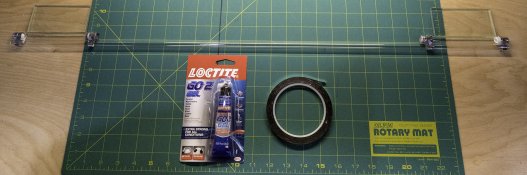
I think I have a way for you to make high-quality coatings without elaborate ventilation. You'll still need to source a few items, but they're almost certainly easier to get right now than anything to do with ventilation. The idea is to make a very long puddle pusher. You'll need a long glass tube (Pyrex or borosilicate) at least 11 inches longer than the width of the surface you want to coat, two 5 inch puddle pushers (sold as 4"x 5"), adhesive (I like Loctite G0 2 Gel), tape (preferably film tape), and UHU tac wall stickem, or a generic equivalent). Basically, you're using the two commercial puddle pushers to make handles for your long glass tube. Tape one to each end of the glass tube with the number of wraps of tape required to bring the coating gap to what you need it to be. Run a line of adhesive between the tube and the puddle pushers, let dry, and then flip the assembly and repeat on the other side. Plug the ends of the long tube and the puddle pushers with the UHU tac.

Use the wet paper coating technique, pulling the emulsion down the canvas with one hand on each handle.

The pic here is the mock up.
 

Attachments

  • MajorPuddlePusher.jpg
    MajorPuddlePusher.jpg
    353 KB · Views: 214
Last edited:
That's an interesting rig - but in my experience, there's just no way to get the canvas really flat, and this month it's around 28x36", but my goal is up to 50x60-some inches. I did just get a roll in of pre-primed canvas that's probably a thinner weight than I've been using, but another issue is the weave of the canvas can really show up with rollers or brushed since it's a little raised. So other than issues of how gelatin may react to spraying and health/environmental concerns, my brain instantly goes to spray coating. If it's a bust, I can probably live with brushing, but I'd probably need a way to brush it flat with something like a tight-stretched electric blanket under it, who knows.

I did find an interesting product though, the full-face snorkeling mask - the snorkel comes out the top and points over the back of your head, and when you exhale there's one-way valves near the cheeks. They're great for their intended use, no leaks (but that may rely on surrounding water pressure for all I know). Wondering if there's a way to force fresh air into the snorkel inlet. Problem right now is, people are buying all those up for covid protection, sticking filters on the snorkel and so on. I cant tent the spray area with heavy black construction fabric and tape it sealed with ceiling exhaust, no issues there. But for starters I just want to test-spray gelatin outdoors and see if it's worth pursuing any further, if I can get a good even coat that's going down slightly wet, that'll be promising. I can always use the HVLP rig around the (90-some-year-old) house if it's a bust!

(What I'm printing on the canvas: doing 16x20 Bromoils from 4x5 negs, then re-photographing those 4x5 and printing them on the canvas; then the canvas gets tinted with oils. But I may find going to 20x24 for the bromoils holds more detail in the final, so I'm hanging onto your rod idea - I have a 24" pyrex tube sitting here - this was an early test of the whole process, about 18x24 final canvas size) :

qCYdr20.jpg
 
Lovely print.
Perhaps someday I can persuade you to make your own emulsion :smile:. If you first prime the canvas with handmade baryta subbing, you can coat handmade emulsion, made with a slightly lower water content, using wet paper technique. You'll wet the primed canvas and squeegee it flat to your coating surface. Then, a glass tube coater will work perfectly.

 
Lovely print.
Perhaps someday I can persuade you to make your own emulsion :smile:. If you first prime the canvas with handmade baryta subbing, you can coat handmade emulsion, made with a slightly lower water content, using wet paper technique. You'll wet the primed canvas and squeegee it flat to your coating surface. Then, a glass tube coater will work perfectly.

Heck, I may simply have to someday, you never know when another product will bite the dust!

One thing I've never seen in emulsion recipes is "how much does this batch make?" I can sort of mentally add up the ingredients, but seems like when you read a cooking/meal recipe, it's "serves four", seems like "makes 250ml of final emulsion" would be good to know. (I've been noting how much I need for a given sheet; I just weigh the cold emulsion in a gram scale and assume it translates, like 25ml is about 25 grams, but now I just have notes like "11x14, 28 grams", which has saved me melting too much emulsion for a sheet).

But I do wonder about flat-coating a 5' swash of emulsion with a 48" rod - maybe I can get one of those Tom-Cruise-Mission-Impossible rigs and recruit my wife to help?? "HONEY, GET READY TO PULL!!!" At least that would make a hell of a post here!
mainimage.jpg
 
Thank you for giving me an interesting engineering challenge :smile:. I see an easy solution. I'm pretty sure you would, too, or perhaps something even better. Making your own emulsions is so much easier than your spray setup, I hope you try.

Start small. That keeps the practice cheap. Calibrate how much emulsion you'll need for your application. The recipes don't usually say because different surfaces and coating techniques require different amounts. After a couple of batches, you'll be able to ramp up to ginormous.
 
Photrio.com contains affiliate links to products. We may receive a commission for purchases made through these links.
To read our full affiliate disclosure statement please click Here.

PHOTRIO PARTNERS EQUALLY FUNDING OUR COMMUNITY:


Ilford ADOX Freestyle Photographic Stearman Press Weldon Color Lab Blue Moon Camera & Machine
Top Bottom