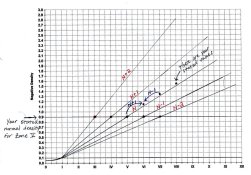


Ok, guys, first I have to tell you that in Jr. High School, my math teacher turned me off so bad that it sent me running straight to art school. I did ok in chem and physics, but I don't do math for fun. I really don't think it matters, really, whether we use .3 log E or just zone - we know what that means. And yes, I did plot the curve. Not only that but I never just plot a curve (well, rarely) but I actually print the test on my choice of paper which is, right now, Ilford MG fiber warmtone.
And, no, I don't think anybody is out to get me. This is a discussion, and I respect what you have to say.
While I LEARNED the ZS by reading AA in the original five volume series (which I consider better, if more difficult to read) I STUDIED in the "Zone Buddhist" school (thanks to Imogen Cunningham for the term. She smiled mischievously when she said it). MW could, and frequently did, drive people screaming into the woods unable to tell what was science and what was religion. I think that his attitude and teaching style (and I say this treasuring his memory; none of us is perfect) did a lot to promote the canonization of the zone system (you know, "octave of zones"). There is, I think, a fair amount of rigidity about it. I think that is too bad. Or, at least, it spoils a lot of fun. Holy Cow.
I think we need to be willing to challenge our own basic assumptions.
Chuck, I have always used zI just as you say, as a basic principle which I considered to be pretty much inviolable. I've been doing this a very long time, and I studied it at the source. Yes, it has been crystal clear for me, too. I have used the zs faithfully for 45 years in my personal and professional work, much of that time pretty much daily. It really makes a lot of sense -- in theory, and most of the time, in practice as well. It is very useful, and by now, for myself, completely intuitive. But, Björn has a good sense of what is going on here. If we assume the classic curve shape, with a well defined toe, straight line and shoulder, you can apply the system as you understand it. If you depart from that general curve shape, that one size no longer fits all.
MW's statement that zI doesn't always work had lodged in my mind. I had simply not seen a situation where that was true. Now I have. I had never encountered a STRAIGHT curve; a curve with little or no toe. The reason that zone I has to disappear in this case is that if it did not, if I did what you suggest, then there would be a zone I -- but there could be no zone II, it would jump right to zone III and everything above would go nutso. Were I to do as you suggest, I would have to shorten my development time and screw up what works really great the way it is; the "curve" would flatten out and IT WOULD BE UGGGGLLLY. If I were to shoot tri x at 64, sure, I could get that nice 0.10 zI, but, what would I gain? Nothing. I'd have zone I, but the rest of the scale would be a mess.
So, when did you ever actually SEE zone I in a print? Show me! What's the problem with eliminating it if all the values that you actually can SEE are in precisely the right place? As it is, I get to shoot tri x at 320, which is right where I like it. I mean tx "400" - in my experience, it is rare to non-existent that the mfr published EI's will work for me. When people talk about "pushing" film, I find it mildly amusing. For me, sacrifice of shadow detail is unacceptable. To sacrifice zone I, however, has no significance at all. I won't miss it, and you can't see it either - in a print. Or do you exhibit your tests?
Björn, there is one circumstance in which I actually do shoot tri x sheet film, not not at 64, but 50. That is with pyro - acetone. What I get for this loss in speed is shadow detail that is nothing short of otherworldly and some other sundry advantages. With a slower film, I think I'd be down to maybe 12 or so. So, I guess we could just not call it tri x anymore? Whatever it is, it's wonderful.
And, no, I don't think anybody is out to get me. This is a discussion, and I respect what you have to say.
While I LEARNED the ZS by reading AA in the original five volume series (which I consider better, if more difficult to read) I STUDIED in the "Zone Buddhist" school (thanks to Imogen Cunningham for the term. She smiled mischievously when she said it). MW could, and frequently did, drive people screaming into the woods unable to tell what was science and what was religion. I think that his attitude and teaching style (and I say this treasuring his memory; none of us is perfect) did a lot to promote the canonization of the zone system (you know, "octave of zones"). There is, I think, a fair amount of rigidity about it. I think that is too bad. Or, at least, it spoils a lot of fun. Holy Cow.
I think we need to be willing to challenge our own basic assumptions.
Chuck, I have always used zI just as you say, as a basic principle which I considered to be pretty much inviolable. I've been doing this a very long time, and I studied it at the source. Yes, it has been crystal clear for me, too. I have used the zs faithfully for 45 years in my personal and professional work, much of that time pretty much daily. It really makes a lot of sense -- in theory, and most of the time, in practice as well. It is very useful, and by now, for myself, completely intuitive. But, Björn has a good sense of what is going on here. If we assume the classic curve shape, with a well defined toe, straight line and shoulder, you can apply the system as you understand it. If you depart from that general curve shape, that one size no longer fits all.
MW's statement that zI doesn't always work had lodged in my mind. I had simply not seen a situation where that was true. Now I have. I had never encountered a STRAIGHT curve; a curve with little or no toe. The reason that zone I has to disappear in this case is that if it did not, if I did what you suggest, then there would be a zone I -- but there could be no zone II, it would jump right to zone III and everything above would go nutso. Were I to do as you suggest, I would have to shorten my development time and screw up what works really great the way it is; the "curve" would flatten out and IT WOULD BE UGGGGLLLY. If I were to shoot tri x at 64, sure, I could get that nice 0.10 zI, but, what would I gain? Nothing. I'd have zone I, but the rest of the scale would be a mess.
So, when did you ever actually SEE zone I in a print? Show me! What's the problem with eliminating it if all the values that you actually can SEE are in precisely the right place? As it is, I get to shoot tri x at 320, which is right where I like it. I mean tx "400" - in my experience, it is rare to non-existent that the mfr published EI's will work for me. When people talk about "pushing" film, I find it mildly amusing. For me, sacrifice of shadow detail is unacceptable. To sacrifice zone I, however, has no significance at all. I won't miss it, and you can't see it either - in a print. Or do you exhibit your tests?
Björn, there is one circumstance in which I actually do shoot tri x sheet film, not not at 64, but 50. That is with pyro - acetone. What I get for this loss in speed is shadow detail that is nothing short of otherworldly and some other sundry advantages. With a slower film, I think I'd be down to maybe 12 or so. So, I guess we could just not call it tri x anymore? Whatever it is, it's wonderful.


 .
.