• Welcome to Photrio!
    Registration is fast and free. Join today to unlock search, see fewer ads, and access all forum features.
    Click here to sign up

Development aid to lighten zones V11 and V111

Recent Classifieds

Forum statistics

Threads
201,722
Messages
2,829,088
Members
100,910
Latest member
SuninPisces
Recent bookmarks
0
OP
OP

Bennett Brown

Member
Allowing Ads
Joined
Oct 3, 2008
Messages
50
Location
Canada
Format
Medium Format
Ian:

My times and temperatures are fine but do you really think that the time taken to fill and empty can cause such discernible darkening?

Bennett
 

2F/2F

Member
Allowing Ads
Joined
Apr 29, 2008
Messages
8,031
Location
Los Angeles,
Format
Multi Format
Ian:

I thought I had properly established my working EI by obtaining a good match between my zone V rendition and the 18' gray test card and relating the exposure value underlying this to the unadjusted film speed to determine my working EI.

Bennett

Bennett

That is fine if you will be placing things at zone V most of the time, like most people do with conventional exposure methods. This defeats the purpose of using the zone system. The problems are that this does not let you control your shadows very well, and that zone V is more variable with development than zone I, so is harder to keep consistent. You should find your EI by seeing what rating lets you consistently and predictably place a zone I. You need a handle on the foot of the film so you can swing the rest of it up and down around the foot, which is more or less nailed down where it lies no matter what you do with development.

In all the time you have put into this post, you could have read the applicable pages of The Negative and have known just as much as you need to know. Repeated Internet posting is a sure way to be led astray, and no way to learn every detail of this stuff.

The underlying problem here is that you have no idea why you want to use the zone system, and therefore the how of it is being made not only difficult, but entirely useless. You cannot understand the how if you do not have any idea why you even want to understand it in the first place. You need to go out and experience some practical problems. This means shooting, printing, analyzing, and coming to the realization that your printing is just too difficult and you aren't getting the results you want. You will not find your magic bullet on the Internet.
 
Last edited by a moderator:
OP
OP

Bennett Brown

Member
Allowing Ads
Joined
Oct 3, 2008
Messages
50
Location
Canada
Format
Medium Format
Many thanks Bjorn for your thoughtful suggestions:

I appreciate the range of counsel and will put some of your ideas to the test.

Bennett
 
OP
OP

Bennett Brown

Member
Allowing Ads
Joined
Oct 3, 2008
Messages
50
Location
Canada
Format
Medium Format
2F/2F:

Time is something I have lots of, I do read but also learn from other peoples' experiences including your comments which must reflect yours. Many thanks for your interest in helping.

Bennett Brown
 

Ian Grant

Subscriber
Allowing Ads
Joined
Aug 2, 2004
Messages
23,408
Location
West Midland
Format
Multi Format
Again 2F/2F makes a good point about reading the Negative. I'd suggest reading Steve Simmonds excellent article on determining film speed & development tome. it's free on the View Camera website.

Ian:

My times and temperatures are fine but do you really think that the time taken to fill and empty can cause such discernible darkening?

Bennett

The 1+9 dilution of Ilfosol 3 and recommended 4 minute development time for FP4 @ 20°C leaves no room for errors, certainly making any N-1 or N-2 development very difficult to control accurately. Perhaps Ilfosol 3 is the wrong type of developer to use with the Zone System.

If you take 30 seconds instead of 15 seconds to fill / empty a tank that's highly significant when the overall time is around 4 minutes. It can be done but it's not sensible when you don't need to.

Ian
 

Ole

Moderator
Subscriber
Allowing Ads
Joined
Sep 9, 2002
Messages
9,245
Location
Bergen, Norway
Format
Large Format
Have you tried printing on graded paper?

Whenever I have negatives like this, I reach for the Ilford Galerie. By now I have stopped using multicontrast papers altogether, except for when I need a "mushy" tonal scale.
 

Ole

Moderator
Subscriber
Allowing Ads
Joined
Sep 9, 2002
Messages
9,245
Location
Bergen, Norway
Format
Large Format
So you usually get negatives like this when you do your Zone System tests then Ole :D

Ian

That's why I have dropped the entire Zone system, and instead develop my negatives for the tonality I want. The negative film has a greater latitude than the paper, so anything but the most extreme contrast can be processed the same way and give similar tonal scales. NOTE: Similar scale, not similar range.

That means that most of my negatives give good tonality prints on fixed grade 2 paper, and I can control the range with burning and dodging. I also don't mind if there are areas of total black and paper-base white - as long as the tonality is right in the important parts.

YMMV, of course. :wink:
 
OP
OP

Bennett Brown

Member
Allowing Ads
Joined
Oct 3, 2008
Messages
50
Location
Canada
Format
Medium Format
Thanks Ian.

D-76 and Edwal FG7 (my former "go to" developer) have been recommended. What do you think?

Bennett
 

edtbjon

Member
Allowing Ads
Joined
Jun 8, 2004
Messages
391
Format
Medium Format
I recon a piece of advice is in order. While I havn't read "Beyond the Zone System" by Phil Davies, I know it is a very good book. There are many among us who find the Zone System quite "quirky" and have either given it up or just use a sub-set of it. While Ansel Adams and Minor White did write the Zone System down in the first place, they were not very pedagogic about it. It was a write-down of the way they work. From what I understand, many who have read the Btzs book does get a better grasp of the whole subject. I.e. suddenly they are at the "wow, now I get it" moment. While Phil Davies manages to explain the zone system in a "better" way, it is still complicated and easy to misinterpret. This is why noone is banging you on the head, but I recon that we all are trying to gently get you on track.
Also in this book you will find simplified methods, which still require some calibration, but which arn't that tedious. (I did mention some of it in an earlier reply, about finding the N time, the N-1½ and the N+1½.) I'm thinking about what I call the "Five-finger method", which may have that very name in the Btzs book too, at least it's derived from there. I use this method for most of my b/w photography and when I want to do something "extravagant", i.e. when I see something which I want to render in a special fashion, I still have good use of this basic method (which by the way is a subset of the zone system). As I said in my earlier post, it's tailormade for a Hasselblad with three filmbacks. (It does of course work very nicely with an LF camera with sheet film, why not in Grafmatics. Hmm, I got seven of those and two more are on their way. :smile: )
Even though I may not always have a perfect negative, I most of the time have a good negative, which requires very little extra work in the darkroom in order to give me what I want. This because (most of the time) my negatives arn't much more than half a zone or so off. Now, this is good enough for me. The goal isn't to get a negative which I don't have to manipulate at all when printing it. The goal is to have a negative which is relatively easy to work with. (Do have a look at Ansel Adams notes on his printing work. He often stuggled quite a lot with his negatives, with lots of intricate dodging and burning.)
The zone system isn't a photography religion, which renders dark but detailed shadows and lucious highlights and sudden sunlight in clearing winter storms to its true devotees. It's a working pattern, which requires a good understanding of all the materials and devices which we use in order to make a picture and that is all there is to it.

(For those who wonder: Apart from having read "The Negative" some 25 years ago, I have indeed read a swedish book called "Avancerad mörkrumsteknik del 1" (Advanced darkroom techniques, part 1) a number of times. (It's easier to read a book in your native tounge.) It is written by Lars Kjellberg, who later started the website Photodo.com. In this book he makes a lot of references to the Phil Davies book and the methods described in there.)

//Björn
 

Ian Grant

Subscriber
Allowing Ads
Joined
Aug 2, 2004
Messages
23,408
Location
West Midland
Format
Multi Format
Bennett you can get excellent results with a wide variety of developers. If you have D76 then stick with it, it's far more important to standardise with one developer and really get everything sorted.

Ian
 

c6h6o3

Member
Allowing Ads
Joined
Oct 16, 2002
Messages
3,215
Format
Large Format
Why in the world would anyone attempt to arrive at his optimal speed for a film based on Zone I? Zone I is on the non-linear portion of the density curve and yields no information whatsoever about the part of the curve that you care about, the straight line portion. That's where the tones live that you're going to print.

When testing a film for EI, I essentially follow Ole's procedure and expose until I get Zone 3 up off the toe and into the straight line portion of the curve. I know that I've got it when there's good detail in the Zone III shadows. I have no idea where that puts Zone I nor do I care. I think that people waste a prodigious amount of time and effort calibrating a "proper" Zone I simply because Ansel Adams said to do that in The Negative.
 
OP
OP

Bennett Brown

Member
Allowing Ads
Joined
Oct 3, 2008
Messages
50
Location
Canada
Format
Medium Format
I don't think that's what I said (I was referring to testing for SNP by determining the first discernible separation between zones 1 and 11), but thanks for the comments.

Bennett Brown
 

Larry Bullis

Subscriber
Allowing Ads
Joined
May 23, 2008
Messages
1,265
Location
White Rock, B.C. Canada
Format
Multi Format
I just found this thread, and have skimmed it fairly well, but if I am duplicating anything that anyone has already said, I hope you will be patient with me.

Bennett, I haven't seen a reference from you that suggests you are using a densitometer. So, while we may need to discuss curves, it may not be helpful to you for us to do so. Right from your initial post, it looks like you are doing this visually. That's fine. Even though I use a denso, I verify my tests visually.

In using the visual method, it is very important to be certain that the print you make in your tests is carefully adjusted so that you print to the maximum obtainable black but NOT BEYOND that. If you don't get this right, what you infer from your results will be misleading. Could this be a factor in your procedure?

To get my print just right, I use the difference between the amount of light in the center of the enlarger's projected field and the amount of light at the edge. To do this, I adjust the print so that the edge of the film (base+fog) is invisible in the center (absolute black of the paper) but barely visible in the corner of the print. When this condition is obtained you can be sure that you have printed enough, but not overprinted. If you don't print to this point, but can see the edges of the film in the center, you would inevitably accept some underexposure as being normal. This might very well produce the issue you describe. The problem would be, in that case, that the zVI value would be where zV ought to be; the curve shape would be off. I have run into this myself in the past. I have found that MOST films do not perform quite right at the ISO the mfr. suggests (and read the disclaimer - they cover themselves by telling you their EI is a starting point only). Usually the useful EI is lower, sometimes a full stop lower. I don't use your developer with FP4, but with both Edwal 12 and FG7, I shoot it at 80.

One problem with the ZS is that even when you do it by the book and get it just right according to theory, sometimes it just doesn't quite look right. A prior poster suggested that using zone I might introduce a problem. It can. I recall Minor White's answer to a question from a workshop student who was having a problem getting a zone I separation. He said, even back in 1964, that the films available then often really didn't separate a decent zone I, and that zone II might be more useful. I generally use zI, because usually I am looking for that graceful toe curve, but just where zIII falls in relation to it, and to zII, is very important. The most important break is that zII-zIII boundary. When do you ever see zI in a print? Never.

When I get the low zone separations I want, I then check zVI and VII; if these are off, I check to see whether everything else is where it ought to be; if it isn't, I look again at my EI, not just my developing time. It is very important to pin that base correctly, and adjust the developing time to give me the slope I want. It may be that the combination that gives me what I'm looking for will include a useful zI, or it may not. I've decided for myself that it doesn't matter. I will change the EI, do another test, making whatever adjustment is necessary. Having done this for some 45 years now, I can save time by just moving my curve this way or that way, but I'd suggest that you actually do the test as many times as needed. Practice; no substitute for it! You are training your eye.

This is not an easy thing. Unfortunately, getting the theory down, while essential, isn't necessarily going to fix it for you. I don't know any other way, really, than working with it, proceeding carefully as if you were doing an experiment in a science lab - which IS what you are doing. Understand and apply the scientific method. You will make mistakes, and from those, you can learn. You will get it right.

You don't need to change developers. That would add one more red herring to the barrel.

Larry
 
OP
OP

Bennett Brown

Member
Allowing Ads
Joined
Oct 3, 2008
Messages
50
Location
Canada
Format
Medium Format
Thanks Larry - more "grist for the mill" as they say and that's what the forum's about: to help and be helped.

Having thoroughly examined the subject it's now time for me to get to work and straighten things out. Lot's of good suggestions, and I'll respond to yours once I've looked at your comments more closaely.

Thanks again.

Bennett
 

Chuck_P

Member
Allowing Ads
Joined
Feb 2, 2004
Messages
2,369
Location
Kentucky
Format
4x5 Format
I'm not that unfamiliar with the zone system and don't really want to change developers and start all over again but...............developing at different times with my existing developer will likely adversely influence the proper rendering I have already achieved with zones 1 through V don't you think? My challenge is to change (lighten) zones V11 and V111 in partiular, without changing zones 1 through V.

Increase the development time as was suggested in the first response to your OP. This will increase the negative density at those upper zones, simple as that.

Don't concern yourself with Zone V by thinking you will somehow control it, you won't. It will land on the curve where it happens to land given the film/dev combo you are using----in traditional zone system thinking, a zone V density of .65 to .75 (with a diffusion enlarger light source) is a check on the strength of the midpoint densities given the combo you are using, but that is all. In that same vein, the "normal" development time is calibrated only once you have determined the film speed that yields a negative density of .1 at Zone I above the film-base and fog level. Once the speed is determined, the development time is adjusted so that the curve crosses the 1.3 density line at Zone VIII for "normal". This is traditional zone system thinking and testing.

Your original post simply indicates that zones VII and VIII are not light enough, increase your development time to increase the negative density for those zones. If you are using the box speed without having done any testing for the optimum speed, well, that's ok, but you may very well be sacrificing contrast in the lower zones. Rate the film slower to improve that situation, but then you will have to adjust the development time downward to keep the upper zone densities in check where you like them to be for easier printing.

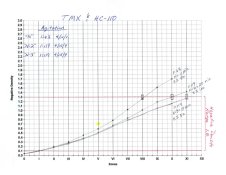
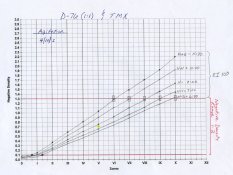
I do not mean to overwhelm, but the ZS is always more complicated in discussion than it is in practice, so I hope to enlighten and not confuse. I post these curves (all are adjusted to reflect the working EI for my process) to show you that it does not matter what developer you use when it comes to calibrating the speed and "normal" development. Once the speed is found to get a zone I density of 0.1 then it acts as a pivot point in adjusting the curves (by adjusting the dev times) to get them to cross the 1.3 density line at the appropriate location (see Alan Ross's website, he is experimenting with calibrating his normal development time based off of a Zone IX density of 1.45; the ZS is meant to be flexible). The appropriate locations are for a zone VIII calibration of 1.3:

"normal" dev: I want the curve to cross 1.3 at Zone VIII
n+1: curve crosses 1.3 at VII
n+2: curve crosses 1.3 at VI
n-1: curve crosses 1.3 at IX
n-2: curve crosses 1.3 at X

So, in this example, with the family of TMX and D-76 1:1 curves, each development time creates the same negative density range for optimum printing. The whole purpose of calibrating with the ZS is to be able to expose various subject brightness ranges either high, normal, or low SBR's, and still be able to develop the negative to the same density range-----this optimizes the negative for printing. Of course, the ZS facilitates visualizing the individual zones and their associated print tonalities, which is the real advantage of this system.

A change in developer could change the curve shape with regard to the middle zones, and that is where you will have the better control over the middle zones. A change in dilution and development process can also affect the middle zones. See the TMX & HC-110 curves----they are all upswept curves with this particular film/dev combo, especially the normal curve, but not until I used the highly dilute HC-110 with an increase in dev time and altering the agitation sequence, did the upsweptness of the curve somewhat flatten out to achieve the compensating affect. A sequence of 4/15/4 indicates 4 inversions in 15 seconds every 4th minute.

I just wanted to clarify some info about the ZS with this post. It has helped me greatly to produce much better negatives, but I've miles to go to still make more pleasing compositions and overall better pictures, only I can help "me" with that part.

Sorry for the very long post but some things are just unavoidable in these types of discussions.
 

Attachments

  • TMX comparison curves  001.jpg
    TMX comparison curves 001.jpg
    147.4 KB · Views: 87
  • TMX&HC-110 curves001.jpg
    TMX&HC-110 curves001.jpg
    115.9 KB · Views: 94
  • TMX-D76 family002.jpg
    TMX-D76 family002.jpg
    201 KB · Views: 87
OP
OP

Bennett Brown

Member
Allowing Ads
Joined
Oct 3, 2008
Messages
50
Location
Canada
Format
Medium Format
Thanks CPorter for the thoughtful response and please don't apologise for the long post.

The information is logically organised, straightforward and helpful. Thanks.

Bennett Brown
 

edtbjon

Member
Allowing Ads
Joined
Jun 8, 2004
Messages
391
Format
Medium Format
Why in the world would anyone attempt to arrive at his optimal speed for a film based on Zone I? Zone I is on the non-linear portion of the density curve and yields no information whatsoever about the part of the curve that you care about, the straight line portion. That's where the tones live that you're going to print.

When testing a film for EI, I essentially follow Ole's procedure and expose until I get Zone 3 up off the toe and into the straight line portion of the curve. I know that I've got it when there's good detail in the Zone III shadows. I have no idea where that puts Zone I nor do I care. I think that people waste a prodigious amount of time and effort calibrating a "proper" Zone I simply because Ansel Adams said to do that in The Negative.

Ehh, every film manufacturer in the world does use zone I being at 0.10 above b+f. So does every single textbook on the subject of finding the EI. Even though AA (and Minor White) did write the first textbook on the zone system, these "mechanics" of film speed have been around for much longer than that.
The subject you are touching at is the concept of "long-toe" vs. "short-toe", but at zone III that shouldn't really matter, as the curve should have straightend out by then, even if the film is extremly long-toed.

//Björn
 

Larry Bullis

Subscriber
Allowing Ads
Joined
May 23, 2008
Messages
1,265
Location
White Rock, B.C. Canada
Format
Multi Format
The subject you are touching at is the concept of "long-toe" vs. "short-toe", but at zone III that shouldn't really matter, as the curve should have straightend out by then, even if the film is extremly long-toed.

When I test any film, I operate on the assumption that zI ought to be 0.10 just as you say. But sometimes a surprise can happen and when it does, one might best be served by maintaining an open mind. In my testing of tri-x (400 version) with Edwal 12, if I were to insist on using zI at .10, I'd have an ISO of about 125 and a hideous flat curve with inadequate separation in the upper register. If, however, I am willing to sacrifice zI (just let it drop below the horizon) and allow zII to be the useful threshold, the whole curve snaps right into place. I have tested tri X over the years with many developers, and I have never seen a result like this. Aberration? Well, dfcardwell got results in his tests that superimpose very closely on mine.

I've had Minor White's observation that I mentioned above in the back of my mind now for some 40+ years, but had never seen clear evidence of it. When I saw this test result, I understood what he meant. I know that he used zI to locate his EI in his own work but apparently he had encountered the same thing at some point.

Ehh, every film manufacturer in the world does use zone I being at 0.10 above b+f.

Can this be quite true? In all of the literature I've ever read from manufacturers, I've never seen any reference to Zone I. I don't think their minds work in the zone system. If PE is around, maybe he could clarify this for us.
 

wogster

Member
Allowing Ads
Joined
Nov 10, 2008
Messages
1,272
Location
Bruce Penins
Format
35mm
That is fine if you will be placing things at zone V most of the time, like most people do with conventional exposure methods. This defeats the purpose of using the zone system. The problems are that this does not let you control your shadows very well, and that zone V is more variable with development than zone I, so is harder to keep consistent. You should find your EI by seeing what rating lets you consistently and predictably place a zone I. You need a handle on the foot of the film so you can swing the rest of it up and down around the foot, which is more or less nailed down where it lies no matter what you do with development.

In all the time you have put into this post, you could have read the applicable pages of The Negative and have known just as much as you need to know. Repeated Internet posting is a sure way to be led astray, and no way to learn every detail of this stuff.

The underlying problem here is that you have no idea why you want to use the zone system, and therefore the how of it is being made not only difficult, but entirely useless. You cannot understand the how if you do not have any idea why you even want to understand it in the first place. You need to go out and experience some practical problems. This means shooting, printing, analyzing, and coming to the realization that your printing is just too difficult and you aren't getting the results you want. You will not find your magic bullet on the Internet.


Maybe an easier way to start with the Zone system, is a simplified zone system, to recognize that the meter in a camera is going to give you zone V, so if your subject is in another zone you can compensate your exposure accordingly, with standard processing. It's only if you need to compress or expand the tonal range that you need to change the processing. This could effectively give you the benefits of the zone system, without needing to deal with trying to process the 36 exposures on a roll, each differently.

Here is what I mean, my subject is very dark, a zone II, so I take a meter reading and get F/5.6 @ 1/250, so I close down up 3 stops to F/16 @ 1/250, however I need a faster exposure, because my subject is moving, so I pick F/8 @ 1/1000 knowing that this is going to get me pretty close, with standard development.

Now suppose my subject is African with a skin tone that is Zone II, and they are standing in front of a window that is Zone VIII. With standard processing I end up with either a blacked out subject or a blown out window, so I alter the development for lower contrast, then print on a lower contrast paper.
 

Chuck_P

Member
Allowing Ads
Joined
Feb 2, 2004
Messages
2,369
Location
Kentucky
Format
4x5 Format
If, however, I am willing to sacrifice zI (just let it drop below the horizon) and allow zII to be the useful threshold, the whole curve snaps right into place.
Bowzart, don't misunderstand the tone of this post, I'm just chatting with you.

I believe (I hope) that I understand enough about the sensitometry behind the ZS to say that this is misguided, I feel anxious as I'm about to make a bold assertion, potentially dangerous :wink:. First, let's agree on the definition of threshhold because that's at the heart of how EI's are determined in the ZS: the amount of exposure needed to yield the first useful density on the negative above the fb+f. So, the relative speed of one curve vs. another is determined by how close to zI the curve crosses the .1 density line. Ex: I have two tests where the original curve crossed the .1 line right at zI, which is great because then I get full box speed with my process for that film/dev combo. All my other tests, the curve crosses the .1 line forward of zI, indicating that with that combo, the speed is too slow to give me a neg density of .1 at zI. So, the amount that I shift the curve back toward zI is the same amount that I take off the box speed to become my EI.

I assume that you actually produced a curve to illlustrate your statement. Your statement says to me and sorry if I got it wrong, that the film/dev/time combo that you used to produce this curve showed that it crossed the 0.1 neg density line at zII. I say this because you said that zII would be the useful threshhold at the box speed of 400 with Edwal 12.

Forgive me while I try to explain myself :smile:
If indeed you assume to want zI to reflect a negative density of 0.1, like you say, then all it would require is that you shift that curve 0.3 log E units to the left on the horizontal axis from zII to zI so that the curve actually does cross the .1 density line at zI--------this is the same as rating the film one stop less at 200 instead of 400 (you asserted 125), with no need to redo the test, just shift the curve a known distance and then you know that if you had used an EI of 200, then your original curve would have crossed the .1 line at zI. That's a very common occurance in ZS testing as far as I can tell. BTW, a lot of this is discussed in John P. Schaefer's Book 2.

____________________
Why 0.3? Because there are 0.3 log E units between each zone on the horizontal axis (this means that .1 log E unit is 1/3 of a stop). Paraphrasing and double checking my facts, I will say that what AA did was to redefine the horizontal axis of the curve by dividing it into zones that are separated by 0.3 log E units, which is an arithmetic factor of 2 as you progress up the scale between zones and one that cuts the values in half as you progress down the scale between zones. This is key because that's exactly what happens when you increase the exposure by one zone----it's a doubling of light intensity or a doubling of time. Or, when reducing by one zone, it's a reduction by half in the intensity of light or the amount of time with the shutter. And that's the beauty of the whole thing, it provides a very practical

"link between camera exposure and the exposure units of sensitometry" (AA, The Negative)

I tried to stop long ago but I could'nt :tongue:. The crazy thing about all this BS, is that once a few ambiguous facts are totally understood (I think I've got them, perhaps someone like PE will cut me down :tongue:) it becomes crystal clear.

Chuck
 

edtbjon

Member
Allowing Ads
Joined
Jun 8, 2004
Messages
391
Format
Medium Format
Bowzart,
The example you give (TX in Edwal 12), really sounds like an exception. You also gave the receipe on how to make this combo give decent results. And the receipe is: either don't care about zone I or move it up to zone II, which lowers the EI to 64. Now, if I hade that kind of results with a 400 film, I would seriously consider trying something else, unless there were something very special about how this particular combo renders the subjects I shoot.
But also, I really do like the fact that you are pointing out that one shouldn't be a slave to the "zone system rules", rather use what is working for you and adjust it to what you are doing. (I.e. I personally don't use the zone system as such, just a subset of it, which is enough for me. (Which I described in my first answer in this subject.))
And yes, as far as I know (which isn't much but anyhow...) .10 above b+f is the industrial norm for the EI.

//Björn
 

analogsnob

Member
Allowing Ads
Joined
Oct 22, 2008
Messages
112
Format
8x10 Format
When Ansel originally set up the Zone System the speed point of Zone I was determined as the exposure necessary to produce the first discernable tone lighter than maximum black of a print exposed so as to make the film base just achieve the max black of the paper. This turned out to be .10 density above film base fog. Zone V was picked to match an 18% medium grey card (also the tone calibration point of the Weston meter) and was achieved by development time. This became "normal" because a Zone V exposure gave a Zone V tone in the print.

Tone curves are not all straight and unless one is doing separation negatives I do not think they should be. If a straight curve is all that is required T-max 100 is the only film required. Fred Picker IMO set back the understanding of the system by equating normal with Zone VIII. In determining normal in that manner the mid tones are always changing depending on the film/developer combination. I have always thought the mid tones to be the most important and the most difficult to visualize. It is unusual to place a value below Zone II or above VII the upper Zones are arrived at by seeing where they "fall" to determin if n- or n+ deveopment is in order.

I have used the system this way for 30 years and I have at times used as many as 12 films and any of 25 developers (different formats are frequently different even with the same emulsion name Kodak being the worst offender) I have found many favorites specifically for the differences in rendering shadows and highlights. Defining Zone VIII as normal masks many of these differences.

One should walk before one runs. I have not used the Ilford developer you started with but have used other similar products in the past and I found the short developing time a problem simply from a mechanical point of view. If working by hand if you happen to be off by 15 seconds it is a much bigger proportion of 4 minutes than 7 or 10. That and the fact that Tmax 100 does a very almost perfect wellseparated Zone I, V, And VIII it helps get the idea of the tone scale. Other combinations and perhaps yours don't behave so reasonably.

I do not advocate the slavish use of one film developer combination. I have never found one I would want to use in all situations.

The density suggestions made elsewhere in this thread should be used as a guide only. The Zone system is to account for your particular set of equipment and choices and as such your numbers are only good for you and may be very different from the norms. My densities are in fact higher and have been higher since I first did them so many years ago.

It is worth saying here that Ansel realized that they are Zones not aimes there is headroom! Ansel himself told me so. He also talked of the differences in film much as I do now.

Once you are calibrated and sure of your numbers there is an period where one makes stupid pictures. Obtaining control is only half the story learning what you want to do with that control is the second half and continues until one day you look around and find you have developed style but thats for another thread.
 
Photrio.com contains affiliate links to products. We may receive a commission for purchases made through these links.
To read our full affiliate disclosure statement please click Here.

PHOTRIO PARTNERS EQUALLY FUNDING OUR COMMUNITY:


Ilford ADOX Freestyle Photographic Stearman Press Weldon Color Lab Blue Moon Camera & Machine
Top Bottom