• Welcome to Photrio!
    Registration is fast and free. Join today to unlock search, see fewer ads, and access all forum features.
    Click here to sign up

Development aid to lighten zones V11 and V111

Recent Classifieds

Forum statistics

Threads
201,724
Messages
2,829,138
Members
100,915
Latest member
WyattRad
Recent bookmarks
0

Larry Bullis

Subscriber
Allowing Ads
Joined
May 23, 2008
Messages
1,265
Location
White Rock, B.C. Canada
Format
Multi Format
Ok, guys, first I have to tell you that in Jr. High School, my math teacher turned me off so bad that it sent me running straight to art school. I did ok in chem and physics, but I don't do math for fun. I really don't think it matters, really, whether we use .3 log E or just zone - we know what that means. And yes, I did plot the curve. Not only that but I never just plot a curve (well, rarely) but I actually print the test on my choice of paper which is, right now, Ilford MG fiber warmtone.

And, no, I don't think anybody is out to get me. This is a discussion, and I respect what you have to say.

While I LEARNED the ZS by reading AA in the original five volume series (which I consider better, if more difficult to read) I STUDIED in the "Zone Buddhist" school (thanks to Imogen Cunningham for the term. She smiled mischievously when she said it). MW could, and frequently did, drive people screaming into the woods unable to tell what was science and what was religion. I think that his attitude and teaching style (and I say this treasuring his memory; none of us is perfect) did a lot to promote the canonization of the zone system (you know, "octave of zones"). There is, I think, a fair amount of rigidity about it. I think that is too bad. Or, at least, it spoils a lot of fun. Holy Cow.

I think we need to be willing to challenge our own basic assumptions.

Chuck, I have always used zI just as you say, as a basic principle which I considered to be pretty much inviolable. I've been doing this a very long time, and I studied it at the source. Yes, it has been crystal clear for me, too. I have used the zs faithfully for 45 years in my personal and professional work, much of that time pretty much daily. It really makes a lot of sense -- in theory, and most of the time, in practice as well. It is very useful, and by now, for myself, completely intuitive. But, Björn has a good sense of what is going on here. If we assume the classic curve shape, with a well defined toe, straight line and shoulder, you can apply the system as you understand it. If you depart from that general curve shape, that one size no longer fits all.

MW's statement that zI doesn't always work had lodged in my mind. I had simply not seen a situation where that was true. Now I have. I had never encountered a STRAIGHT curve; a curve with little or no toe. The reason that zone I has to disappear in this case is that if it did not, if I did what you suggest, then there would be a zone I -- but there could be no zone II, it would jump right to zone III and everything above would go nutso. Were I to do as you suggest, I would have to shorten my development time and screw up what works really great the way it is; the "curve" would flatten out and IT WOULD BE UGGGGLLLY. If I were to shoot tri x at 64, sure, I could get that nice 0.10 zI, but, what would I gain? Nothing. I'd have zone I, but the rest of the scale would be a mess.

So, when did you ever actually SEE zone I in a print? Show me! What's the problem with eliminating it if all the values that you actually can SEE are in precisely the right place? As it is, I get to shoot tri x at 320, which is right where I like it. I mean tx "400" - in my experience, it is rare to non-existent that the mfr published EI's will work for me. When people talk about "pushing" film, I find it mildly amusing. For me, sacrifice of shadow detail is unacceptable. To sacrifice zone I, however, has no significance at all. I won't miss it, and you can't see it either - in a print. Or do you exhibit your tests?

Björn, there is one circumstance in which I actually do shoot tri x sheet film, not not at 64, but 50. That is with pyro - acetone. What I get for this loss in speed is shadow detail that is nothing short of otherworldly and some other sundry advantages. With a slower film, I think I'd be down to maybe 12 or so. So, I guess we could just not call it tri x anymore? Whatever it is, it's wonderful.
 

dancqu

Member
Allowing Ads
Joined
Sep 7, 2002
Messages
3,649
Location
Willamette V
Format
Medium Format
... Multgrade paper, Dektol) I find that while zones 1 through
V are rendering acceptably, zones V11 and V111 are printing
about one zone too dark, with some textural detail even
visible in zone 1X. Many thanks. Bennett Brown

Although worded differently I think it likely the problem may be
one now and then mentioned; a lack of contrast in the highlight
areas when using VC papers. Phil Davis in a D-Max article has
described the phenomenon. Apparently the problem is to be
expected when using VC papers from whom ever.

It is a characteristic of VC papers to be less variable as density
in the print diminishes. Check out the curves of some VC papers
then compare them with those of some Graded papers. You will
see more clearly what I've seen; what Phil has explained. Dan
 

Larry Bullis

Subscriber
Allowing Ads
Joined
May 23, 2008
Messages
1,265
Location
White Rock, B.C. Canada
Format
Multi Format
....
It is a characteristic of VC papers to be less variable as density
in the print diminishes. Check out the curves of some VC papers
then compare them with those of some Graded papers. You will
see more clearly what I've seen; what Phil has explained. Dan

This would be even more a factor if the negatives have any brownish color. The color is equivalent to a yellow filter. If the stain is proportional to the silver density that it accompanies, the contrast reduction effect increases along with the density of the image.

It is quite pronounced when using Windisch pyrocatechin, which produces espresso looking negatives. I have had occasions with night images where the shadow values have a great deal of snap, but even streetlamps etc. (sources) just won't be white at all. The problem disappears when vc is abandoned for a traditional graded paper; there, the yellow color adds additional printing density producing greater contrast overall.

There are times when the reduction in contrast in the highlights can actually be an advantage. It adds something of a wildcard to the mix, though, since the yellow reacts differently according to which filter is being used. With the higher grade filters, contrast increases dramatically; with the lower, it decreases pretty drastically.

I've never used ilfosol, so I don't know what color the image would be. I suspect, though, that it is more likely to be neutral or near neutral. It might be interesting to compare densitometer readings made through a blue filter with readings made with white light. If the corrected blue scale shows greater (and increasing) differences than does the white scale, there would be a brownish component to the image, whether it is obvious to the eye or not.
 

analogsnob

Member
Allowing Ads
Joined
Oct 22, 2008
Messages
112
Format
8x10 Format
ZI is now a reference point and even back in the day one needed a good D-max reference and good light to see it. With all the slick tools and mathematical rigor we have today it sometimes helps to remember AA did it visually first.
 

analogsnob

Member
Allowing Ads
Joined
Oct 22, 2008
Messages
112
Format
8x10 Format
Bennett it seems you need a frame of reference, something that works as a point of departure. Tmax 100 in Tmax rs printed on a graded paper of choice should work easily. Once you have achieved that go back to Ilfosol and vc paper one step at a time and see then exactly where the problem begins. Otherwise these problems can become like walking in circles in a forest. Another clue is to see how it shoots, the proof of the pudding is in the eating.

Do enough calibration and you can come out and digress with the rest of us:rolleyes:
 

c6h6o3

Member
Allowing Ads
Joined
Oct 16, 2002
Messages
3,215
Format
Large Format
Ehh, every film manufacturer in the world does use zone I being at 0.10 above b+f.

I'm not a film manufacturer. I'm a photographer. I do what produces the best prints, and never made a good one until I stopped wasting my time finding an EI at the threshold of Zone I.

Film tests are like statistics. Torture them long enough and they'll tell you anything.
 

nworth

Member
Allowing Ads
Joined
Aug 27, 2005
Messages
2,228
Location
Los Alamos,
Format
Multi Format
There is a lot of good advice and discussion above. But I would first make certain whether the problem is with the negative or the print. You may just be underdeveloping your negatives, which can give gray highlights even though the shadows are right. If the negative is giving reasonable density steps in Zones VI - VIII, you need to change your print to lighten the highlights. How depends on the paper. You may be able to use a higher contrast to solve the problem. Dodging may help. Ferricyanide is always an option.
 

edtbjon

Member
Allowing Ads
Joined
Jun 8, 2004
Messages
391
Format
Medium Format
I'm not a film manufacturer. I'm a photographer. I do what produces the best prints, and never made a good one until I stopped wasting my time finding an EI at the threshold of Zone I.

Film tests are like statistics. Torture them long enough and they'll tell you anything.

Well put. It's easy to get lost and become a "I just need to do one more test" - junkie. But I do recon you have found your own EI for the film(s) and developers that you are using. Or something which works for you in terms of honing in to what you would call "a nice well-exposed negative" which will produce that nice print.

//Björn
 

dancqu

Member
Allowing Ads
Joined
Sep 7, 2002
Messages
3,649
Location
Willamette V
Format
Medium Format
That's what started this whole line of questioning -
that a dilution beyond the manufacturer's recommended
working solution would "move" the upper zones without
disturbing zones 1 thorugh V. Do you agree? Bennett

At least generally, developers become more compensating
as they become more dilute. I'd expect some little increase
in EI at higher dilutions. High light density will increase as
development times increase. If you need greater contrast
in the high light areas first try increasing development
time; what ever the dilution. Dan
 

2F/2F

Member
Allowing Ads
Joined
Apr 29, 2008
Messages
8,031
Location
Los Angeles,
Format
Multi Format
When Ansel originally set up the Zone System the speed point of Zone I was determined as the exposure necessary to produce the first discernable tone lighter than maximum black of a print exposed so as to make the film base just achieve the max black of the paper. This turned out to be .10 density above film base fog. Zone V was picked to match an 18% medium grey card (also the tone calibration point of the Weston meter) and was achieved by development time. This became "normal" because a Zone V exposure gave a Zone V tone in the print.

Tone curves are not all straight and unless one is doing separation negatives I do not think they should be. If a straight curve is all that is required T-max 100 is the only film required. Fred Picker IMO set back the understanding of the system by equating normal with Zone VIII. In determining normal in that manner the mid tones are always changing depending on the film/developer combination. I have always thought the mid tones to be the most important and the most difficult to visualize. It is unusual to place a value below Zone II or above VII the upper Zones are arrived at by seeing where they "fall" to determin if n- or n+ deveopment is in order.

I have used the system this way for 30 years and I have at times used as many as 12 films and any of 25 developers (different formats are frequently different even with the same emulsion name Kodak being the worst offender) I have found many favorites specifically for the differences in rendering shadows and highlights. Defining Zone VIII as normal masks many of these differences.

One should walk before one runs. I have not used the Ilford developer you started with but have used other similar products in the past and I found the short developing time a problem simply from a mechanical point of view. If working by hand if you happen to be off by 15 seconds it is a much bigger proportion of 4 minutes than 7 or 10. That and the fact that Tmax 100 does a very almost perfect wellseparated Zone I, V, And VIII it helps get the idea of the tone scale. Other combinations and perhaps yours don't behave so reasonably.

I do not advocate the slavish use of one film developer combination. I have never found one I would want to use in all situations.

The density suggestions made elsewhere in this thread should be used as a guide only. The Zone system is to account for your particular set of equipment and choices and as such your numbers are only good for you and may be very different from the norms. My densities are in fact higher and have been higher since I first did them so many years ago.

It is worth saying here that Ansel realized that they are Zones not aimes there is headroom! Ansel himself told me so. He also talked of the differences in film much as I do now.

Once you are calibrated and sure of your numbers there is an period where one makes stupid pictures. Obtaining control is only half the story learning what you want to do with that control is the second half and continues until one day you look around and find you have developed style but thats for another thread.

Out of curiosity, is it zone V you use as your target for finding "normal"?
 

analogsnob

Member
Allowing Ads
Joined
Oct 22, 2008
Messages
112
Format
8x10 Format
I have always used Zone V as my basis for normal because it is a definate reference point (18% grey and the calibration point of most lightmeters). If I am before the subject I have always found it simpler to be confident that my Zone V placement becomes Zone V in the print and anticipate the treatment of the higher zones according to the deveper choice I make for the scene. I have tested many film developer combinations and many do not IMO have what most would consider a good Zone VIII. To make those combinations. . do Zone VIII causes the mid tones (the more important ones IMO) to darken and loose separation or lighten and extend the separation depending on the developer at hand.

To use an example I found that Plus X in Edwal FG-7 made with sulfite gave a Normal where Zone V was on but the curve shouldered steeply at about 61/2. It also did N+2 so that V moved to VII (my definition of N+2) but something that fell on VII did not push beyond VIII.

So in that circumstance I got predictable and beautiful mid tones expanded without buring the highlights but some would call my N+2 Normal as defined by Zone VIII. Which is easier to visualize? To me it was always mid tones with changing highlights as opposed to a V that doesn't yield V predictably. Only if one limits ones'self to combinations that yield all 9 zones for normal IMO does defining Normal by Zone VIII work. To do that also limits one to devlopers that all look alike and what fun is that?

The only film that gave a problem with my definition was Tech pan in something like HC-110 and I don't think that a Zone VIII definition would do any better in that case.

My favorite combinations were Super XX in D-23, Plus X in FG7 with sulfite, Plus X in Weston's dilution of Pyro 45, Super XX in water bath,Royal pan in a phenidone glycin developer that didn't have a name. I also used a fair amount of DK-50, standard Pyro 45 and various Windisch formulas. With the exception of D-23 and phenidone glycin most of the others didn't do a"normal" Zone VIII.

For the record I defined my developments around V for normal and N+1 and N+2 IOW A ZoneV placement becomes V=normal VI=+1 VII=+2
N-1 and N-2 were defined around Zone VII VII moves to VI=-1 VII moves to V=-2. Not every combination did +2 to -2. For roll film I did not even consider +2 because of grain issues.

I know that Ansel used Zone V I don't recall the rest of his definitions but they must be close to mine because he was my guide. Through the 80's I had about one long phone argument with Fred Picker a year over this issue (when I bought something else) but I assume we both remain unconvinced of the other's arguement.
 

Chuck_P

Member
Allowing Ads
Joined
Feb 2, 2004
Messages
2,369
Location
Kentucky
Format
4x5 Format
I have always used Zone V as my basis for normal because it is a definate reference point (18% grey and the calibration point of most lightmeters).

As a point of comparison, I calibrate my "normal" development time based off of achieving a Zone VIII density of 1.3 and my EI based of off the speed that provides a Zone I density of 0.1----the resultant negative density range is 1.3 -.1 = 1.2.

So what amount of negative density are you targeting for your Zone V exposure---for your current film/dev combo, how long do you develop the film to reach that Zone V density? Just curious.
 

analogsnob

Member
Allowing Ads
Joined
Oct 22, 2008
Messages
112
Format
8x10 Format
My density aimes are considerably higher. For a diffusion enlarger grade 2 paper. Zone V .85-.95 Zone VI 1.10-1.20 Zone VII 1.30-1.40 Zone VIII 1.5-1.6 (all above fbf). I arrived at mine empirically the first time being at minimum exposure for max black through the processed but blank film base what ever density gave me a good match to an 18% grey card. After that I averaged where the other zones fell and adapted those averages.

Those aimes have survived several densitometers and many enlargers. I questioned myself when Todd Zakia and White came out with their book which gave numbers like yours and in my experience I keep comming back to mine. Thats why one tests- if everones numbers were the same testing would be unnecessary.

As for normal process times (from memory) Tri- X 120 non pro D-23 8 min@68 degrees agitation constant first 30 seconds followed by 5 seconds every 30,15 seconds drain
 

Chuck_P

Member
Allowing Ads
Joined
Feb 2, 2004
Messages
2,369
Location
Kentucky
Format
4x5 Format
Thats why one tests- if everones numbers were the same testing would be unnecessary.

There's no implication that everyone's "numbers" should be the same----whatever do you mean by this? There's nothing about testing one's EI and development times that suggests everyone's should be the same.
 
Joined
Jan 7, 2005
Messages
2,737
Location
Los Angeles
Format
4x5 Format
I have always used Zone V as my basis for normal because it is a definate reference point (18% grey and the calibration point of most lightmeters).

Sorry, but 18% isn't the calibration point. Ignoring the fact that meters aren't calibrated to any reflectance, if you take the value of the luminance from the calibration equation from the ISO standard and compare it to the statistically average scene, the reflectance value for the luminance point is 12%. That's 1/2 stop darker than 18%.

Also, any density aims have are based upon such things as type of enlarger, paper, and paper grade for controlled conditions. One of the major elements that makes any talk for definite "aim" values next to impossible is flare and it never seems to be discussed.

There's also the little known statement of Loyd Jones that states that there isn't a strict correlation between negative density range and print exposure range to print quality. In his paper Control of Photographic Printing: Improvement in Terminology and Further Analysis of Results, JOSA 1948, he states for the soft papers, the density ranges of the negatives should in most cases exceed the exposure range of the paper, whereas, for the hard papers, the density ranges of the negatives should in most cases be less than the exposure range of the paper. He was uncharacteristically funny in this conclusion proposing the system we still use today as "what other choice do we have?"
 
Last edited by a moderator:

Chuck_P

Member
Allowing Ads
Joined
Feb 2, 2004
Messages
2,369
Location
Kentucky
Format
4x5 Format
For the record I defined my developments around V for normal and N+1 and N+2 IOW A ZoneV placement becomes V=normal VI=+1 VII=+2

I just don't know where to start---------perhaps here is a good place. A +1 development time is not defined by a density that is one zone higher than your "normal" calibration point. Using your stated "normal" calibration of 0.9 neg density at Zone V, +1 development would be defined by a Zone IV luminance value developed to a 0.9 negative density; +2 would be a Zone III luminance value developed to a 0.9 negative density.

N-1 and N-2 were defined around Zone VII VII moves to VI=-1 VII moves to V=-2. Not every combination did +2 to -2.

For starters, in the ZS, and I assume you are thinking you are using the ZS, all development times are based around the "normal" time for any given film/dev/dilution you are using. Secondly, the zones don't move from one place to another on the curve as you seem to imply.
 

analogsnob

Member
Allowing Ads
Joined
Oct 22, 2008
Messages
112
Format
8x10 Format
Well first I did mean that everybody's numbers will be different because we are also useing different lenses, cameras, enlargers, chemical scales,etc.

Back in the day (pre ISO) it was widely held that a meter was calibrated to determin an exposure to yield18% gray. That is the assumption Ansel made in the beginning. I eventually used the exposure formula Ansel mentions in the "Basic Photo Series" where the film speed determins the key stop and then meter readings in candles per square foot at the key stop are the shutter speed for Zone V placement.

With my definitions I mean an N+1 is Zone V placement yields a Zone VI density in the print and so forth. N-1 is a Zone VII exposure yields a Zone VI density in the print and so forth. Even if one disparages (As everyone has the right to do) my choice of definition I see no intuitive method except to use a similar definition of some kind (pick a Zone). The whole point of the Zone Sytem is to link sensitometry to the everyday problem of determining, while in frount of the subject, how one wishes the print to look.

After I made several series of the prints to prove out what I was getting I took my density readings for each Zone averaged them and used that value as a target for the rest of my testing.

In my testing I used a 9 Zone target made of ND filters in frount of a light source so camera flair was automatically taken into account. Once I had normal I tested until I got the density change I was looking for and then plotted the curve for that time both plus and minus. I found that Zone III and IV were more influenced by exposure than development and after all it is a Zone not an exact value.
 

analogsnob

Member
Allowing Ads
Joined
Oct 22, 2008
Messages
112
Format
8x10 Format
For starters, in the ZS, and I assume you are thinking you are using the ZS, all development times are based around the "normal" time for any given film/dev/dilution you are using. Secondly, the zones don't move from one place to another on the curve as you seem to imply.

Normal is only part of the story and if Zones don't move what's the point? What is N+ and N- supposed to be? If you are in frount of a subject and you place something on Zone IV and the high value falls on Zone X to me thats N-1 VII moves to VI 10 moves to VIII with D-23 and Kodalk on Super XX. Without considering the specific film /developer what do you call that situation? And if Zone X is not "moving" to Zone III whats it doing?
 

analogsnob

Member
Allowing Ads
Joined
Oct 22, 2008
Messages
112
Format
8x10 Format
I should say moves to Zone VIII (good thing I'm not a keyboarder for a living...LOL)
 

Chuck_P

Member
Allowing Ads
Joined
Feb 2, 2004
Messages
2,369
Location
Kentucky
Format
4x5 Format
With my definitions I mean an N+1 is Zone V placement yields a Zone VI density in the print and so forth. N-1 is a Zone VII exposure yields a Zone VI density in the print and so forth.

I fully believe that when commenting publicly in these forums that we should be prepared to be challenged in what we say. So, I'm challenging you on this one particular assertion that you are making as it is the one single thing that is sticking in my craw in this discussion.

You have already stated that your "normal" calibration is based off a Zone V density of between .85 to .95, or .9 to take the middle------ok, that's your choice, I don't understand it, but that's your choice. But your discussion of expansion and contraction of the negative is patently wrong as it relates to the ZS as I see it---your "definitions", as you call them, are a mutilation (no disrespect intended) :wink:.

Any film/fev/dilution combo has one "normal" development time that achieves a desired negative density at a particular zone. In my case (and most that I've seen) it is a Zone VIII density of 1.3; I saw on Alan Ross's website that he is experimenting with calibrating his normal development time based off a Zone IX density of 1.45. You have stated that yours is a Zone V density of .9.

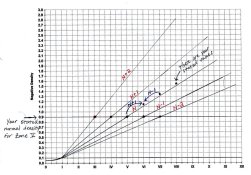
You appear to be stating that your expansions and contractions are occurring along the same curve using a single stated development time of 8 minutes with whatever film and developer it was. This is impossible if you claim it is the ZS-----each expansion and contraction has its own curve, defined by a development time needed to get the curve to cross the target density line at the proper zone.

To back up what I'm trying to say, I've included a graph to try and illustrate it. It's a simple set of simulated straightline curves that assumes the correction for EI (hence the reason all the curves merge at Zone I). The "red" indicates what I'm saying and the "blue" is what I think you are saying; the solid black dots are the densities you stated earlier for those zones.
 

Attachments

  • simulated curves001.jpg
    simulated curves001.jpg
    166 KB · Views: 100

Larry Bullis

Subscriber
Allowing Ads
Joined
May 23, 2008
Messages
1,265
Location
White Rock, B.C. Canada
Format
Multi Format
Sorry, Chuck. I'm lost. What your curves are showing me is that what he's saying is not at all what your "blue curve" shows. What I think he's saying is more like the whole set of curves you are showing. I think you guys are talking across each other's bows.
 
Photrio.com contains affiliate links to products. We may receive a commission for purchases made through these links.
To read our full affiliate disclosure statement please click Here.

PHOTRIO PARTNERS EQUALLY FUNDING OUR COMMUNITY:


Ilford ADOX Freestyle Photographic Stearman Press Weldon Color Lab Blue Moon Camera & Machine
Top Bottom