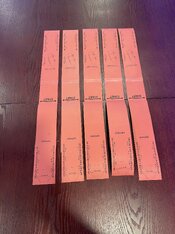
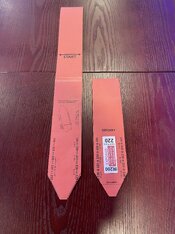
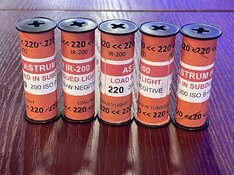
Photographic material from Ukraine Astrum Svema
In summary, I have been in e-mail contact with the company Astrum since the end of December.
The 25% owner of the newly re-established company Astrum, which also sells films and photographic materials under the name Svema, calls himself Alexey (Oleksei Yaroshko) in English.
With the exception of the color films, all products are labeled "Made in Ukraine."
I should have paid more attention in my Russian for Beginners class; then I could at least understand some things/or at least read them.
Contact was repeatedly interrupted, sometimes for several days or even one to two weeks, due to the ongoing war on the Russian-Ukrainian border. Production takes place in Shostka, about 50 km from Russia in eastern Ukraine. Certainly not where the picture of the unfinished building circulating in this forum was taken.
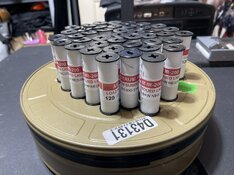
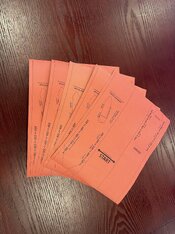
,Because I am interested in the quality of the predominantly black and white materials, I ordered a selection of films in various formats and ISO settings. The price lists in euros have already been published. The materials arrived about a month ago (mid-April). Since I'm an amateur photographer, that wasn't a problem. I think everyone understands that it takes longer for deliveries to arrive from there. Don't be alarmed by several days of silence from your email
The tone of the email communication in English was always very, very polite and explanatory, especially if the answers arrived long after the questions.
According to Alexey, the clientele is very diverse; word of the company has clearly spread throughout Europe and the USA, even reaching Brazil. Americans buy a lot of large-format sheet film from them.
For me, that stops at 4x5 inch. I use photographic paper with my other DIY cameras (whether pinhole or "normal field" cameras) so I don't have to spend the last penny.
So far, I've tested the films (135, ASA 64 and 200, 120, 100 and 400, and 4x5 inch ISO 100) for my own use and have already taken some nice pictures with them. Since 2014, I've primarily used Caffenol or similar phenolic developers, for both film and photographic paper. The basis for this process includes not only instant coffee, but also basil or other herbs, cheap black or green teas, or the second infusion of Darjeeling tea, and even potato peels. If the beer tastes awful, it also goes into the darkroom. Coffee grounds also work wonderfully, especially with photographic paper. The slightly longer development time of the papers (up to 4-5 minutes) is rewarded with incredibly deep blacks.
Daggie Brundert, the master of alternative film developers, lives in Berlin and is constantly developing new developer variations.
The materials from Ukraine are particularly well-suited for Caffenol developers. The film packaging recommends Rodinal (now called Adonal) and a Russian developer, UP-5 (Metol developer, MPQ…), which originally dates back to the Soviet era and can even handle the most difficult films (according to The Darkroom Cookbook). I also received Up-5 in powder form, but haven't used it yet, as the Caffenol developers work so exceptionally well. The C-L variant, in particular, is very effective (it's somewhat reminiscent of Rodinal with high dilutions and long development times), but with times of 50-80 minutes (depending on the ISO). The film is only agitated for the first 60 seconds; after that, it remains in the developer bath until the end of the development time.
The negatives of the Svema films remind me of my youth, when I mainly used Agfapan 100. The deep, warm blacks of the Agfa papers are resurrected in the Svema films with Caffenol. When Agfapan was no longer so common, I increasingly used Ilford and then T-Max films. Now I'm back to using a lot of Svemapan 100.
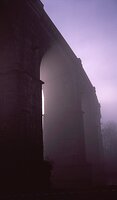
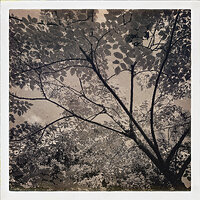
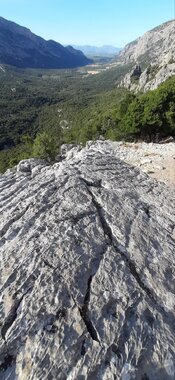
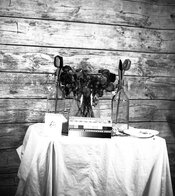
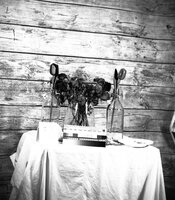
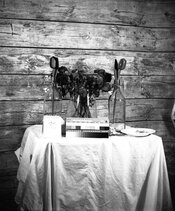
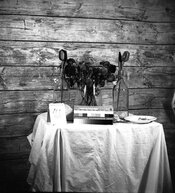
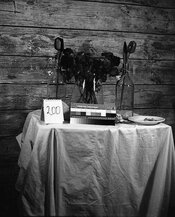
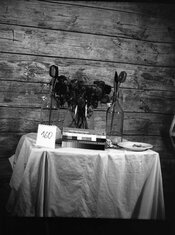
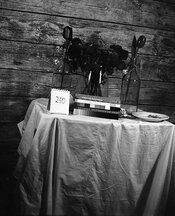
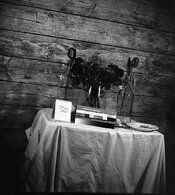
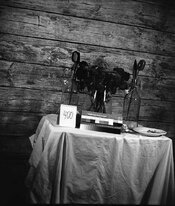
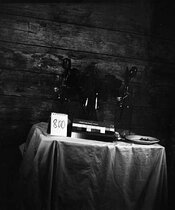
The attached test photos show, to the left of the Kodak gray scale and the standard colors (because they're not visible, but in text form), a small label with the ASA values of the shots.
For my film-developer combination, the nominal sensitivity or slightly lower is the only option. Nothing unusual for black and white films. So, for example, with a nominal sensitivity of 100 ASA, 80 ASA. A 64 ASA version produces extremely dark negatives (i.e., borderline overexposure).
The image quality limitation only allows 300 dpi scanned images to be posted here in the forum.
I enlarged all the negatives to approximately 12x on the photocopier, resulting in a negative print of approximately 70x70cm for the 6x6cm negatives. I then developed only small sections, approximately 20x25cm, for all ASA levels, meaning only the central parts of the image are visible. This includes the Kodak grayscale levels (20 in total). There was no trace of grain visible in the example of the 120 Svema Foto 100 film in the range of 64 to 125 ASA.
Please ask if anything is unclear.
See images here: