• Welcome to Photrio!
    Registration is fast and free. Join today to unlock search, see fewer ads, and access all forum features.
    Click here to sign up

Bulk rolling 120/220 film

Recent Classifieds

Forum statistics

Threads
204,274
Messages
2,866,528
Members
102,207
Latest member
gustavocf
Recent bookmarks
1
Well, they're put up for sale. Whether someone buys them is a different matter.

Either way, I don't think for EK the potential and very soft/weak value of selling this as a sustainability gain would offset the loss in value due to channel conflicts, reputation damage, transaction cost due to small-scale sales etc. As to the latter - if an EK employee spends 10 minutes on your order, they'll likely not make any money on that small volume of film. What's the rationale for them? All they can do on such small-scale sales is lose money and incur all manner of risks (=additional costs). It might be different if they were organized for high-mix/low-volume e-commerce sales, but fact of the matter is that they're no Amazon and they likely don't aspire to become one.

Keep in mind that this is a manufacturing company and they're in business to make money. Ultimately someone in the chain of command will look at it through that lens and if it doesn't make sense, it ain't gonna happen.
 
The question is, what does Kodak do with the leftover film that's essentially unsellable?

Kodak could boast about its environmental credentials if they sold this leftover film to hobby photographers instead of gradually disposing of it.

I believe that only a very tiny percentage of people actually put in the work involved.

Cutting it lengthwise and then widthwise. Then adding the paper backing...
all done blindly in the darkroom...

This can't become a big competitive business, especially since there's no guaranteed continuous supply.

And whoever then sells the roll film can't offer any quality guarantee.

Feel free to pass this on to your Kodak contacts.
Kodak buys back unused cans. Studios deal with the leftover shirt ends and recans. Sometimes they sell it, sometimes they keep it for future projects if they have them in the immediate future. However the studios and film brokers have been told not to sell to photographers now.

As far as your last points, there are 120 making machines that you can buy now, they are still only semi-automated and cost $9k, but they have a very consistent quality compared to hand rolled film. And if you are large enough to justify that, you will have a contact with a movie studio that gets you a constant supply of film. This is why 120 Cine film in China is extremely common now, even more than before.
 
If EK can't sell enough still film cheaply, the production will be shifted away from photographic products to their other products that make use of their coating technology and expertise. The machines and people are already being used for more and more of that.
It is all about return on investment. And EK is absolutely ruthless about factoring in every possible cost relating to the product sold when determining that ROI.
With Kodak Alaris, EK basically had no need to factor in downstream costs, and with a single customer with (I expect) minimum order requirements, it was relatively easy to convince management to continue to devote capital to the still film business.
Without Kodak Alaris being in that role, I'm really concerned about continued availability of product - particularly given current political and economic realities.
 
If EK can't sell enough still film cheaply, the production will be shifted away from photographic products to their other products that make use of their coating technology and expertise. The machines and people are already being used for more and more of that.
It is all about return on investment. And EK is absolutely ruthless about factoring in every possible cost relating to the product sold when determining that ROI.
With Kodak Alaris, EK basically had no need to factor in downstream costs, and with a single customer with (I expect) minimum order requirements, it was relatively easy to convince management to continue to devote capital to the still film business.
Without Kodak Alaris being in that role, I'm really concerned about continued availability of product - particularly given current political and economic realities.

That's an interesting perspective. So why is EK selling anything directly? Why not continue to funnel everything through Alaris?

I'm a total non expert and am not questioning that this is factually correct. Just observing that basically everything I read on the web is anti Alaris, but you're highlighting the benefit for EK.
 
That's an interesting perspective. So why is EK selling anything directly? Why not continue to funnel everything through Alaris?

I'm a total non expert and am not questioning that this is factually correct. Just observing that basically everything I read on the web is anti Alaris, but you're highlighting the benefit for EK.
That doesn’t have a simple answer.

This is my understanding of some information that may or may not be accurate. Do take it with a grain of salt.

KA was originally tasked with being the sole seller and distributor of stills film as a means to create an income stream for the UK Pension Fund. However, allegedly that agreement only lasted until 2018, at which point Kodak was free to sell films on their own, and it seems they may have been doing B2B for some time now. But they stayed with Alaris as they had taken over the old selling/distributing network and Kodak didn’t want to have to rebuild that since the market was pretty much nonexistent.

However, at some point, they decided to rebuild a distribution network on their own and begin selling film again, apparently something in the works for the last couple years. Why they did this is probably a combination of seeing a resurgence in the market, and Kodak wanting to distance themselves from KA (possibly due to the buyout).

Friend who knows people seems to think they’re rolling out the film as they coat new batches of each emulsion, which does actually make a bit of sense. It should allow Kodak to get more money per roll without putting that price on the end customer, so I’m optimistic.
 
The initial KA - EK agreement was renewed/replaced and continued into the Covid years, when Kodak Alaris had huge problems due to all the pandemic related effects on shipping and markets.
At that point, the agreement was re-negotiated and EK was able to expand its sales of things like entire master rolls of the remjet lacking Vision stocks to Cinestill, but KA continued to have exclusive rights for most still films.
The recent changes are quite opaque, but I expect that they will not bode well for most of us interested in niche products like Kodak black and white roll films - particularly if we are outside the USA.
 
The initial KA - EK agreement was renewed/replaced and continued into the Covid years, when Kodak Alaris had huge problems due to all the pandemic related effects on shipping and markets.
At that point, the agreement was re-negotiated and EK was able to expand its sales of things like entire master rolls of the remjet lacking Vision stocks to Cinestill, but KA continued to have exclusive rights for most still films.
The recent changes are quite opaque, but I expect that they will not bode well for most of us interested in niche products like Kodak black and white roll films - particularly if we are outside the USA.

I'm always amazed we can still get 120 film in as many choices. I agree that KA has been great at distribution. Very unknown territory we are in. Politics is for another forum but I've never seen anything remotely like what's happening today, and additionally, right now silver is 99 USD per troy ounce.
 
The recent changes are quite opaque, but I expect that they will not bode well for most of us interested in niche products like Kodak black and white roll films - particularly if we are outside the USA.
Are you thinking Kodak may discontinue still B&W film? Or stop selling bulk rolls?
 
I just ordered 10 rolls of 120 Tri-X ☺️

I love Ilford and Kentmere but dang the tariffs are brutal to buy good British made film. I have loaded up on the Kentmere 200, bulk 35mm and plenty of 120, I'm very fond of this stuff. No one left outside of Europe making black and white paper, love the Foma and Ilford.

Crazy time.
 
Are you thinking Kodak may discontinue still B&W film? Or stop selling bulk rolls?

Eastman Kodak's sales of still B&W film are smaller than Harman/Ilford's.
Harman/Ilford's production facilities are much more appropriately sized for current markets than Eastman Kodak's - in particular wrt bulk rolls.
The EK machinery and systems for bulk rolls are relatively ancient - they are remnants from when bulk rolls were used by high volume school and ID photography users and are not really designed for the sort of customers that we are - and as such, production of those rolls is incredibly labour intensive and really costly.
And unlike Harman/Ilford, the still film business is a relatively small part of EK's business, that has to compete with the other EK coating related businesses for capital and resources.
If the EK still film people have to justify a niche product like B&W still film in order to get access to the necessary capital and resources, and if that justification isn't supported by an entity like KA and its likely obligation to purchase relatively high quantities and if EK also has to shoulder more of the marketing and distribution costs, management are going to be less likely to want to devote those relatively scarce resources to B&W film when there may very well be more profits available from other products.
 
That's an interesting perspective. So why is EK selling anything directly? Why not continue to funnel everything through Alaris?

I expect much of that is due to decisions by Kodak Alaris, which may relate to minimum order issues.
 
Taking here the opportunity to remind everyone
Thanks, I'll do the same:
...that this thread is about DIY spooling 120/220, not about Kodak's film distribution. More comments on the latter topic can go here: https://www.photrio.com/forum/threa...om-eastman-kodak-was-kodacolor-100-new.216146
...that we like to keep ads out of the general forum, but since you're giving away something for free and it's related to the thread, we'll let it slip as a relevant notification and leave your post here. But in general, please don't use forum threads to advertise sales.
 
I'd take you up on the offer but the shipping from Belgium to the Great Lakes would be prohibitively expensive.
This was my exact response a few months ago…
 
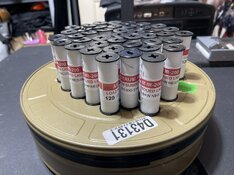
I rolled a ton of 120 this weekend, honestly once you start making this much at a time you kinda get into a rhythm and can get 40 rolls done in around half a day. It’s by no means fast but it’s definitely possible.
 

Attachments

  • IMG_5147.jpeg
    IMG_5147.jpeg
    304 KB · Views: 47
Yes, it's been a while. It took some time, of course, with the constant turmoil of war nearby.

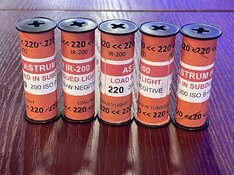
I received from Svema/Astrum in Ukraine : black and white film in 120 and 135 formats bulk, plus 4x5" sheet film and photographic paper, and I'll test them as soon as possible. All the products come with processing instructions.

I'll be in touch again.

Does anyone have a reciprocity tabel 1sec to 30 or 100sec on eg. Foto 200 (135) or Foro 100 and 400 ( format 120)?
 
Looks like Kodak is putting out a new Cine line, and in 65mm. I wonder if they'll sell to the public again. That would ease things up for bulk rolling 120 film.
 
Looks like Kodak is putting out a new Cine line, and in 65mm. I wonder if they'll sell to the public again. That would ease things up for bulk rolling 120 film.
One of my friends already called about 35mm and 65mm pricing. It costs more than ektachrome, and they still will not sell to the public.
 
Honestly I'd like to be able to shoot 220, which is nonexistent as far as I can tell.

 
Photographic material from Ukraine Astrum Svema

In summary, I have been in e-mail contact with the company Astrum since the end of December.

The 25% owner of the newly re-established company Astrum, which also sells films and photographic materials under the name Svema, calls himself Alexey (Oleksei Yaroshko) in English.

With the exception of the color films, all products are labeled "Made in Ukraine."

I should have paid more attention in my Russian for Beginners class; then I could at least understand some things/or at least read them.

Contact was repeatedly interrupted, sometimes for several days or even one to two weeks, due to the ongoing war on the Russian-Ukrainian border. Production takes place in Shostka, about 50 km from Russia in eastern Ukraine. Certainly not where the picture of the unfinished building circulating in this forum was taken.

,Because I am interested in the quality of the predominantly black and white materials, I ordered a selection of films in various formats and ISO settings. The price lists in euros have already been published. The materials arrived about a month ago (mid-April). Since I'm an amateur photographer, that wasn't a problem. I think everyone understands that it takes longer for deliveries to arrive from there. Don't be alarmed by several days of silence from your email

The tone of the email communication in English was always very, very polite and explanatory, especially if the answers arrived long after the questions.

According to Alexey, the clientele is very diverse; word of the company has clearly spread throughout Europe and the USA, even reaching Brazil. Americans buy a lot of large-format sheet film from them.

For me, that stops at 4x5 inch. I use photographic paper with my other DIY cameras (whether pinhole or "normal field" cameras) so I don't have to spend the last penny.

So far, I've tested the films (135, ASA 64 and 200, 120, 100 and 400, and 4x5 inch ISO 100) for my own use and have already taken some nice pictures with them. Since 2014, I've primarily used Caffenol or similar phenolic developers, for both film and photographic paper. The basis for this process includes not only instant coffee, but also basil or other herbs, cheap black or green teas, or the second infusion of Darjeeling tea, and even potato peels. If the beer tastes awful, it also goes into the darkroom. Coffee grounds also work wonderfully, especially with photographic paper. The slightly longer development time of the papers (up to 4-5 minutes) is rewarded with incredibly deep blacks.

Daggie Brundert, the master of alternative film developers, lives in Berlin and is constantly developing new developer variations.

The materials from Ukraine are particularly well-suited for Caffenol developers. The film packaging recommends Rodinal (now called Adonal) and a Russian developer, UP-5 (Metol developer, MPQ…), which originally dates back to the Soviet era and can even handle the most difficult films (according to The Darkroom Cookbook). I also received Up-5 in powder form, but haven't used it yet, as the Caffenol developers work so exceptionally well. The C-L variant, in particular, is very effective (it's somewhat reminiscent of Rodinal with high dilutions and long development times), but with times of 50-80 minutes (depending on the ISO). The film is only agitated for the first 60 seconds; after that, it remains in the developer bath until the end of the development time.

The negatives of the Svema films remind me of my youth, when I mainly used Agfapan 100. The deep, warm blacks of the Agfa papers are resurrected in the Svema films with Caffenol. When Agfapan was no longer so common, I increasingly used Ilford and then T-Max films. Now I'm back to using a lot of Svemapan 100.

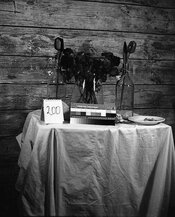
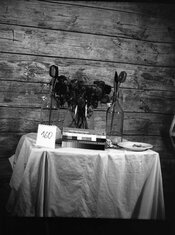
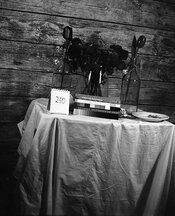
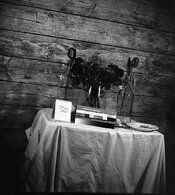
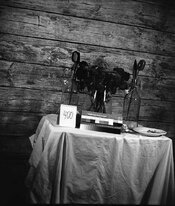
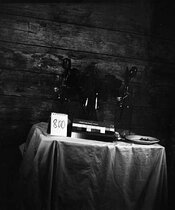
The attached test photos show, to the left of the Kodak gray scale and the standard colors (because they're not visible, but in text form), a small label with the ASA values of the shots.

For my film-developer combination, the nominal sensitivity or slightly lower is the only option. Nothing unusual for black and white films. So, for example, with a nominal sensitivity of 100 ASA, 80 ASA. A 64 ASA version produces extremely dark negatives (i.e., borderline overexposure).

The image quality limitation only allows 300 dpi scanned images to be posted here in the forum.

I enlarged all the negatives to approximately 12x on the photocopier, resulting in a negative print of approximately 70x70cm for the 6x6cm negatives. I then developed only small sections, approximately 20x25cm, for all ASA levels, meaning only the central parts of the image are visible. This includes the Kodak grayscale levels (20 in total). There was no trace of grain visible in the example of the 120 Svema Foto 100 film in the range of 64 to 125 ASA.

Please ask if anything is unclear.

See images here:

 

Attachments

  • img064.jpg
    img064.jpg
    68.8 KB · Views: 23
  • img050.jpg
    img050.jpg
    66.3 KB · Views: 23
  • img080.jpg
    img080.jpg
    68.8 KB · Views: 25
  • img100.jpg
    img100.jpg
    74.5 KB · Views: 27
  • img200.jpg
    img200.jpg
    71.8 KB · Views: 24
  • img160.jpg
    img160.jpg
    60.8 KB · Views: 21
  • img250.jpg
    img250.jpg
    71.3 KB · Views: 22
  • img320.jpg
    img320.jpg
    54.2 KB · Views: 20
  • img400.jpg
    img400.jpg
    84.2 KB · Views: 26
  • img800.jpg
    img800.jpg
    53.9 KB · Views: 24
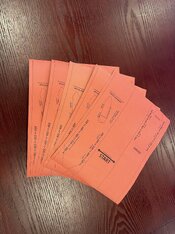
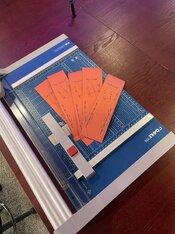
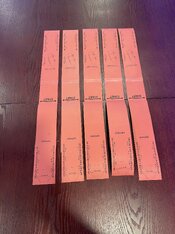
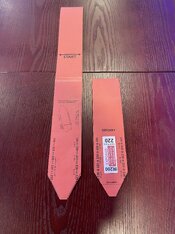
Here’s how I make my 220 backing paper and the finished rolls:
IMG_5633.jpeg
Template printed onto a piece of opaque paper

IMG_5634.jpeg
Paper cut to 63mm strips

IMG_5635.jpeg
The 2 pieces of the leader are taped together

IMG_5636.jpeg
Ends are cut and the exposed sticker is attached

IMG_5638.jpeg
Finished rolls
 
Here’s how I make my 220 backing paper and the finished rolls:
View attachment 424668
Template printed onto a piece of opaque paper

View attachment 424669
Paper cut to 63mm strips

View attachment 424670
The 2 pieces of the leader are taped together

View attachment 424671
Ends are cut and the exposed sticker is attached

View attachment 424672
Finished rolls


Hi,

Thanks for your post!

You're showing the start and end of the roll of film.

If I understand correctly, you're using regular tape to attach these pieces together.

What does the middle section look like?

Is it also made up of pieces?

Regarding the taped sections, I'm curious whether you're overlapping the backing paper? If so, by how much, 0.5 cm?

My idea for labeling the middle section would be a kind of stencil that I can reuse. The idea isn't fully developed yet.

My multi-cutter isn't quite finished yet. It's made from some wooden slats (about 2 mm thick) from a discarded sunshade.

One of the wooden slats holds the sharp wallpaper knife blade.

My DIY spirit has been reactivated, just like when I cut a 127 film from a 120 film. I built it according to the instructions here:

 
Photrio.com contains affiliate links to products. We may receive a commission for purchases made through these links.
To read our full affiliate disclosure statement please click Here.

PHOTRIO PARTNERS EQUALLY FUNDING OUR COMMUNITY:


Ilford ADOX Freestyle Photographic Stearman Press Weldon Color Lab Blue Moon Camera & Machine
Top Bottom