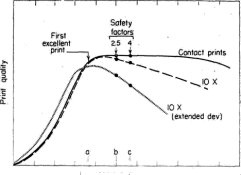
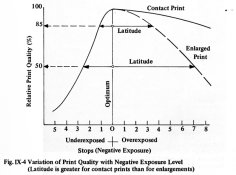
Another point I keep trying to make is there isn't a fixed correlation between Zones and negative densities.
If we are to establish a negative density range by which to develop the negative to, there must be. And so, in the ZS "proper", there is. The usage of the term "proper" is in reference to ZS thinking as it is taught in
The Negative, for what that may be worth to anyone. I understand that you may not believe it to be so proper, but I am not one who will generally argue any minor points of theory with what I consider to be obvious success.

We can only specifically control two points on the curve with each development of the negative. Those two points on the curve require a fixed relationship between a zone and its negative density------the speed point, Zone I, with the ISO rating that yields a density of between .09 and .11 and the Zone VIII negative density calibration point for the "normal" development time. Back in the early 80's when
The Negative was written and given the materials at the time, AA decided, quote: "
I have found that 1.3 above fb+f is a useful standard for Value VIII, for diffusion type enlargers." He then adds a clarification later by saying,
"I have used Value VIII as a standard for high-value density specifically because of its importance as the lightest area in a full-scale image that retains some texture." Now, I don't presume to think that any quotes provided will pursuade anyone, I just add them for clarity of my point.
Those two points on the curve establish the negative density range, as described in the ZS, between Zone I (0.1) and Zone VIII (1.3) (range = 1.2) for any given negative that is to be developed under one of the various development times, generally from N+2 down to N-2 or -3, that has been established through "proper" testing.
The range should not be considered as etched in stone, and in ZS testing the the main questionable variable is the upper density limit. Adams recognized then that, depending on the trend of the exposure scale for the
"so called normal papers", with normal implying grade 2,
"this optimum range must be subject to continual review and revision as required." The most notable example that I have come across is with Alan Ross, he's supposed to be toying with the idea of calibrating his "normal" development time off a Zone IX negative density of 1.45, extending the density range to 1.35. His reasoning being that with Zone VIII calibration, a -2 development time may not produce densities that will print as paper base white, presumably with today's papers.