• Welcome to Photrio!
    Registration is fast and free. Join today to unlock search, see fewer ads, and access all forum features.
    Click here to sign up

Barnbaum - Zone IV Shadows

Recent Classifieds

Forum statistics

Threads
202,087
Messages
2,834,888
Members
101,106
Latest member
ludwigkirch
Recent bookmarks
0

ParkerSmithPhoto

Member
Allowing Ads
Joined
Jan 16, 2010
Messages
1,685
Location
Atlanta, GA
Format
Medium Format
I know Barnbaum advocates placing shadows on Zone IV, and also cutting the ASA in half for standard developers. So, he is essentially saying, "for an ASA 400 film, set your meter on ASA 100, and place the shadows on Zone III."

From there, you would want to develop a Normal neg so that you maintain the same optical density spread between Zones III and VIII, which is 0.91, only now your Zone III is around .54, Zone VIII is around 1.45, giving you tons of shadow detail.

I am testing several films (TX400, HP5, and TMY, FP4) with XTOL, and I was wondering if this technique would lead to blocked highlights. Barnbaum says most modern films don't shoulder off, but I figured I'd ask the experts.
 

jgjbowen

Member
Allowing Ads
Joined
Oct 13, 2003
Messages
879
Location
Richmond, VA
Format
Large Format
TMY won't shoulder (at least not if developed in Pyrocat-HD).

I guess I should state that I have never had that combination blow the highlights out.

Of course your tests will answer your question for you.
Best,
 

Roger Cole

Member
Allowing Ads
Joined
Jan 20, 2011
Messages
6,069
Location
Atlanta GA
Format
Multi Format
I've not found a shoulder in normal use of TMY or the -2 version in T-Max RS. I have at least one 4x5 neg where I forgot to stop down resulting in three stops overexposure from what I intended and I had metered at 200 yet that negative turned out to be my favorite of that subject that day.

This sort of generous exposure WILL increase grain though. This doesn't matter to me with TMY in 4x5 and matters little with most other films and medium format but it starts to matter in 35mm or if you make large prints.
 

Mark Layne

Subscriber
Allowing Ads
Joined
Jun 9, 2003
Messages
967
Location
Nova Scotia
Format
Medium Format
I know Barnbaum advocates placing shadows on Zone IV, and also cutting the ASA in half for standard developers. So, he is essentially saying, "for an ASA 400 film, set your meter on ASA 100, and place the shadows on Zone III."

From there, you would want to develop a Normal neg so that you maintain the same optical density spread between Zones III and VIII, which is 0.91, only now your Zone III is around .54, Zone VIII is around 1.45, giving you tons of shadow detail.

I am testing several films (TX400, HP5, and TMY, FP4) with XTOL, and I was wondering if this technique would lead to blocked highlights. Barnbaum says most modern films don't shoulder off, but I figured I'd ask the experts.

Tri-X 400 will shoulder off. Bruce uses Tri-X P 320 which will not shoulder.
Mark
 

ic-racer

Member
Joined
Feb 25, 2007
Messages
16,751
Location
USA
Format
Multi Format
I rate my tri-x at 1600 and place the shadows on VI...
A speed index or 'rating' is applicable only to the person using it. It is non-transferable to anyone else, unless you transfer the camera, meter, shutter, lens, meter, metering technique etc...
 
Joined
Jan 7, 2005
Messages
2,743
Location
Los Angeles
Format
4x5 Format
A major limiting factor with exposure is the degree of enlargement. More so than the film shoulder. You don't have as much flexibility with the smaller formats.
 

Chuck_P

Member
Allowing Ads
Joined
Feb 2, 2004
Messages
2,369
Location
Kentucky
Format
4x5 Format
......... and I was wondering if this technique would lead to blocked highlights.

Yes------underrating a film without taking provisions for controlling the highlight density on the negative with development can definitely lead to blocked highlights. The fact remains, regardless of a pronounced shoulder or not, you still have to develop the density range of the negative to fit within the the exposure scale of the paper.


An opinion on the clip----AA must still be scratching his head in the grave to know that he was doing it all wrong all those years by not placing all shadows on Zone IV :confused:, if he had only known, what a great photographer and printer he would have become.
 

ChuckP

Subscriber
Allowing Ads
Joined
Jan 8, 2003
Messages
722
Location
NW Chicagola
Format
Multi Format
If he is using the long toed 320 TRi-x more exposure will shift the shadows to a steeper part of the curve for more contrast. It won't shoulder off in the normal scene contrast range. Just set the development time to maintain the negative contrast to match your paper. But I'm not sure this is needed for the other normal toed films. Tmax even has a shorter toe and should have good shadow contrast without added exposure. This may be a special case based on the film he is using.
 

c6h6o3

Member
Allowing Ads
Joined
Oct 16, 2002
Messages
3,215
Format
Large Format
I know Barnbaum advocates placing shadows on Zone IV, and also cutting the ASA in half for standard developers. So, he is essentially saying, "for an ASA 400 film, set your meter on ASA 100, and place the shadows on Zone III."

Exactly, and I agree with him. You just don't get good shadow detail unless you do this (well, at least I don't). This is why I've gone back to HP5+ and development by inspection. While TMY will hold detail to well > density 2.00, you can still end up with a negative that's unprintable through excessive contrast range. I've found that with TMY I need a slow, soft working developer like Harvey's.
 
Joined
Jan 7, 2005
Messages
2,743
Location
Los Angeles
Format
4x5 Format
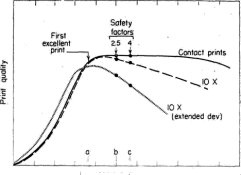
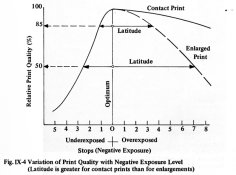
I've attached two Quality/ Exposure Curves. This is the text that relates to Exposure Quality Curve 1:

"The results are summarized in Fig. 1. The solid curve shows that the quality of the contact prints increases rapidly at first as the camera exposure increases and then reaches a plateau, where it remains constant over a long range of camera exposures. Eventually, the quality decreases. The range of camera exposures over which the print quality remains nearly equal to the maximum quality is defined as the camera-exposure latitude. Each of the intervals marked along the camera-exposure axis is one camera stop. In the case of the solid curve, where the contact prints were made from 4- X 5-in. negatives of a studio portrait scene, using the optimum grade of paper for printing each negative, the camera-exposure latitude was 32 times, or five camera stops. The camera exposure marked a corresponds to a safety factor of 1. The camera exposures marked b and c correspond to safety factors of 2.5 and 4, respectively. There was, obviously, no loss in print quality at either of these two levels of exposure when the prints were made by contact.

In the next part of the test, represented by the dashed line in Fig. 1, the same film, subject, and lens were used as before but the size of the negatives was much smaller as a result of increasing the camera-to-subject distance until the size was typical of the negatives obtained in a 35mm camera. These negatives were enlarged 10 diameters, using the optimum grades of paper, and the enlargements were judged for quality. As shown by the dashed curve, the heavily exposed negatives gave enlargements of lower quality. This loss in quality was due to a very noticeable increase in graininess with increase in negative exposure. At the exposure corresponding to a safety factor of 2.5, the quality was slightly below the maximum quality. The camera-exposure latitude was about 3 times, or approximately one and two-thirds camera stops."
 

Attachments

  • Exposure Quality Curve 1.jpg
    Exposure Quality Curve 1.jpg
    79.7 KB · Views: 194
  • Exposure Quality Curve 2.jpg
    Exposure Quality Curve 2.jpg
    161.9 KB · Views: 182

DarkMagic

Member
Allowing Ads
Joined
Feb 20, 2011
Messages
86
Location
Norway
Format
Multi Format
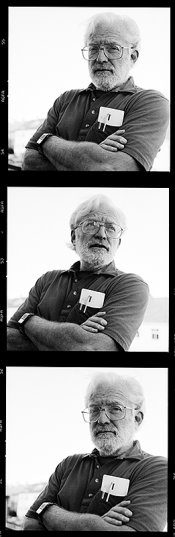
When i last met B B he told me that he theese days was using: Kodak Tech Pan, Fujii Acros, Ilford Delta and FP4. He admitted using Tri-X but addet:

- It isnt the same film as it used to be.
 

Attachments

  • Bruce-Barnbaum_kontactsheet.jpg
    Bruce-Barnbaum_kontactsheet.jpg
    107.3 KB · Views: 271

Harrison Braughman

Member
Allowing Ads
Joined
Nov 18, 2011
Messages
6
Location
Ipswich UK
Format
8x10 Format
"...I know Barnbaum advocates placing shadows on Zone IV, and also cutting the ASA in half for standard developers. So, he is essentially saying, "for an ASA 400 film, set your meter on ASA 100, and place the shadows on Zone III...." by ParkerSmith

Bruce, a B&W master printer and expert, is saying to cut your film by 50% (ISO 400 to ISO 200) and place important shadow detail on Zone IV. (If you have seen the luminous quality of Bruce's prints, you would understand why he advocates placing important shadow detail on ZIV.)

Ansel stated "... placing shadow detail on Zone IV or higher. (See page 61, paragraph 3, line 6 of the Negative.), will yield a fuller and more luminous detail...." Once you have placed the shadow detail on your desired Zone, you use developing to control your highlights.

You have to do development testing (your film, camera and chemistry) to determine where full detail will be present in the highlights (Zone VII,VIII, or IX) and are printable on your paper of choice.
 

jscott

Member
Allowing Ads
Joined
Aug 19, 2010
Messages
113
Location
PNW
Format
Multi Format
After saying "put shadow detail on Zone IV", in the next breath he says "and then adjust for it in the darkroom".
He also speaks out against testing your materials.

It works for Bruce, but I would never try it because I lack his knowledge and experience.

It's all a very individual, idiosyncratic, and somewhat iconoclastic masterly approach.

In the week I spent with him, he proudly changed just about every rule that I had ever heard regarding photography. Masters can do that. But if you are less than a master, don't try it.
 

Shawn Dougherty

Member
Allowing Ads
Joined
Jul 22, 2004
Messages
4,129
Location
Pittsburgh
Format
Multi Format
I have only been going this in earnest since 2004. That said I have learned that rating at half box speed and placing 'important' shadow detail on zone IV gives me the look I am after. As stated, this method requires film development testing and subsequent printing to determine where your highlights need to be.

In short - fully exposed and gently developed negatives make lovely prints and offer lots of choices in the darkroom when printing with multigrade papers.
 
Joined
Jan 7, 2005
Messages
2,743
Location
Los Angeles
Format
4x5 Format
After saying "put shadow detail on Zone IV", in the next breath he says "and then adjust for it in the darkroom".
He also speaks out against testing your materials.

If you break it down, Barnbaum isn't doing anything at all out of the ordinary. According to jscott, he's not testing, so he has to be using the film's ISO as a starting point and then setting the EI at 1/2 the ISO speed. How many people already do this whether automatically or through Zone System testing? I've frequently make the point that ZS testing has different testing parameters than the ISO speed testing which will result in EIs that are consistently 1/2 to 1 stop lower than the ISO speed (without taking equipment into account).

Next he opens up an extra stop when shooting which is no different than rating the film a stop lower. So, compared to ZS testers, he's only over-exposing one stop. Even considering he's over-exposing the film two stops from the ISO speed, it's no big deal with 4x5 film.

My problem is how he explains it can potentially confuse people. While not a stickler for ZS etiquette, if the intention is to print a tone on Zone III, then you really aren't exposing it on Zone IV, you're exposing it on Zone III on a film that has its EI set differently. Another point I keep trying to make is there isn't a fixed correlation between Zones and negative densities. Over-exposing the film simply moves everything toward the right on the film curve.

Barnbaum's approach is not as radical as it might at first appear.
 
Last edited by a moderator:

Chuck_P

Member
Allowing Ads
Joined
Feb 2, 2004
Messages
2,369
Location
Kentucky
Format
4x5 Format
Another point I keep trying to make is there isn't a fixed correlation between Zones and negative densities.

If we are to establish a negative density range by which to develop the negative to, there must be. And so, in the ZS "proper", there is. The usage of the term "proper" is in reference to ZS thinking as it is taught in The Negative, for what that may be worth to anyone. I understand that you may not believe it to be so proper, but I am not one who will generally argue any minor points of theory with what I consider to be obvious success. :smile:

We can only specifically control two points on the curve with each development of the negative. Those two points on the curve require a fixed relationship between a zone and its negative density------the speed point, Zone I, with the ISO rating that yields a density of between .09 and .11 and the Zone VIII negative density calibration point for the "normal" development time. Back in the early 80's when The Negative was written and given the materials at the time, AA decided, quote: "I have found that 1.3 above fb+f is a useful standard for Value VIII, for diffusion type enlargers." He then adds a clarification later by saying, "I have used Value VIII as a standard for high-value density specifically because of its importance as the lightest area in a full-scale image that retains some texture." Now, I don't presume to think that any quotes provided will pursuade anyone, I just add them for clarity of my point.

Those two points on the curve establish the negative density range, as described in the ZS, between Zone I (0.1) and Zone VIII (1.3) (range = 1.2) for any given negative that is to be developed under one of the various development times, generally from N+2 down to N-2 or -3, that has been established through "proper" testing.

The range should not be considered as etched in stone, and in ZS testing the the main questionable variable is the upper density limit. Adams recognized then that, depending on the trend of the exposure scale for the "so called normal papers", with normal implying grade 2, "this optimum range must be subject to continual review and revision as required." The most notable example that I have come across is with Alan Ross, he's supposed to be toying with the idea of calibrating his "normal" development time off a Zone IX negative density of 1.45, extending the density range to 1.35. His reasoning being that with Zone VIII calibration, a -2 development time may not produce densities that will print as paper base white, presumably with today's papers.

 
Last edited by a moderator:

Chuck_P

Member
Allowing Ads
Joined
Feb 2, 2004
Messages
2,369
Location
Kentucky
Format
4x5 Format
Barnbaum's ability as a photographer and printer can't be denied.

However to try and re-define the ZS based off his own methodology, I think, is wrong. No wander the ZS over the years has been thought to be a madening thing to learn. After setting in that class and having never gone to the original source to learn the ZS, then, to subsequently go to that source, a person would be pulling their hair out.

I agree, what a good way to confuse someone if they thought they were in that class to learn the ZS. Perhaps BB stated, in the beginning, IDK, that his method departs drastically from how AA taught the ZS. That is perfectly fine.

However, if that is not the case, to tell a class that it is "wrong" to place a shadow on Zone III for textural purposes is a drastic departure, and hugely arrogant---- and to suggest that only if you want to develop a "tone" on Zone III is it ok to then make a Zone III placement, again, a drastic departure, and hugely arrogant, IMO. All of that is absolute nonsense---as ZS teaching points.

When I read my words here, it sounds angry, but it's not meant to sound that way.
 
Last edited by a moderator:

DREW WILEY

Member
Allowing Ads
Joined
Jul 14, 2011
Messages
14,899
Format
8x10 Format
What might have one worked traditonally as a "thick neg" technique for Tri-X, might be horrible advice for films with different curve characteristics. And a lot depends on how you print. Modern
VC papers will soemetimes let you have your cake and eat it too. A few people respond to Barnbaum's doctrine well, but I personally find it wacko. The actual shape of the bottom of the
curve is way more important than the alleged Zone per se. With straight-line films I sometimes base
the shadow reading way down on "Zone I" or even "0", but with something like HP5 it would be more
like Zone III. Just way too many variable to make a religion out of any of this. I'm very comfortable
precisely working with a variety of films, but it all takes testing and actual printing.
 

ic-racer

Member
Joined
Feb 25, 2007
Messages
16,751
Location
USA
Format
Multi Format
I've attached two Quality/ Exposure Curves. This is the text that relates to Exposure Quality Curve 1:

I have not done a formal test but, based on my 25 year experience with the film, I suspect that enlarged T-max 35mm film does NOT behave that way, and has more of a plateau in the exposure vs quality curve. But this could likely be a muti-page discussion in itself.
 

paul ron

Member
Allowing Ads
Joined
Jan 22, 2004
Messages
2,709
Location
NYC
Format
Medium Format
Yes this can all be madening if you don't do the extensive testing required to get your control on that thin line. To be able to move a zone V to a zone VI takes knowing exactly what your materials n techniques are doing. You can't get that control by just reading about it, it's a hands on learn as you go system... and a system is what it is. It comprises everything from analysing the scene, to exposure, to development, expansion n compression compensations for placed high values, n printing technique n materials.

I learned using the little yellow bible, Minor White's Zone system, back in the early 70s adn did strugle to finally understand it.

To this day I am still learning n testing as materials change so rapidly, but I feel more confident in my techniques n pretty happy with my end results. I feel as if I do have control over my shots.

.
 

DREW WILEY

Member
Allowing Ads
Joined
Jul 14, 2011
Messages
14,899
Format
8x10 Format
I'd hardly call Barnbaum a master. Just stubborn. He gets good personal results using methods tailored for himself, but which might otherwise be counterproductive in a wider context. I can think
of a few other photographers who get beautiful final results based upon honing individual techniques,
but who can be fish out of water if one of the key variables happens to change. I have nothing against that approach per se, but like I said, once someone tries to make a religion out of it, well, go figure. I'm all for practical introductory tools, but in the long run there is no silver bullet, Zone
System or otherwise. But guys like Barnbaum who just preempt the importance of understanding sensitometry and tell you to just go do it are actually putting a straightjacket on fine-tuning the
process.
 
Joined
Jan 7, 2005
Messages
2,743
Location
Los Angeles
Format
4x5 Format
Those two points on the curve establish the negative density range, as described in the ZS, between Zone I (0.1) and Zone VIII (1.3) (range = 1.2) for any given negative that is to be developed under one of the various development times, generally from N+2 down to N-2 or -3, that has been established through "proper" testing.

The range should not be considered as etched in stone, and in ZS testing the the main questionable variable is the upper density limit. Adams recognized then that, depending on the trend of the exposure scale for the "so called normal papers", with normal implying grade 2, "this optimum range must be subject to continual review and revision as required." The most notable example that I have come across is with Alan Ross, he's supposed to be toying with the idea of calibrating his "normal" development time off a Zone IX negative density of 1.45, extending the density range to 1.35. His reasoning being that with Zone VIII calibration, a -2 development time may not produce densities that will print as paper base white, presumably with today's papers.

Hey Chuck,

I apologize if my post wasn't clear, but my point had nothing to do with the negative density range. However since you brought it up, and in the meantime while I put together my clarification, not too long ago you were doing some paper testing. I'm curious. Were you ever able to reconcile the difference between ZS negative density range and paper LERs?
 

Bill Burk

Subscriber
Allowing Ads
Joined
Feb 9, 2010
Messages
9,479
Format
4x5 Format
One point Bruce Barnbaum makes perfectly clear
Luminous, detailed, clean shadows are dear

So he picks something different from which to judge quality
And so doing trades-off sharpness, resolution and granularity

He shows you with drawings - Huh, speed point's Zone III?
Oh you know what he means - Move it on up to IV

If you weren't before, you're on straight line now
And effectively cut your box speed by four

Are you kidding me? joking? hilarity? jollity?
Nope it is perfectly sound sensitometry

Todd-Zakia Photographic Sensitometry chapter IV
Analysis of Sensitometric Data, Film Speed

1. Specify the quality of the image that is required
Bruce Barnbaum says shadows are just what you need
 
Photrio.com contains affiliate links to products. We may receive a commission for purchases made through these links.
To read our full affiliate disclosure statement please click Here.

PHOTRIO PARTNERS EQUALLY FUNDING OUR COMMUNITY:


Ilford ADOX Freestyle Photographic Stearman Press Weldon Color Lab Blue Moon Camera & Machine
Top Bottom