• Welcome to Photrio!
    Registration is fast and free. Join today to unlock search, see fewer ads, and access all forum features.
    Click here to sign up

Astrum IR B+W Negative, or IR-200

Forum statistics

Threads
202,511
Messages
2,841,706
Members
101,356
Latest member
Memo chris
Recent bookmarks
0
Dragonfilm is 25L. They are mislabeling it. helped a reddit guy out with that ID earlier this year, as if it was Type 42L, it would be the same film as Santa Rae 1000.

I shoot quite a bit of Astrum A-2Sh right now, have it in 35mm, 61mm, and 70mm sizes, and once I get it dialed in for the contrast and development that I want, I'll be ordering some in 5" wide.
 
Any clue what Foto-100 is then? My assumption was that it was 25L. Foto-200 is Aviphot 200 IIRC.
 
Some thoughts after thinking it over:

We know for sure Foto-200 is Aviphot 200, and FN64 is Aviphot 80. Aviphot 200 tops off at 750 nm, Aviphot 80 tops off at ~775 nm. Thus it is definitely not Aviphot-200, and Aviphot 80 may be too slow - from what I've read Adox HR-50 goes down in EI by a few stops with an R72 filter.

There are only, to my knowledge, 3 film stocks still in production that are intended to have IR sensitivity - Aviphot 200, Aviphot 80, and Ilford SFX 200. Only Aviphot 80 reaches to 775 nm.

Tasma films have little to no IR sensitivity, their upper limit is 730 nm at best. Type-25L is also very contrasty, very noticeably more than Aviphot 200. Type-42L has slightly more contrast than Aviphot 200. Tasma does not manufacture any other 35 mm photographic film.

FPP sells a 200-speed IR film that they claim has sensitivity all the way to 850nm (!). Perhaps this is the same as Astrum's IR-200, even though they don't label it as such? This does not match with any currently produced film, at least not one that can be easily found for respooling. The thin polyester base also suggests an aerial film versus SFX 200's traditional acetate base.

In that case, Aviphot 400 is a possibility. It has enough sensitivity, and the base material and thickness matches. However, it has been out of production for over a decade by now and the remaining stocks are believed to have dried up. That said, 200 ISO is an appropriate compensation factor for ~1 decade-expired film, if it was Aviphot 400.

Maybe FPP and Astrum/Svema are sitting on the last pancakes of Aviphot 400 after all? It's possible FPP is just making stuff up, but if you really are seeing IR response at EI 50 from a supposed 200 speed film - there are very few options for what it could be.
 
Some thoughts after thinking it over:

We know for sure Foto-200 is Aviphot 200, and FN64 is Aviphot 80. Aviphot 200 tops off at 750 nm, Aviphot 80 tops off at ~775 nm. Thus it is definitely not Aviphot-200, and Aviphot 80 may be too slow - from what I've read Adox HR-50 goes down in EI by a few stops with an R72 filter.

There are only, to my knowledge, 3 film stocks still in production that are intended to have IR sensitivity - Aviphot 200, Aviphot 80, and Ilford SFX 200. Only Aviphot 80 reaches to 775 nm.

Tasma films have little to no IR sensitivity, their upper limit is 730 nm at best. Type-25L is also very contrasty, very noticeably more than Aviphot 200. Type-42L has slightly more contrast than Aviphot 200. Tasma does not manufacture any other 35 mm photographic film.

FPP sells a 200-speed IR film that they claim has sensitivity all the way to 850nm (!). Perhaps this is the same as Astrum's IR-200, even though they don't label it as such? This does not match with any currently produced film, at least not one that can be easily found for respooling. The thin polyester base also suggests an aerial film versus SFX 200's traditional acetate base.

In that case, Aviphot 400 is a possibility. It has enough sensitivity, and the base material and thickness matches. However, it has been out of production for over a decade by now and the remaining stocks are believed to have dried up. That said, 200 ISO is an appropriate compensation factor for ~1 decade-expired film, if it was Aviphot 400.

Maybe FPP and Astrum/Svema are sitting on the last pancakes of Aviphot 400 after all? It's possible FPP is just making stuff up, but if you really are seeing IR response at EI 50 from a supposed 200 speed film - there are very few options for what it could be


FPP's IR film is the IR-200 from Astrum. It's not sensitive out to 850nm, only 775.

It's also not any of the Aviphot stocks that are available currently, as according to the last time the person I know with information talked to Astrum it was a master roll they bought that did not meet the original specification, but instead had the extra IR response. A "bastard child", as it were.

When they run out, I doubt they can get more, which is why they don't offer it as a regular product-you have to call and ask for it.

Also I doubt that Foto 100 and Foto 200 are Aviphot, or at least they were not until recently. The films are quite different in contrast.
 
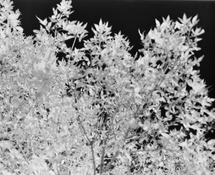
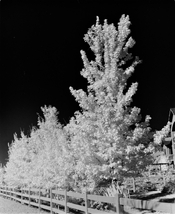
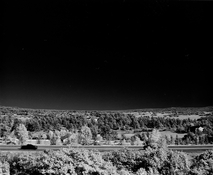
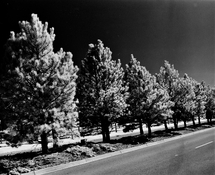
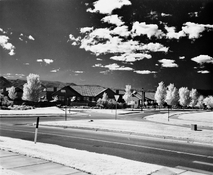
Well, whatever this film is, it is absolutely stunning. Just looking at these negatives, I can already tell you that these are going to be amazing images.
IMG_4008.jpeg

Quick and dirty version of one of my favorite shots:
IMG_4009.jpeg

Wonderful film. I will absolutely be buying some more of it for myself!
 
Tasty stuff
 
FPP's IR film is the IR-200 from Astrum. It's not sensitive out to 850nm, only 775.

It's also not any of the Aviphot stocks that are available currently, as according to the last time the person I know with information talked to Astrum it was a master roll they bought that did not meet the original specification, but instead had the extra IR response. A "bastard child", as it were.

When they run out, I doubt they can get more, which is why they don't offer it as a regular product-you have to call and ask for it.

Also I doubt that Foto 100 and Foto 200 are Aviphot, or at least they were not until recently. The films are quite different in contrast.

Not surprised FPP is being optimistic. Thanks for the insight into the stock! That's fascinating. I wonder what the base stock was? Also interested that there was no governmental interest in a more IR sensitive photo stock, U-2 and RQ-4 techs are still training on loading and using the Optical Bar Camera, and most other countries are still using film reconnaissance tools. Sounds like I need a few rolls for future use.

Foto-100 is definitely Tasma. I've shot it and compared it to the Aviphot I've shot, and the difference is pretty visible. It's very high contrast and has a bit of a different look. In Eastern Europe, Tasma stocks are/were commonly respooled as cheap panchromatic stocks, and over in Russia, respoolers give Type 25L a box speed of 100 or 125 ISO, and for Type 42L, 400 ISO. So I'm pretty confident that Foto-100/NK-2Sh is Tasma's Type 25L film.

I believe Foto-200 is Aviphot 200, especially since it is advertised as having IR sensitivity, but I haven't shot it yet, so I can't confirm. I've heard from others that it is though.


Well, whatever this film is, it is absolutely stunning. Just looking at these negatives, I can already tell you that these are going to be amazing images.
View attachment 408780

Quick and dirty version of one of my favorite shots:
View attachment 408779

Wonderful film. I will absolutely be buying some more of it for myself!

These look really spectacular! You shoot at ISO50 with these along with an R72?
 
Not surprised FPP is being optimistic. Thanks for the insight into the stock! That's fascinating. I wonder what the base stock was? Also interested that there was no governmental interest in a more IR sensitive photo stock, U-2 and RQ-4 techs are still training on loading and using the Optical Bar Camera, and most other countries are still using film reconnaissance tools. Sounds like I need a few rolls for future use.

Foto-100 is definitely Tasma. I've shot it and compared it to the Aviphot I've shot, and the difference is pretty visible. It's very high contrast and has a bit of a different look. In Eastern Europe, Tasma stocks are/were commonly respooled as cheap panchromatic stocks, and over in Russia, respoolers give Type 25L a box speed of 100 or 125 ISO, and for Type 42L, 400 ISO. So I'm pretty confident that Foto-100/NK-2Sh is Tasma's Type 25L film.

I believe Foto-200 is Aviphot 200, especially since it is advertised as having IR sensitivity, but I haven't shot it yet, so I can't confirm. I've heard from others that it is though.


These look really spectacular! You shoot at ISO50 with these along with an R72?

Yeah it's not 25L...they sell 25L as A-2SH.
 
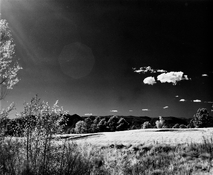
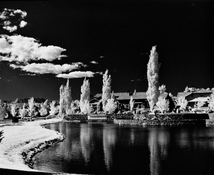
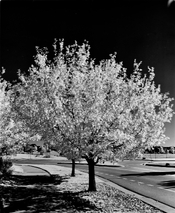
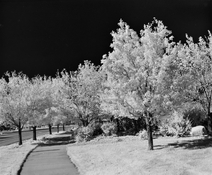
Shot in the RB67 with a 90mm f/3.8. Exposed at EI 50 w/ 720nm filter. Scanned with D5300 / Nikkor 55mm f/3.5. Some super nice results.
 

Attachments

  • IMG_4227.jpeg
    IMG_4227.jpeg
    352.6 KB · Views: 59
  • IMG_4235.jpeg
    IMG_4235.jpeg
    360 KB · Views: 57
  • IMG_4234.jpeg
    IMG_4234.jpeg
    317.7 KB · Views: 56
  • IMG_4233.jpeg
    IMG_4233.jpeg
    482 KB · Views: 57
  • IMG_4232.jpeg
    IMG_4232.jpeg
    466.3 KB · Views: 55
  • IMG_4231.jpeg
    IMG_4231.jpeg
    372.5 KB · Views: 56
  • IMG_4230.jpeg
    IMG_4230.jpeg
    387 KB · Views: 54
  • IMG_4229.jpeg
    IMG_4229.jpeg
    395.3 KB · Views: 57
  • IMG_4228.jpeg
    IMG_4228.jpeg
    365.5 KB · Views: 59
Last edited:
I'm looking forward to trying it out.
Do you need to adjust focus using the IR focus mark, or do you just use the normal focus mark?
 
I think technically you’re supposed to, although the RB67 doesn’t have an IR focusing mark, so I just kinda didn’t. I don’t remember what a lot of these were shot at, but I think I tried to stick around F8 to account for this.
 
They're gorgeous! When you shoot at EI 50, how are you picking aperture and shutter? Are you just metering the scene as if it you were shooting a normal ISO 50 film, or is there some extra peculiarity to shooting IR that I am missing?
 
They're gorgeous! When you shoot at EI 50, how are you picking aperture and shutter? Are you just metering the scene as if it you were shooting a normal ISO 50 film, or is there some extra peculiarity to shooting IR that I am missing?

You got it right! I metered without the filter on for 50 ISO, then put the filter on and took the photo!
 
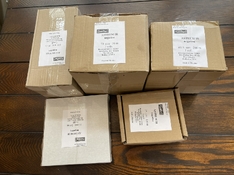
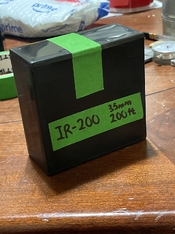
The IR-200 came in last week, I got all the bulk rolls and 35mm cassettes finished, will be working on 120 for weeks though.

I actually bought 200 ft for myself for making an Eyemo load, can’t wait to shoot it later this summer!
 

Attachments

  • IMG_4951.jpeg
    IMG_4951.jpeg
    356.4 KB · Views: 32
  • IMG_4989.jpeg
    IMG_4989.jpeg
    327 KB · Views: 36
I'm looking forward to trying it out.
Do you need to adjust focus using the IR focus mark, or do you just use the normal focus mark?

It's only sensitive up to about 775nm, so focus compensation is not necessary.
 
It's only sensitive up to about 775nm, so focus compensation is not necessary.
Interesting, I had assumed that there would be some focus correction required. Maybe not as much as with HIE, but still a little bit?

I still try and make the depth of field relatively large, just in case.
 
I've never applied any focus compensation for Aviphot, Rollei IR (which is Aviphot), and Ilford's SFX. In fact, with HIE, I only applied focus comp when using the opaque 87C. I always shot it at f/16-22, including the three other films mentioned.
 
Most IR and near IR photography includes some non-IR light.
And of course, the accuracy of the focus scale on your camera and/or lens isn't perfect.
 
Thank you @MCB18 - do you have development recommendations?
 
I see from the dev chart reference that your 8.5 minute time was for D-76 stock solution. I'm going to try 510-pyro 1+100 for 10 minutes.
 
The IR-200 came in last week, I got all the bulk rolls and 35mm cassettes finished, will be working on 120 for weeks though.

I actually bought 200 ft for myself for making an Eyemo load, can’t wait to shoot it later this summer!

Hey, can you tell me where exactly these orders are made and if there's a price list? I remember it was in some chat, and the price list was a PDF…
 
Sorry for the late responses, been very busy with school and stuff.

Thank you @MCB18 - do you have development recommendations?
I just tried Foto-200 times and it seems to work well.

I see from the dev chart reference that your 8.5 minute time was for D-76 stock solution. I'm going to try 510-pyro 1+100 for 10 minutes.
Hope that works out for you!

Hey, can you tell me where exactly these orders are made and if there's a price list? I remember it was in some chat, and the price list was a PDF…
I order via email, but you can also order on Instagram. I think the instagram person just emails the order to the same person I do, idk.

And yeah there’s a PDF that has the prices, I’m not at my computer now but I have an older one i can attach. The prices are a bit higher now. You should be able to ask for the new one.
 

Attachments

  • Price_List_01.02.2023_1.doc
    54.5 KB · Views: 11
Last edited:
Scans are back, and holy crap this film is super awesome.

All taken on an RB67 with a 90mm lens and Zomei filter. Unless otherwise noted, all images are IR.

Visible light, EI 200 (control, to ensure development was correct)
View attachment 407066

EI 50
View attachment 407067

EI 25
View attachment 407068

EI 12
View attachment 407069


EI 50
View attachment 407070

EI 25:
View attachment 407071

EI 12
View attachment 407072


EI 50
View attachment 407073

EI 25
View attachment 407074

EI 12
View attachment 407075

  • 12 to me looks almost overexposed. But maybe that’s just me. You can see some of the shadows get crushed. There’s a bit of that with 25 as well, but to a lesser extent.
  • 50 looks absolutely stunning, and I would have zero issues using this as a 50 speed IR film, but the sky isn’t quite as dark as I’d like.
  • 25 seems like a nice sweet spot in my opinion.
What thoughts do you guys have?
This thread has reminded me that I have some 35mm IR film in my fridge salad draw. I'm waiting for some constant sunshine here in the UK before using it... It might be a while... :smile:

I love the tones in your images, but I actually prefer the ISO 12 images, but then I do prefer darker prints and the others could be printed that way.

As for exposure, when I've used it in the past with my Pentax MZ5N 35mm camera, I exposed with the IR filter on the lens used and bracketed the exposures over 2f's in 1/2f stop increments. Surprisingly the cameras meter did really well and I got a good set of negatives.

But on both film and digital exposures, I never used the IR red line on the lens, but used a middle f-stop of about f8 to be on the safe side. The red line was only slightly different than the 'normal' focus mark on the lenses anyway.

Terry S
UK
 
Photrio.com contains affiliate links to products. We may receive a commission for purchases made through these links.
To read our full affiliate disclosure statement please click Here.

PHOTRIO PARTNERS EQUALLY FUNDING OUR COMMUNITY:


Ilford ADOX Freestyle Photographic Stearman Press Weldon Color Lab Blue Moon Camera & Machine
Top Bottom